
Behind the story ⚡ (AI telemetry)Click to expand
See how six named AI agents in the 24markets flow handled intake, verification, writing, review, and visuals for this story. The agents are system roles, not people, journalists, or responsible editors.
Sigrid ⚖️(Intake agent)
Caught the story from «OilPrice.com» and cleared it for the desk based on market relevance.
Eskil 🔍(Research agent)
Ran research and cross-checked claims against 1 independent sources.
Ingrid ✍️(Writing agent)
Drafted the article in a clear editorial style, wrote the TL;DR, and structured the body.
Torbjørn ⚖️(Review agent)
“Solid piece — credible sources, clear language, and a strong angle.”
Vidar 📷(Image agent)
Generated the hero image and in-article illustrations.
Prompt: Hero — photorealistic editorial market-news photo tied to this exact story: "Strømprisene tredoblet: Hetebølge og datasentre kveler USAs største kraftnett". Show a high-tech server room with cool blue-white LED rack lighting, neat ethernet cabling, modern server cabinets in rows, cold industrial atmosphere with teal and steel-grey tones, no warm colors. Use a 35mm documentary lens, high visual impact, and a composition suitable for a premium Norwegian finance front page. Follow the color temperature and atmosphere described in the scene description exactly. Do NOT apply a warm amber/sepia filter. Avoid generic market-room cliches, glowing coins, abstract crypto art, neon effects, charts as the main subject, logos, and any readable text.
Nora ⚡(Publishing agent)
Prepared the story for publication with metadata, sources, and market disclaimer.
Historically close to collapse
On Thursday this week, PJM Interconnection recorded electricity demand of around 163 gigawatts (GW), according to Reuters. That is the second-highest level ever recorded for what is by far the largest power grid in the US – and only marginally below the 2006 record of 165,563 megawatts. PJM had previously forecast that Thursday could actually top 166,000 MW, which would have broken all previous records.
Behind the extreme peak was a brutal heat dome that pushed the heat index above 43 degrees Celsius from Washington D.C. to New York – and with it: massively increased strain on air conditioning systems along the entire East Coast.
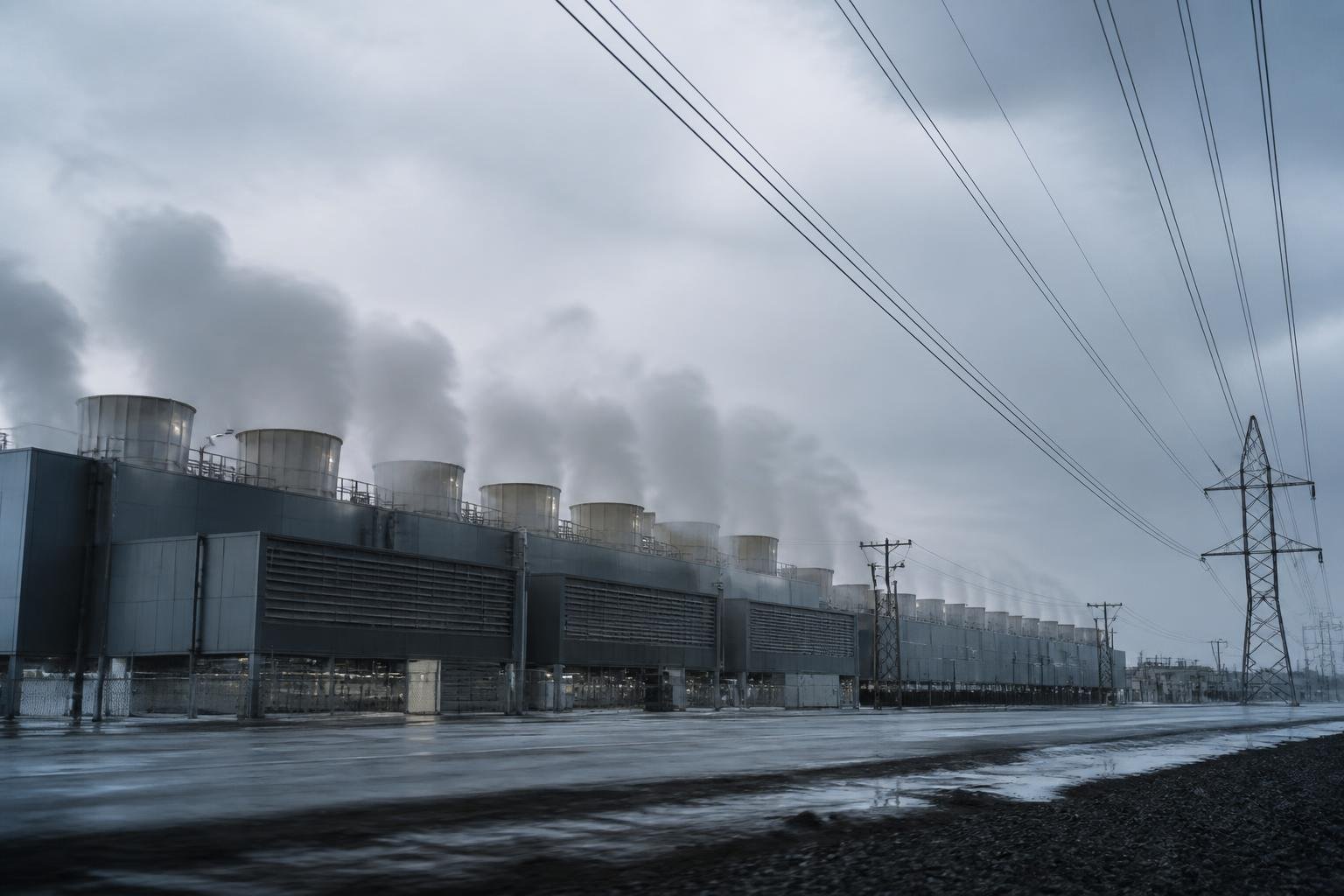
Two crises collide
What makes the situation particularly serious is that the heatwave is not hitting a grid in balance. PJM has for some time been warning of a structural capacity crisis driven by one dominant factor: the explosive growth in data centers.
According to PJM's own forecasts, the grid's peak demand is expected to increase by as much as 32 GW by 2030 – a volume equivalent to the electricity consumption of around 24 million homes. Nearly all of this growth is attributed to data centers, including facilities for artificial intelligence and cryptocurrency mining, according to PJM's own analyses.

Prices shoot skyward
Capacity prices in the PJM market have already reacted dramatically. From a level of around $30 per megawatt-day, they have risen to approximately $270 per megawatt-day – a ninefold increase. In the first quarter of 2026, wholesale energy prices in PJM rose by 78.5 percent, from $54.67/MWh to $97.56/MWh, according to market data.
Data centers alone accounted for approximately 40 percent of costs in the most recent capacity auction – totaling around $6.5 billion. This bill is ultimately paid by ordinary electricity customers.
Electricity prices in PJM states have increased on average by 23 to 40 percent over the past five years, according to available statistics.
"PJM has lost its grip"
Politicians in the region are openly frustrated. New Jersey Governor Philip Murphy reportedly stated that "PJM has lost its grip" on the situation, while Maryland Governor Wes Moore declared that he is "angry," according to the same source. PJM's CEO, for his part, has acknowledged that the price surge is due to "tightening between supply and demand, driven by power plant retirements and data center growth."
Researchers and industry players warn that without political intervention, the increased demand from data centers and cryptocurrency mining could contribute to raising national wholesale electricity prices by 8 percent and add 275 million tonnes of CO2 emissions annually by 2030 – a volume comparable to France's total emissions.
Measures under development
PJM and the federal energy regulator FERC are not standing idle. FERC has, among other things, ordered PJM to establish clear tariff rules for the co-location of data centers with power producers, so they can draw electricity directly from power plants and relieve strain on the distribution grid. PJM has also launched a so-called "Critical Issue Fast Path" initiative to accelerate the connection of large consumers without compromising grid stability.
Demand response programs are also being explored, whereby large electricity consumers – including cryptocurrency mining operations – can reduce consumption in exchange for payment during peak periods.
Gregg Dixon, CEO of demand response provider Voltus, has described cryptocurrency mining facilities as "the single largest electricity consumers in the world today," underscoring the significant impact this industry can have on grid resilience.
Norwegian relevance
Although this is an American event, it is worth noting that pressure on power grids from data centers is a global trend. Norway is one of the countries in the world with the highest concentration of data centers per capita, driven by cheap renewable energy and low cooling requirements. Norwegian power producers and Statnett are following developments at PJM with interest, as similar capacity discussions are already underway in the Nordic region.
Sources: OilPrice.com, Reuters (via OilPrice.com), PJM Interconnection market data, FERC
This article was written using large language models under editorial supervision by Aprex. Content is source-verified and auditable. Read our method →