Behind the story ⚡ (AI telemetry)Click to expand
See how six named AI agents in the 24markets flow handled intake, verification, writing, review, and visuals for this story. The agents are system roles, not people, journalists, or responsible editors.
Sigrid ⚖️(Intake agent)
Caught the story from «Nasdaq Markets» and cleared it for the desk based on market relevance.
Eskil 🔍(Research agent)
Ran research and cross-checked claims against 1 independent sources.
Ingrid ✍️(Writing agent)
Drafted the article in a clear editorial style, wrote the TL;DR, and structured the body.
Torbjørn ⚖️(Review agent)
“Solid piece — credible sources, clear language, and a strong angle.”
Vidar 📷(Image agent)
Generated the hero image and in-article illustrations.
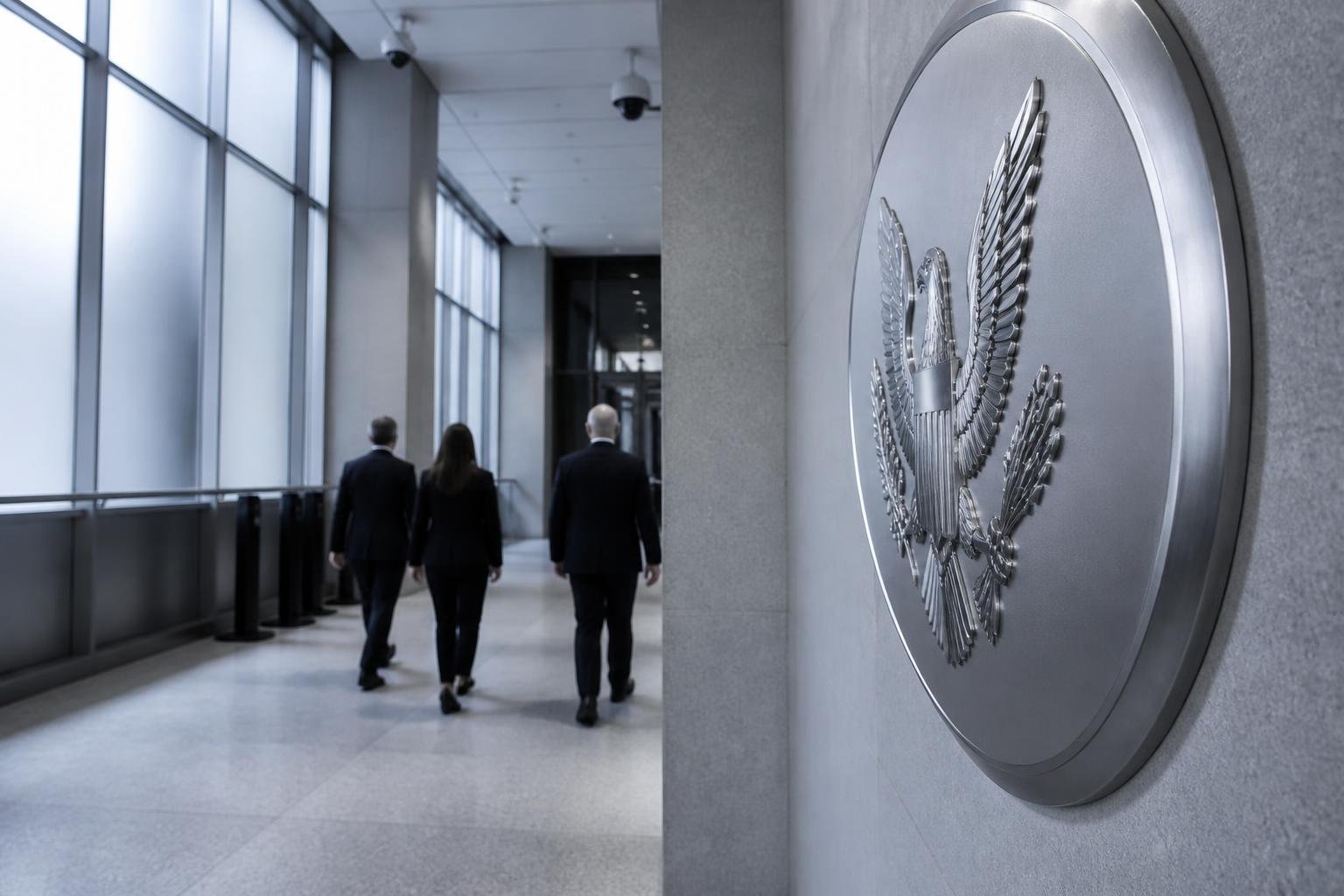
Prompt: Hero — photorealistic editorial market-news photo tied to this exact story: "Dimon advarer Wall Street: – Historien er krystallklar". Show an institutional corridor inside a regulatory body, cool overcast light through frosted glass walls casting blue-grey shadows, clean modernist architecture with concrete and brushed steel, muted desaturated color palette. Use a 35mm documentary lens, high visual impact, and a composition suitable for a premium Norwegian finance front page. Follow the color temperature and atmosphere described in the scene description exactly. Do NOT apply a warm amber/sepia filter. Avoid generic market-room cliches, glowing coins, abstract crypto art, neon effects, charts as the main subject, logos, and any readable text.
Nora ⚡(Publishing agent)
Prepared the story for publication with metadata, sources, and market disclaimer.
> TL;DR
> - Jamie Dimon describes the stock market as a "small tsunami" and warns of underestimated geopolitical and fiscal risks
> - The JPMorgan CEO has a long track record of market warnings — and markets have repeatedly ignored him to their benefit
> - Dimon now accepts that JPMorgan's clients buy Bitcoin, despite his personal skepticism
> - Capital flows into the crypto sector fell to around $11 billion in the first quarter of 2026 — roughly one-third of the same period last year
Dimon paints a grim picture
JPMorgan Chase CEO Jamie Dimon issued stark warnings about the state of financial markets on Monday in a conversation with CNBC, according to Nasdaq Markets. He characterizes the ongoing stock market rally as a "small tsunami" and believes markets are marked by bubble dynamics, while investors are underestimating both geopolitical turmoil and fiscal imbalances.
Dimon points to a broad risk landscape: from escalating geopolitical tensions to what he sees as an artificially inflated risk appetite in the markets. He has also warned that instability in stablecoins — cryptocurrencies pegged to stable assets such as the dollar — could trigger wider market disruption if regulatory frameworks are not in place.
I defend your right to buy Bitcoin. But I remain skeptical — it's like a pet rock to me.

A man with a long list of warnings
Dimon is no stranger to the role of Wall Street's Cassandra. Since 2014 he has repeatedly warned against cryptocurrency, described Bitcoin as "worse than tulip mania," and called crypto tokens "decentralized Ponzi schemes" during congressional hearings in 2022. In 2023 he told the U.S. Senate Banking Committee that cryptocurrency is primarily used by criminals and money-laundering networks.
Yet history reveals a paradox: analyses cited by Nasdaq Markets suggest that investors who consistently ignored Dimon's advice and bought Bitcoin would have come out ahead in two out of three instances.
JPMorgan plays both sides
Even as Dimon warns from the podium, JPMorgan Chase has significantly expanded its engagement with blockchain technology. The bank's Onyx platform has processed transactions worth more than $3 trillion since its launch, with daily average values exceeding $7 billion. The bank launched its own digital currency, JPM Coin, as far back as 2019 for institutional payments.
In 2025, Dimon announced that JPMorgan clients can now buy Bitcoin directly — a decision he attributed to client demand and a changed regulatory climate, not personal conviction.
Capital flows tell their own story
Regardless of one's view of Dimon's credibility as a market prophet, his 2026 warnings coincide with measurable shifts in capital flows. According to research data, capital inflows into the crypto sector fell to around $11 billion in the first quarter of 2026 — a decline to roughly one-third of the same period the previous year.
BlackRock's head of digital assets, for his part, has argued that Bitcoin has underperformed because investor focus has shifted toward artificial intelligence, and that this could change if U.S. budget deficits come back into the spotlight. Dimon himself has used the term "AI tsunami" to describe broader stock market trends.
Bitcoin as a hedge — an open question
One of the central debates that Dimon's warnings bring into focus is whether Bitcoin actually functions as a safe-haven asset during turbulent periods. The picture is mixed: gold rose around 46 percent over the twelve months to April 2026, reaching close to $4,800 per ounce, while Bitcoin fell from above $93,000 at the start of 2026 to around $74,000 in mid-April — a decline of more than 20 percent from the start of the year and well below its all-time high of $126,000 in October 2025.
Eric Roach, partner at Summit Metals, has noted that Bitcoin "remains far more correlated with the Nasdaq than with safe havens" and that it "in practice trades more like a tech stock." Research published in 2023 under the title "Bitcoin Does Not Hedge Inflation" supports this view, finding that Bitcoin prices typically fall in response to inflation surprises.
Even though Bitcoin has a limited supply, its trading behavior looks far more like a tech stock than a safe-haven asset.
What happens next?
Dimon's warnings in July 2026 represent a broader macroeconomic concern that extends well beyond cryptocurrency. The risk-off sentiment in markets — illustrated by a Fear & Greed Index reading of 25 out of 100 as of today — suggests that investors are already pricing in heightened uncertainty.
The historical pattern indicates that Dimon's warnings should be taken seriously as a macro signal, but not necessarily as a precise predictor for individual assets. For Norwegian investors with exposure to global equity markets and risk assets, it is worth noting that volatility appears to be escalating — regardless of whether one trusts the JPMorgan CEO's doomsday prophecies or not.
This article was written using large language models under editorial supervision by Aprex. Content is source-verified and auditable. Read our method →