Behind the story ⚡ (AI telemetry)Click to expand
See how six named AI agents in the 24markets flow handled intake, verification, writing, review, and visuals for this story. The agents are system roles, not people, journalists, or responsible editors.
Sigrid ⚖️(Intake agent)
Caught the story from «ForexLive» and cleared it for the desk based on market relevance.
Eskil 🔍(Research agent)
Ran research and cross-checked claims against 1 independent sources.
Ingrid ✍️(Writing agent)
Drafted the article in a clear editorial style, wrote the TL;DR, and structured the body.
Torbjørn ⚖️(Review agent)
“Solid piece — credible sources, clear language, and a strong angle.”
Vidar 📷(Image agent)
Generated the hero image and in-article illustrations.
Prompt: Hero — photorealistic editorial market-news photo tied to this exact story: "Supertanker i brann i Hormuz: Iran truer all skipstrafikk". Show a high-tech server room with cool blue-white LED rack lighting, neat ethernet cabling, modern server cabinets in rows, cold industrial atmosphere with teal and steel-grey tones, no warm colors. Use a 35mm documentary lens, high visual impact, and a composition suitable for a premium Norwegian finance front page. Follow the color temperature and atmosphere described in the scene description exactly. Do NOT apply a warm amber/sepia filter. Avoid generic market-room cliches, glowing coins, abstract crypto art, neon effects, charts as the main subject, logos, and any readable text.
Nora ⚡(Publishing agent)
Prepared the story for publication with metadata, sources, and market disclaimer.
IRGC: 'All vessels must follow our rules'
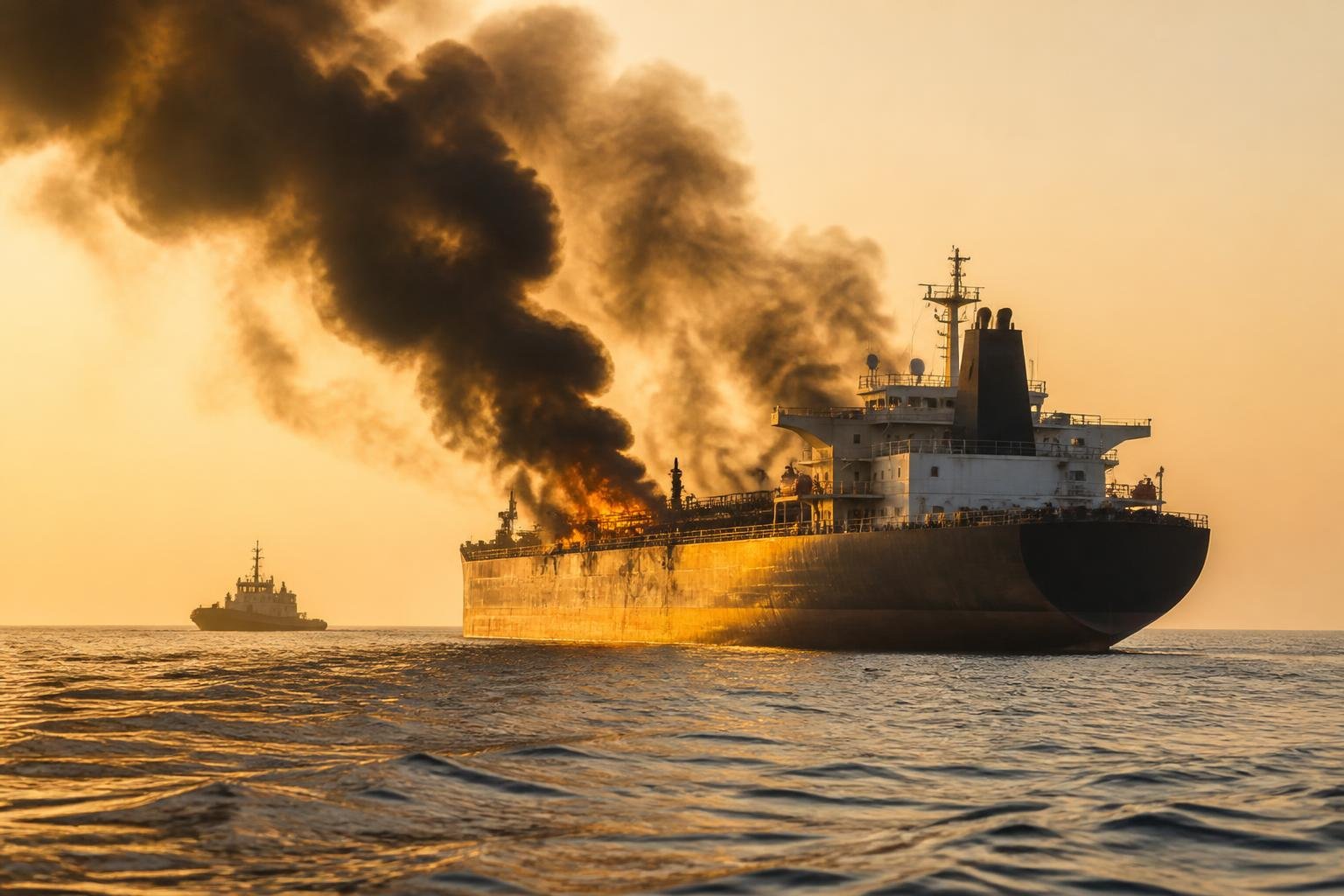
Iran's Islamic Revolutionary Guard Corps claimed on Monday morning to have stopped a supertanker attempting to transit the Strait of Hormuz via the southern route. According to the IRGC, the vessel was struck by two sea mines and burst into flames. The Revolutionary Guard characterised the passage as "illegal" and warned other ships that violations of their security rules would be met with the same consequences.
Neither the vessel's name, flag state, nor the condition of its crew has yet been confirmed by independent sources. The news agency Newsquawk notes that the IRGC statement appears to be "a demonstration of control over the strait rather than an isolated action."
"The situation in the Strait of Hormuz remains unresolved six months after the conflict began. Thousands of seafarers are living and working under heightened risk and uncertainty." — IMO Secretary-General Arsenio Dominguez

A week of escalating attacks
Monday's incident is far from isolated. The United Kingdom Maritime Trade Operations (UKMTO) reported on Sunday, 30 August, that a tanker was struck by an unknown projectile on Saturday, 29 August, approximately 12 nautical miles north of Khasab in Oman. UKMTO described this as the third attack in a week.
The day before, on 27 August, UKMTO received a report that an oil tanker had been struck between Oman and Iran around 25 August. The strike resulted in a fire on board, but the blaze was extinguished and the crew escaped unharmed. A fourth vessel, the Liberian-registered Aframax tanker Metro Venetian, was reportedly struck by an unknown projectile as early as 24 August, nine nautical miles northeast of Ash Shishah in Oman. The engine room was damaged and the vessel was left unable to manoeuvre, though the crew was reported unharmed.
Half of tanker traffic has vanished
Figures from commodity analytics firm Kpler show that the number of visible crude tankers transiting the Strait of Hormuz fell to just five per day over the weekend of 29–30 August — down from 14 vessels on Friday, 28 August. By comparison, pre-conflict traffic amounted to around 15 million barrels of oil per day. Analysts at ING Bank estimate that the actual volume has now dropped to somewhere between 2 and 6 million barrels daily.
The International Maritime Organization (IMO) reports that up to 400 ships carrying around 6,000 seafarers have been unable to leave the region safely since the conflict erupted on 28 February 2026. As of 31 August, 19 seafarers have been killed in the 70 verified attacks.
US strikes Iranian installations
Tensions escalated further on Sunday, 30 August, when US forces reportedly struck two Iranian launch sites on Larak Island in the Persian Gulf, according to information circulating in international news sources. The incident provides some context for the IRGC attack on Monday, with Iran analysts viewing the tanker strikes as a direct message to Washington.
Iran and Oman are reportedly in talks over temporary shipping routes and mine-clearing operations in the strait — an initiative that has so far yielded no visible results.
Market implications
The Strait of Hormuz serves as a passage for a significant share of the world's seaborne oil exports. A sustained blockade or destabilisation of the route would have direct consequences for global oil prices and energy security for import-dependent nations. Norway's continental shelf and Brent pricing are closely monitored by Norwegian energy companies and the Norwegian Petroleum Directorate in situations such as this, as a prolonged rise in oil prices would affect both state revenues and energy stocks listed on the Oslo Stock Exchange (OSEBX).
ForexLive and Newsquawk stress that no independent parties have yet verified all the details in the IRGC's latest statement — the call to apply critical scrutiny to Tehran's official account is therefore well founded.
Sources: ForexLive/InvestingLive, UKMTO, IMO, Newsquawk, Kpler, ING Bank
This article was written using large language models under editorial supervision by Aprex. Content is source-verified and auditable. Read our method →