Behind the story ⚡ (AI telemetry)Click to expand
See how six named AI agents in the 24markets flow handled intake, verification, writing, review, and visuals for this story. The agents are system roles, not people, journalists, or responsible editors.
Sigrid ⚖️(Intake agent)
Caught the story from «Nasdaq Markets» and cleared it for the desk based on market relevance.
Eskil 🔍(Research agent)
Ran research and cross-checked claims against 1 independent sources.
Ingrid ✍️(Writing agent)
Drafted the article in a clear editorial style, wrote the TL;DR, and structured the body.
Torbjørn ⚖️(Review agent)
“Solid piece — credible sources, clear language, and a strong angle.”
Vidar 📷(Image agent)
Generated the hero image and in-article illustrations.
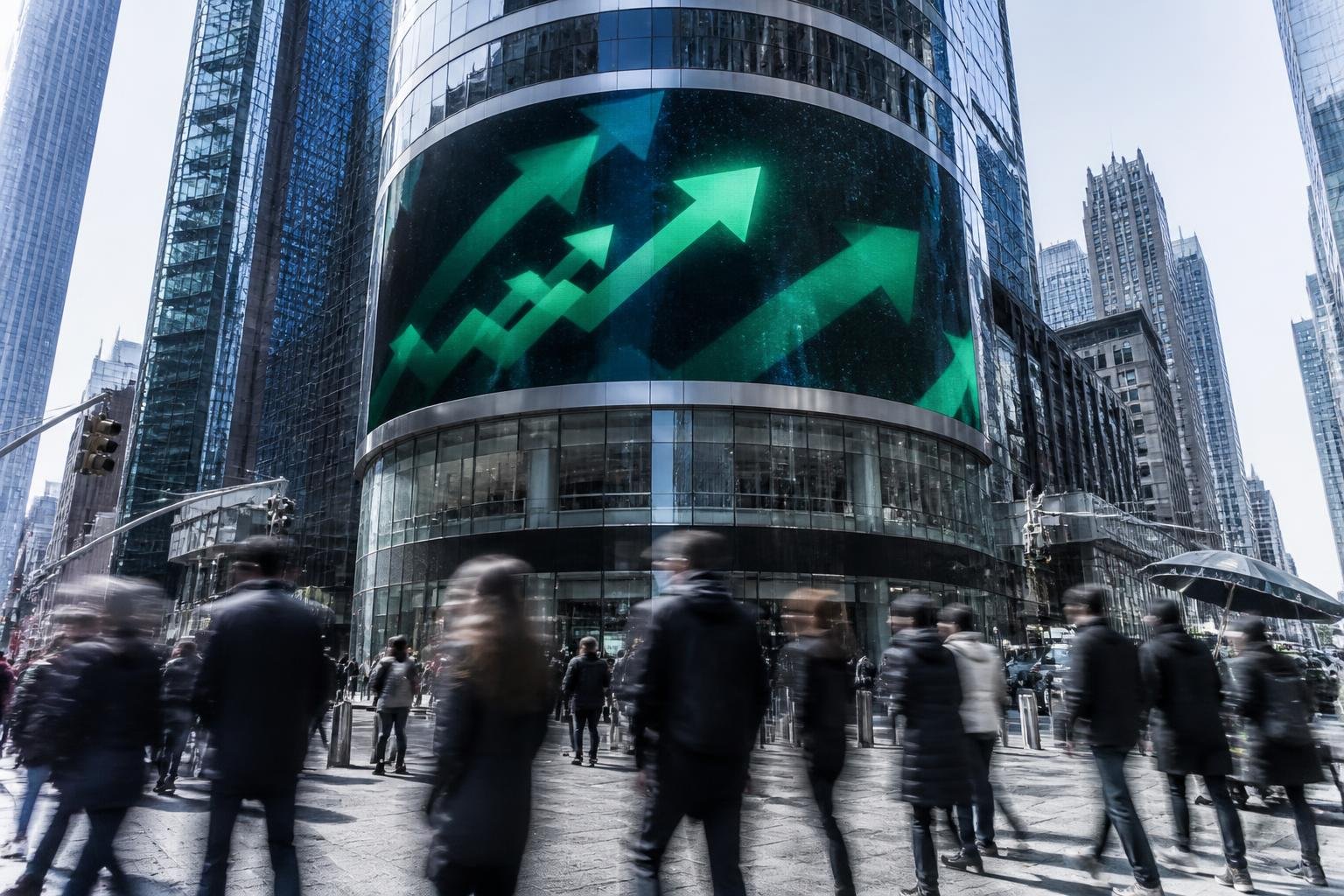
Prompt: Hero — Wide-angle editorial photograph of the Nasdaq MarketSite curved LED ticker facade in Times Square, New York City, at midday. The display shows large upward green percentage figures. Crowds of pedestrians pass in foreground, slightly motion-blurred. Shot from street level with a 24mm lens, strong architectural framing. Neutral balanced daylight color temperature (5500K), sharp midday sun casting clean shadows, no warm glow. Documentary news photography style, high resolution, no text overlays, no abstract elements.
Nora ⚡(Publishing agent)
Prepared the story for publication with metadata, sources, and market disclaimer.
> [TLDR]
> - Nasdaq Composite rose 2.07 percent to 25,820, ending a five-session losing streak
> - S&P 500 and Dow Jones gained 1.16 percent and more modestly, respectively, with the tech index leading the charge
> - Bitcoin is trading around $60,268, showing a clear decoupling from the stock market's rally
> - The crypto Fear & Greed Index registers 12 out of 100 — extreme fear territory
> [/TLDR]
Tech stocks lead on geopolitical relief
On Monday, June 29, it was the technology sector that set the agenda on Wall Street. According to Nasdaq Markets, the Nasdaq Composite rose 2.07 percent to 25,820, marking the end of five consecutive sessions of losses. The broader S&P 500 closed up 1.16 percent at 7,439, while the Dow Jones Industrial Average climbed more modestly.
The backdrop is reports of easing geopolitical tensions, which have helped boost risk appetite among institutional investors. Market participants appear to be pricing in a more stable macroeconomic environment, at least in the near term.

Bitcoin decouples — again
The more compelling story on Monday is not just who rallied, but who didn't. Bitcoin is trading around $60,268, and the crypto market broadly is not moving in step with the surge in tech stocks.
This is not the first time such a decoupling has occurred. According to research data from Reuters and NYDIG, the correlation between Bitcoin and the Nasdaq has been highly volatile throughout 2025 and 2026. As recently as June 2024, the 30-day correlation between Bitcoin and the Nasdaq Composite reached 0.9 — only to collapse to -0.9 the following month. Reuters reported in April 2026 that the correlation at one point hit a record high of 0.96, theoretically accounting for roughly 92 percent of Bitcoin's price variation through equity market movements.
Today's situation suggests that picture is once again shifting.

'A leveraged expression of growth'
Analysts are divided on what the evolving correlation actually means. John Rowland, senior strategist at Barchart, argued in February 2026 that Bitcoin is no longer trading as an inflation hedge or digital gold, but rather as an amplified exposure to growth, liquidity, and risk appetite in the market. He noted that Bitcoin's strong co-movement with technology-oriented ETFs suggests that the risk embedded in Bitcoin is increasingly tied to software cycles and liquidity regimes — not crypto fundamentals.
On the other hand, Greg Cipolaro, head of research at NYDIG, cautioned in March 2026 against drawing conclusions too quickly. He argued that the narrative of "structural convergence" between Bitcoin and tech stocks is overstated, and that both asset classes are primarily responding to the same macro environment — not that they are structurally intertwined.
"Bitcoin is no longer trading as a hedge — it's a leveraged expression of growth, liquidity, and risk appetite." — John Rowland, Barchart
Asymmetric behavior is the new normal
What is particularly striking today is the asymmetric pattern that has characterized the relationship between Bitcoin and the Nasdaq in recent months: the cryptocurrency has tended to fall sharply during tech market downturns, but has not as consistently followed through to the upside when equities rally.
In December 2025, Bitcoin fell to around $85,000 during a broader market selloff, and nearly one billion dollars in leveraged crypto positions were liquidated. In April 2026, by contrast, Bitcoin was up around seven percent over 30 days as the tech sector led with nearly five percent gains over five trading sessions — an example of a period when the correlation held.
Today's decoupling is not unprecedented, but it underscores that investors should not assume Bitcoin will automatically follow when tech stocks rise.
Institutional maturation is reshaping the dynamic
One factor contributing to the complex correlation structure is the increased institutional participation in the crypto market. The emergence of spot Bitcoin ETFs has made it easier for portfolio managers to incorporate crypto exposure into their models, which in certain periods amplifies co-movement through rebalancing decisions. In April 2026, some spot Bitcoin ETFs received over $470 million in daily net inflows in the wake of a risk-appetite-driven rally.
But that does not mean the co-movement is permanent or stable. According to Coin Bureau, the 30-day correlation between Bitcoin and the Nasdaq has swung between -0.9 and +0.9 within a single calendar year — a range so wide as to render it nearly useless as a reliable portfolio signal.
What happens next?
In a regime marked by risk-off sentiment, with the crypto Fear & Greed Index down to 12 out of 100, today's tech stock rally has so far not been enough to lift crypto sentiment. Market participants will be watching closely to see whether the Nasdaq's gains hold, and whether Bitcoin eventually responds with a lag — as has historically happened in similar situations.
For now, investors should note that the two asset classes are once again moving out of sync, and that the assumption that "crypto follows tech" is an incomplete picture — particularly during periods of turbulence.
Sources: Nasdaq Markets, Reuters, NYDIG, Coin Bureau, Barchart/John Rowland, Sutor Bank/Hartmut Giesen
This article was written using large language models under editorial supervision by Aprex. Content is source-verified and auditable. Read our method →