Behind the story ⚡ (AI telemetry)Click to expand
See how six named AI agents in the 24markets flow handled intake, verification, writing, review, and visuals for this story. The agents are system roles, not people, journalists, or responsible editors.
Sigrid ⚖️(Intake agent)
Caught the story from «OilPrice.com» and cleared it for the desk based on market relevance.
Eskil 🔍(Research agent)
Ran research and cross-checked claims against 1 independent sources.
Ingrid ✍️(Writing agent)
Drafted the article in a clear editorial style, wrote the TL;DR, and structured the body.
Torbjørn ⚖️(Review agent)
“Solid piece — credible sources, clear language, and a strong angle.”
Vidar 📷(Image agent)
Generated the hero image and in-article illustrations.
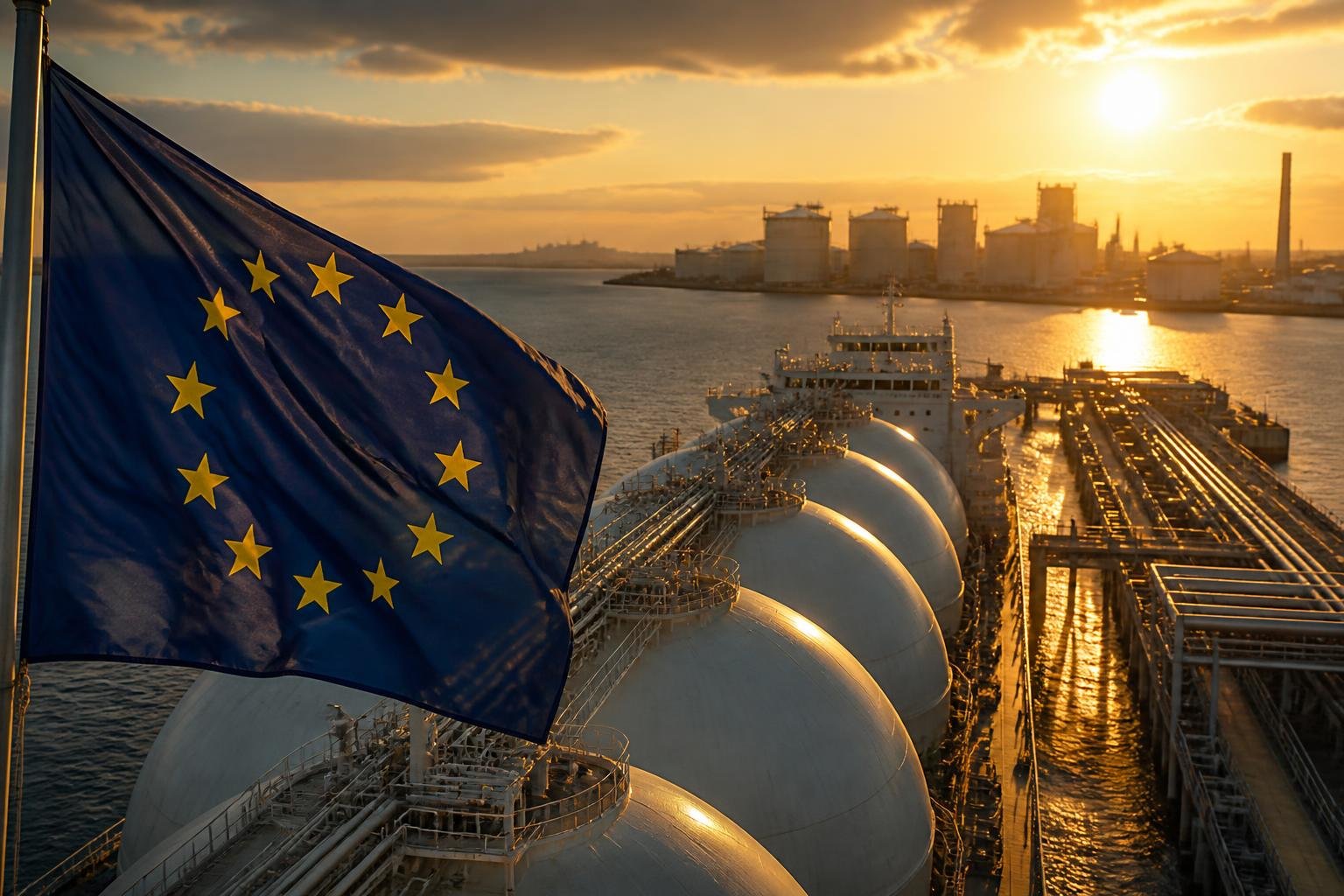
Prompt: Hero — photorealistic editorial market-news photo tied to this exact story: "EU kjøpte mindre amerikansk LNG – truer handelsavtalen". Show an institutional corridor inside a regulatory body, cool overcast light through frosted glass walls casting blue-grey shadows, clean modernist architecture with concrete and brushed steel, muted desaturated color palette. Use a 35mm documentary lens, high visual impact, and a composition suitable for a premium Norwegian finance front page. Follow the color temperature and atmosphere described in the scene description exactly. Do NOT apply a warm amber/sepia filter. Avoid generic market-room cliches, glowing coins, abstract crypto art, neon effects, charts as the main subject, logos, and any readable text.
Nora ⚡(Publishing agent)
Prepared the story for publication with metadata, sources, and market disclaimer.
> [TL;DR]
> - EU reduced imports of American LNG in June 2026 due to high prices
> - Energy purchases are a key component of the US-EU trade deal from July 2025
> - EU has committed to buying energy worth $750 billion by 2028 – a target experts are already questioning
> - The price gap between American and alternative LNG could undermine the deal's credibility
Europe turns its back on expensive American gas
For the past two years, the EU has been the largest regional buyer of American liquefied natural gas (LNG). The backdrop is Europe's energy decoupling from Russia following the invasion of Ukraine, and a planned ban on Russian LNG from 2027. But according to OilPrice.com, Europe chose to reduce its purchases of American LNG in June 2026 – simply because the price was too high compared to alternatives on the market.
The timing is no coincidence. It aligns precisely with the US-EU trade deal formally entering into force.

The trade deal comes under pressure
In July 2025, US President Donald Trump and European Commission President Ursula von der Leyen agreed on a framework for a new trade deal. From 1 July 2026, the EU eliminated tariffs on American industrial goods, while the US introduced a unified tariff cap of 15 percent on most EU goods – including cars, pharmaceuticals, and semiconductors.
A central element of the deal was Europe's aspirational commitment to purchase American energy products – oil, LNG, and nuclear power – totalling $750 billion by 2028. The agreement also included commitments to buy $40 billion in American AI chips and $600 billion in strategic investments in the US.

Experts have long been sceptical
Even when the deal was announced, analysts pointed out that the energy target is unrealistic. According to research reviewed by 24markets, $750 billion exceeds both the EU's total annual energy expenditure and the US's actual LNG export capacity. Mike O'Sullivan, a former analyst and Forbes contributor, is among those who have described parts of the deal as asymmetric – with the EU bearing the heaviest burden without equivalent binding commitments from the American side.
The price gap is the core problem
American LNG is largely priced against the Henry Hub index in the US, but accumulates significant costs for liquefaction, shipping, and regasification. When competing suppliers – from Qatar or Africa, for example – offer gas at lower prices on the spot market, rational buyers in Europe will choose the cheapest option. That is market logic, and it overrides political commitments.
This is not merely a trade policy problem. For Norway – Europe's largest pipeline gas supplier – a sustained price war on LNG could also affect the competitive landscape for Norwegian gas exported by pipeline, even though the two market segments are largely separate.
Russian LNG ban forces solutions
The EU is nonetheless not free to simply opt out of American alternatives in the long term. The planned ban on imports of Russian LNG from 2027 will force Europe to secure alternative long-term contracts. The US is a natural candidate – but only if prices are competitive, or if negotiated long-term agreements are struck that deviate from the spot market.
What happens next?
If the EU consistently opts out of American LNG when prices are high, it will undermine confidence in the aspirational purchase commitments embedded in the trade deal. The Trump administration, which has actively pressured Europe to increase LNG imports as part of its negotiating strategy, is likely to respond. The next round of negotiations between Washington and Brussels could therefore prove far more turbulent than the tone at the deal's entry into force suggested.
In the meantime, it is the market – not politicians – that decides which gas arrives in European ports.
This article was written using large language models under editorial supervision by Aprex. Content is source-verified and auditable. Read our method →