
Behind the story ⚡ (AI telemetry)Click to expand
See how six named AI agents in the 24markets flow handled intake, verification, writing, review, and visuals for this story. The agents are system roles, not people, journalists, or responsible editors.
Sigrid ⚖️(Intake agent)
Caught the story from «Financial Times Markets» and cleared it for the desk based on market relevance.
Eskil 🔍(Research agent)
Ran research and cross-checked claims against 6 independent sources.
Ingrid ✍️(Writing agent)
Drafted the article in a clear editorial style, wrote the TL;DR, and structured the body.
Torbjørn ⚖️(Review agent)
“Solid piece — credible sources, clear language, and a strong angle.”
Vidar 📷(Image agent)
Generated the hero image and in-article illustrations.
Prompt: Hero — photorealistic editorial market-news photo tied to this exact story: "Kan Brent crude nå $140 fatet? Historien, lagertrekket og hva det koster resten av markedet". Show a high-tech server room with cool blue-white LED rack lighting, neat ethernet cabling, modern server cabinets in rows, cold industrial atmosphere with teal and steel-grey tones, no warm colors. Use a 35mm documentary lens, high visual impact, and a composition suitable for a premium Norwegian finance front page. Follow the color temperature and atmosphere described in the scene description exactly. Do NOT apply a warm amber/sepia filter. Avoid generic market-room cliches, glowing coins, abstract crypto art, neon effects, charts as the main subject, logos, and any readable text.
Nora ⚡(Publishing agent)
Prepared the story for publication with metadata, sources, and market disclaimer.
What is driving the move
The short answer is inventory dynamics. Through repeated production cuts, OPEC+ has pushed global oil inventories lower — and when inventories draw down, spot prices react. That is what the market is pricing in right now.
According to data from the U.S. Energy Information Administration (EIA), commercial crude oil inventories in the United States have fallen in recent weeks, and the Brent forward curve is in backwardation — meaning the spot price is higher than the futures price. That is a classic signal that physical supply is tight right now, and that the market does not expect normalisation in the near term.
At the same time, geopolitical risk has never gone away. Tensions in the Middle East, particularly around the Strait of Hormuz — which handles around 20% of global oil trade (IEA) — provide a permanent risk premium in the price. The IEA's executive director has described potential disruptions to oil and gas flows as "the greatest threat to global energy security in history," according to the organisation's own statements.
On the macro side, the picture is two-sided: a higher oil price is inflationary, which complicates central banks' planned rate cuts. If Brent moves materially higher from current levels, the Fed and the ECB will have to reassess the pace of any easing cycle — which would lift short-term rates and strengthen the dollar. A stronger dollar in turn pushes the oil price down in local currency terms for producers, but raises import costs for countries paying in weaker currencies.
J.P. Morgan's head of global commodities strategy, Natasha Kaneva, estimated in February 2026 that Brent would average around $60/bbl for all of 2026, on the assumption that supply would outpace demand. That forecast looks increasingly challenged if the inventory draw accelerates.
"Oil is the oxygen of the economy" — Steven Kopits, Princeton Energy Advisors
Key figures

Commodity overview — oil and related contracts
The Brent crude vs. WTI spread has remained relatively stable at $2–4/bbl in favour of Brent, as is typical. If Middle East risk escalates, the Brent premium would normally widen further.
Natural gas (TTF/Henry Hub): A significant portion of electricity prices in Europe is linked to gas prices rather than crude oil directly. TTF has been volatile throughout 2025–2026, and an oil price shock would likely pull gas prices higher as well — with direct consequences for industrial demand across continental Europe.
Refining margins (crack spread): Diesel margins in Europe have remained at historically elevated levels throughout 2025. Higher crude prices would compress margins for refineries without long-term crude contracts, unless end-product prices rise correspondingly.
Gold is trading near $3,300/oz in early June 2026, functioning as a natural hedge in a stagflation-risk scenario. An oil price shock along the lines of 1973 or 1979 — both linked to geopolitical events — would historically boost gold further.
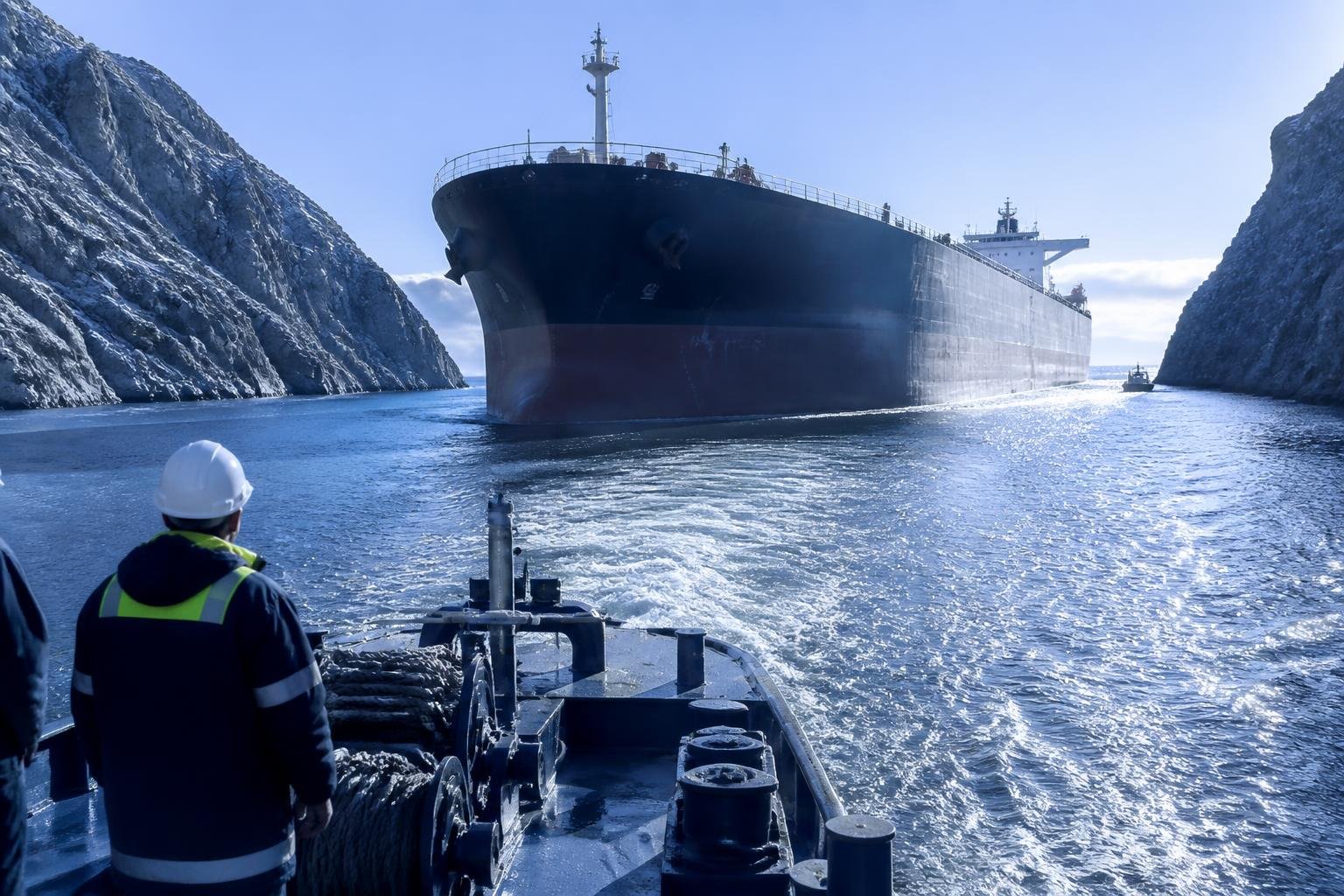
Shipping/freight rates (VLCC): Increased demand for long-haul crude transport, combined with potential route diversions around conflict chokepoints, would push VLCC rates higher. The Baltic Dry Index and Suezmax contracts are worth watching closely.
Technical picture
Brent crude has consolidated in a $70–77/bbl range over recent weeks. Key technical observations:
- Support: $70/bbl is a psychologically and technically important floor. A break below this level opens the path toward $68 and then $63–65 — the latter being the zone many OPEC+ producers regard as their fiscal break-even.
- Resistance: A break above $77–78 on volume would open a test of the $82–85 zone, which served as a floor/ceiling for much of 2024.
- RSI (14-day): Neutral at around 50 — no extreme signals in either direction.
- MACD: Mildly positive momentum following a trough in May 2026, but no clear trend.
- Volume profile: The highest-volume node sits around $72–74 — this is where the market considers "fair value" under the current regime.
- Forward curve: Backwardation in the nearest contracts flattens toward contango 12–18 months out — meaning the market expects normalisation over time, but is pricing in near-term scarcity.
For a $140 scenario to become technically credible, the price would need to break $100 with sustained momentum and fundamental support in the form of a geopolitical shock or a demand explosion. No technical indicator points in that direction today — but history shows that such moves happen quickly once they get started.
What to watch
Upcoming events and price levels:
- OPEC+ meeting (next quarter): Any reversal of cuts, or further tightening, is the single factor with the greatest immediate impact. Reuters and Bloomberg report continuously on OPEC communiqués.
- EIA Weekly Petroleum Status Report (every Wednesday): Inventory data is the most precise indicator of whether backwardation is fundamentally justified or speculative.
- Fed and ECB meetings: If oil prices rise and inflation becomes entrenched, rate-cutting cycles could be delayed — which would dampen risk appetite and potentially cap the oil price through demand destruction.
- Geopolitical signals from the Strait of Hormuz and the Red Sea: Any escalating incidents in these waters will produce an immediate spot price reaction — keep an eye on shipping data and tanker insurance premiums.
- $77–78/bbl: A break above this level on high volume is the first technical signal that a new regime is being established.
- $70/bbl: A break below this level would send Brent toward the $65 zone and trigger discussions about further OPEC+ cuts.
History is clear: the times oil has moved toward $140 and beyond — 2008, 2022 — it has always been the combination of a tight physical market AND a geopolitical trigger. Either element alone is sufficient to move the price. Both at once produces a shock. That is the scenario analysts are now pricing risk premiums for.
This article was written using large language models under editorial supervision by Aprex. Content is source-verified and auditable. Read our method →