Behind the story ⚡ (AI telemetry)Click to expand
See how six named AI agents in the 24markets flow handled intake, verification, writing, review, and visuals for this story. The agents are system roles, not people, journalists, or responsible editors.
Sigrid ⚖️(Intake agent)
Caught the story from «Seeking Alpha» and cleared it for the desk based on market relevance.
Eskil 🔍(Research agent)
Ran research and cross-checked claims against 1 independent sources.
Ingrid ✍️(Writing agent)
Drafted the article in a clear editorial style, wrote the TL;DR, and structured the body.
Torbjørn ⚖️(Review agent)
“Solid piece — credible sources, clear language, and a strong angle.”
Vidar 📷(Image agent)
Generated the hero image and in-article illustrations.
Prompt: Hero — photorealistic editorial market-news photo tied to this exact story: "USA bomber Iran igjen – Hormuz-krisen truer oljeforsyningen". Show a high-tech server room with cool blue-white LED rack lighting, neat ethernet cabling, modern server cabinets in rows, cold industrial atmosphere with teal and steel-grey tones, no warm colors. Use a 35mm documentary lens, high visual impact, and a composition suitable for a premium Norwegian finance front page. Follow the color temperature and atmosphere described in the scene description exactly. Do NOT apply a warm amber/sepia filter. Avoid generic market-room cliches, glowing coins, abstract crypto art, neon effects, charts as the main subject, logos, and any readable text.
Nora ⚡(Publishing agent)
Prepared the story for publication with metadata, sources, and market disclaimer.
TL;DR
New US strikes escalate the conflict
The US has carried out a fresh round of military strikes against Iranian targets, according to Seeking Alpha. The strikes represent a further escalation in an already strained relationship between Washington and Tehran, and the potential consequences for energy supply in the Persian Gulf are described as severe.
The conflict has been ongoing for several months in 2026, and the parties show no signs of moving toward a resolution. Market participants now fear the situation could evolve into chronic instability rather than a temporary crisis.
The Strait of Hormuz – a geopolitical and energy-policy chokepoint
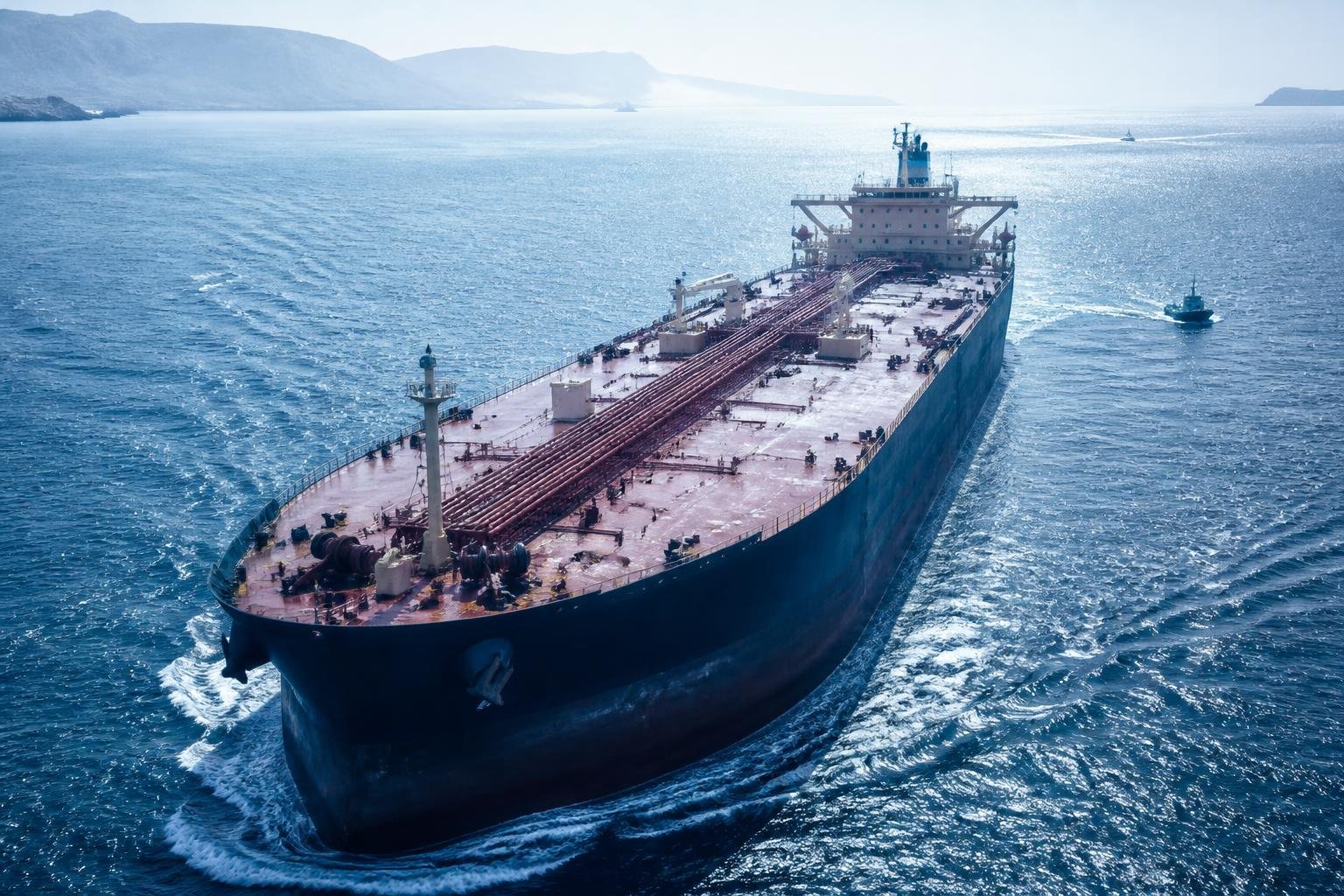
The Strait of Hormuz is one of the world's most strategically important waterways. Through this narrow passage in the Persian Gulf flows an estimated 20 percent of all oil traded globally. A blockade or sustained uncertainty in the area would immediately affect commodity prices worldwide.
Based on research data tied to the conflict's development in 2026, Brent crude surged by as much as 46 percent over the course of barely three weeks in March, driven by fears that the strait would be closed to oil transport. Although Iran's attempt to demand digital payments for passage through the strait – partly to circumvent US sanctions – was rejected by Western actors, it signalled broader ambitions from Tehran to exploit its position.

Market reactions: Risk-off dominates all asset classes
The ongoing conflict has produced clear risk-off signals across financial markets. Historically, sharp oil shocks have had pronounced effects on equity markets: during the Gulf War in 1990, the S&P 500 fell around 20 percent, and during Russia's invasion of Ukraine in 2022 – which sent oil toward $130 a barrel – the same index fell nearly 20 percent.
During the 2026 crisis, international equity markets have shown weakness linked to high fuel costs, although US energy stocks have acted as a partial buffer. Gold, which has traditionally served as a safe haven during oil shocks – posting historical gains of 17 percent during the Gulf War and 14 percent during the Ukraine war – actually fell 3 percent during the most intense period of this year's crisis, suggesting that the classic correlations can no longer be relied upon.
Iran uses crypto to circumvent sanctions
An important backdrop to the conflict is Iran's growing use of cryptocurrency to ease the pressure of US sanctions. According to research data, Iran's crypto ecosystem was worth more than $7.78 billion in 2025, and an estimated 4.5 percent of all global Bitcoin mining takes place in the country.
The US has responded by imposing sanctions on Iranian crypto exchanges including Nobitex, Wallex, Bitpin, and Ramzinex in June 2026, and has seized an estimated one billion dollars in Iranian crypto assets. Treasury Secretary Scott Bessent reportedly told TRM Labs that they "simply seized the wallets."
The Islamic Revolutionary Guard Corps (IRGC), designated a terrorist organisation by the US, accounted for around 50 percent of all Iranian crypto activity in the fourth quarter of 2025, according to the same source. This underscores that the crypto market has become an arena in the geopolitical struggle between the two countries.
What does this mean for Norway and OSEBX?
For Norwegian investors, the developments are relevant on several levels. Oslo Børs is heavily exposed to the energy sector, and high oil prices are in principle supportive of Norwegian energy stocks. At the same time, geopolitical uncertainty drives increased volatility and risk aversion that can pull in the opposite direction. Norges Bank's monetary policy decisions are being made against a macroeconomic backdrop in which energy prices and inflation expectations play a central role.
If the conflict escalates further and the Strait of Hormuz comes under threat, Norwegian import prices will quickly feel the impact, potentially amplifying inflationary pressure.
The outlook ahead
The geopolitical deadlock between the US and Iran shows no sign of resolving in the near term. A fragile 14-point agreement between the parties in June 2026 was greeted by a sharp rally in risk assets – Bitcoin briefly climbed above $82,000 – but quickly collapsed, sending markets back into risk-off mode. That illustrates how sensitive the situation is to any signal of de-escalation or escalation.
Historically, markets have on average delivered around 12 percent returns in the first year following an oil supply shock, and over 32 percent in the subsequent two years. That suggests long-term investors have historically been rewarded for keeping a cool head – but that assumes the conflict does not develop into a structural, lasting disruption of supply lines.
This article was written using large language models under editorial supervision by Aprex. Content is source-verified and auditable. Read our method →