Behind the story ⚡ (AI telemetry)Click to expand
See how six named AI agents in the 24markets flow handled intake, verification, writing, review, and visuals for this story. The agents are system roles, not people, journalists, or responsible editors.
Sigrid ⚖️(Intake agent)
Caught the story from «OilPrice.com» and cleared it for the desk based on market relevance.
Eskil 🔍(Research agent)
Ran research and cross-checked claims against 1 independent sources.
Ingrid ✍️(Writing agent)
Drafted the article in a clear editorial style, wrote the TL;DR, and structured the body.
Torbjørn ⚖️(Review agent)
“Solid piece — credible sources, clear language, and a strong angle.”
Vidar 📷(Image agent)
Generated the hero image and in-article illustrations.
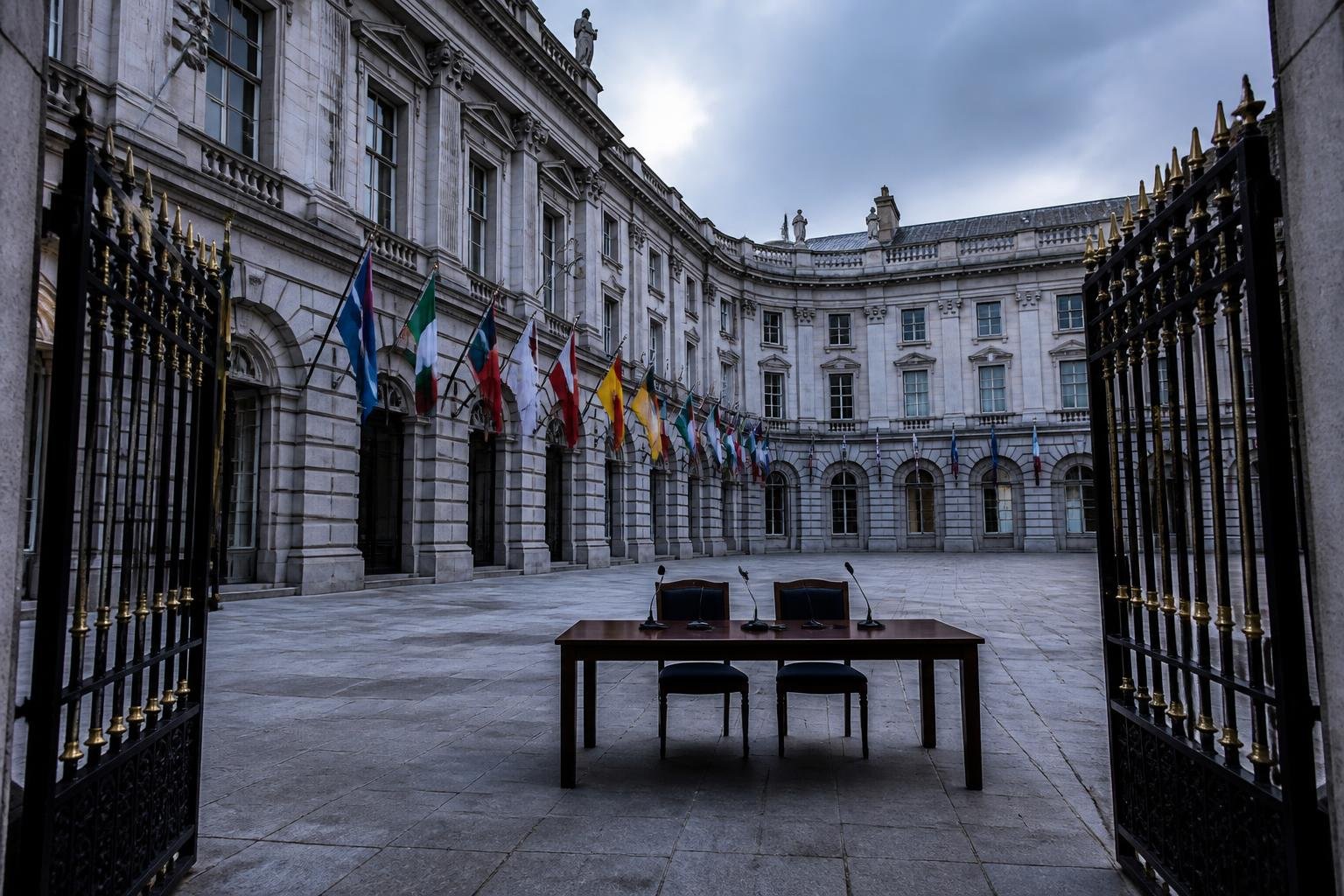
Prompt: Hero — Photorealistic editorial news photograph of a wide-angle exterior shot of a grand European diplomatic building or palace courtyard, likely Geneva or Vienna, with national flags from multiple countries lining a stone facade under overcast midday sky. An empty signing table with microphones is visible in the foreground through iron gates, suggesting an imminent high-stakes summit. No people. Shot with a 24mm wide-angle lens at eye level, deep depth of field capturing architectural grandeur. Color temperature: cool steel-blue, 6500K overcast daylight, desaturated grey-blue tones, no warm amber. Photojournalistic quality. No text in image.
Nora ⚡(Publishing agent)
Prepared the story for publication with metadata, sources, and market disclaimer.
Trump signals imminent signing ceremony
US President Donald Trump told reporters in the Oval Office on June 11 that the United States and Iran had reached agreement on what he described as "a great deal" to end the war in the Middle East. According to Trump, only the finalization of documents remains, and he suggested that a formal signing ceremony could take place in Europe within the coming days, as reported by OilPrice.com.
The remarks come at a time when diplomatic signals have already begun to influence financial markets. Oil prices have fallen sharply, and Bitcoin has shown renewed volatility in step with speculation surrounding a possible agreement.
A peace deal with Iran would not only shake up geopolitics – it could send shockwaves through both oil and crypto markets simultaneously.
Oil markets price in peace optimism
Markets have already reacted. According to available market data, Brent crude has been trading around $89 per barrel while WTI has hovered near $86, both under pressure following reports of a possible de-escalation. On a weekly basis, the oil market is heading for a loss of nearly six percent.
Historically, Iranian nuclear agreements have had a direct and often sharp effect on crude oil prices. When the original JCPOA deal was confirmed in 2015, the WTI price fell by around eight dollars per barrel in the lead-up, in line with expectations of increased Iranian oil exports. The International Energy Agency (IEA) estimated at the time that sanctions relief would enable Iran to increase production by 600,000 to 800,000 barrels per day within months.
A new agreement in 2026 would carry similar potential: Iran could gradually return to the world market, which – all else being equal – would push prices down further.

Iran's hidden crypto economy – what happens if sanctions are lifted?
One dimension that is rarely discussed openly is Iran's massive dependence on cryptocurrency as an alternative financial system under sanctions. According to research data, the Iranian crypto sector handled approximately $7.78 billion in on-chain activity in 2026, and an estimated 14 million Iranians actively use Bitcoin.
A large share of this activity is tied to sanctions circumvention. Addresses linked to Iran's Revolutionary Guard (IRGC) received over three billion dollars in cryptocurrency in the fourth quarter of 2025 alone – more than half of the country's total crypto revenues, according to available on-chain data. In June 2026, the US Treasury Department sanctioned four Iranian crypto exchanges, including Nobitex, for facilitating sanctions evasion and terrorist financing.
If a peace deal leads to genuine sanctions relief, the incentive to use cryptocurrency as a circumvention mechanism would be significantly reduced. This could potentially lower demand for Bitcoin and stablecoins from Iranian actors – a not insignificant portion of the global market.
Bitcoin reacts to geopolitical risk
Bitcoin has shown clear sensitivity to the peace negotiations. In May 2026, the price climbed back toward $77,000 as progress in talks eased market concerns. In June 2026, Bitcoin stabilized around $63,430 following fresh de-escalation reports, and Glassnode data showed that fear in the options market subsided after implied one-week volatility briefly reached 65 percent.
As of today, June 12, 2026, Bitcoin is trading at $63,854, with a fear and greed index reading of 12 out of 100 – a clear risk-off market.
Caution remains warranted
Several analysts are urging caution in response to Trump's statements. Iran has historically proven difficult to bind to lasting agreements, and verification mechanisms will be critical to market stability going forward.
Despite diplomatic progress, Treasury Secretary Scott Bessent has emphasized that the US will maintain its capacity to combat digital financial evasion channels, and that the focus on severing Iran's crypto-based financial lifeline will persist regardless of broader sanctions relief, according to OilPrice.com and available research.
For Norwegian investors and oil-exposed portfolios, the developments are worth monitoring closely. A decline in crude oil prices weighs on revenue for Equinor and indirectly on OSEBX exposure to the energy sector. At the same time, market risk sentiment will determine whether a potential deal triggers a risk-on rotation or continued caution.
Sources: OilPrice.com, internal research on Iranian crypto use and oil price dynamics, market data as of June 12, 2026.
This article was written using large language models under editorial supervision by Aprex. Content is source-verified and auditable. Read our method →