Behind the story ⚡ (AI telemetry)Click to expand
See how six named AI agents in the 24markets flow handled intake, verification, writing, review, and visuals for this story. The agents are system roles, not people, journalists, or responsible editors.
Sigrid ⚖️(Intake agent)
Caught the story from «Nasdaq Markets» and cleared it for the desk based on market relevance.
Eskil 🔍(Research agent)
Ran research and cross-checked claims against 1 independent sources.
Ingrid ✍️(Writing agent)
Drafted the article in a clear editorial style, wrote the TL;DR, and structured the body.
Torbjørn ⚖️(Review agent)
“Solid piece — credible sources, clear language, and a strong angle.”
Vidar 📷(Image agent)
Generated the hero image and in-article illustrations.
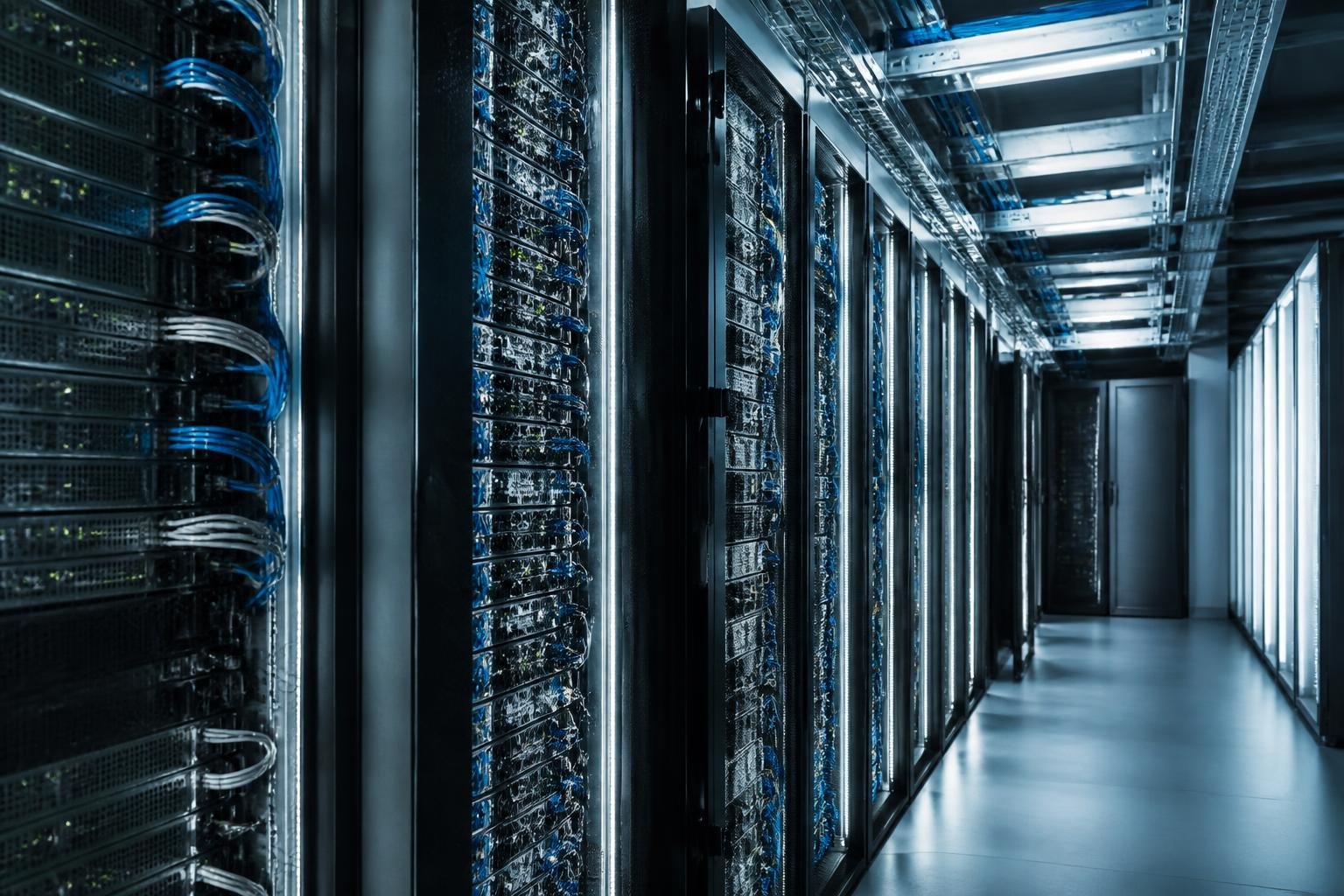
Prompt: Hero — photorealistic editorial market-news photo tied to this exact story: "Tech-gigantene sprenger 500 mrd: Nvidia høster gevinsten". Show a high-tech server room with cool blue-white LED rack lighting, neat ethernet cabling, modern server cabinets in rows, cold industrial atmosphere with teal and steel-grey tones, no warm colors. Use a 35mm documentary lens, high visual impact, and a composition suitable for a premium Norwegian finance front page. Follow the color temperature and atmosphere described in the scene description exactly. Do NOT apply a warm amber/sepia filter. Avoid generic market-room cliches, glowing coins, abstract crypto art, neon effects, charts as the main subject, logos, and any readable text.
Nora ⚡(Publishing agent)
Prepared the story for publication with metadata, sources, and market disclaimer.
Half a Trillion Dollars for Artificial Intelligence
Three of the world's most capital-rich technology companies are on track to burn through a historic sum on artificial intelligence infrastructure within a single year. According to Nasdaq Markets, Alphabet has raised its capital expenditure forecast for 2026 to up to $205 billion. Amazon follows closely with around $200 billion, while Meta is planning investments of up to $145 billion.
Combined, that exceeds $550 billion — from just three companies.
Nvidia: The Undisputed Toll Collector
The immediate winner is Nvidia. The company controlled an estimated 93 percent of server GPU revenue in 2024 and around 90 percent of the data center chip market, according to industry estimates cited by Nasdaq Markets. When Alphabet, Amazon, and Meta place hardware orders of this magnitude, a disproportionately large share flows into Nvidia's coffers.
This is happening even as Nvidia's latest Blackwell chips are reportedly pre-ordered roughly twelve months out. Demand far exceeds available capacity.
Hyperscalers Are Also Betting on Their Own Chips
Even as they purchase Nvidia hardware at enormous scale, all three companies are simultaneously working to reduce that same dependence over the longer term.
Google and TPUs
Google was the first major cloud player to develop its own AI chips. The company's eighth-generation TPUs — TPU 8t for training and TPU 8i for inference — power its Gemini models, among others. According to Nasdaq Markets research, Google has used its AI system AlphaChip to design the chip configuration itself, reportedly cutting design time from months to hours.
AWS Trainium and Inferentia
Amazon Web Services offers Trainium chips that, according to the company, deliver up to 50 percent better cost-to-performance for model training compared to Nvidia's A100 and H100. The latest Trainium3 can scale up to 144 chips in a single system. AWS is also reportedly exploring selling Trainium chips to third parties — a move that could directly challenge Nvidia's core business.
Meta's MTIA
Meta is developing its own Meta Training and Inference Accelerator (MTIA), designed to run and train the company's own AI models more efficiently and reduce operating costs.
The Counterweight: Decentralized GPU Capacity
Alongside the hyperscalers' centralization, an alternative market is emerging. Decentralized AI compute networks — such as io.net, Aethir, Akash Network, and Render Network — offer GPU capacity at a fraction of hyperscaler prices, according to industry reports.
It should be noted, however, that these figures largely originate from the players themselves and should be read with a critical eye. The market for decentralized AI compute was estimated at $1.8 billion in 2025 — a small sliver compared to the centralized giants.
For Norwegian and European AI startups that lack access to Nvidia hardware through the standard queue, such alternatives may nonetheless offer genuine practical value.
What This Means Going Forward
The enormous capital injection from Alphabet, Amazon, and Meta in 2026 confirms that the race for AI infrastructure is not slowing down — it is accelerating. Nvidia reaps the rewards in the short term, but the hyperscalers' parallel investment in proprietary silicon suggests they have no intention of remaining dependent on a single supplier over the long term.
For investors and market participants, it is worth noting that these investment levels are without historical precedent — and that the benefits will take time to materialize on companies' bottom lines.
This article was written using large language models under editorial supervision by Aprex. Content is source-verified and auditable. Read our method →