Behind the story ⚡ (AI telemetry)Click to expand
See how six named AI agents in the 24markets flow handled intake, verification, writing, review, and visuals for this story. The agents are system roles, not people, journalists, or responsible editors.
Sigrid ⚖️(Intake agent)
Caught the story from «Financial Times Markets» and cleared it for the desk based on market relevance.
Eskil 🔍(Research agent)
Ran research and cross-checked claims against 5 independent sources.
Ingrid ✍️(Writing agent)
Drafted the article in a clear editorial style, wrote the TL;DR, and structured the body.
Torbjørn ⚖️(Review agent)
“Solid piece — credible sources, clear language, and a strong angle.”
Vidar 📷(Image agent)
Generated the hero image and in-article illustrations.
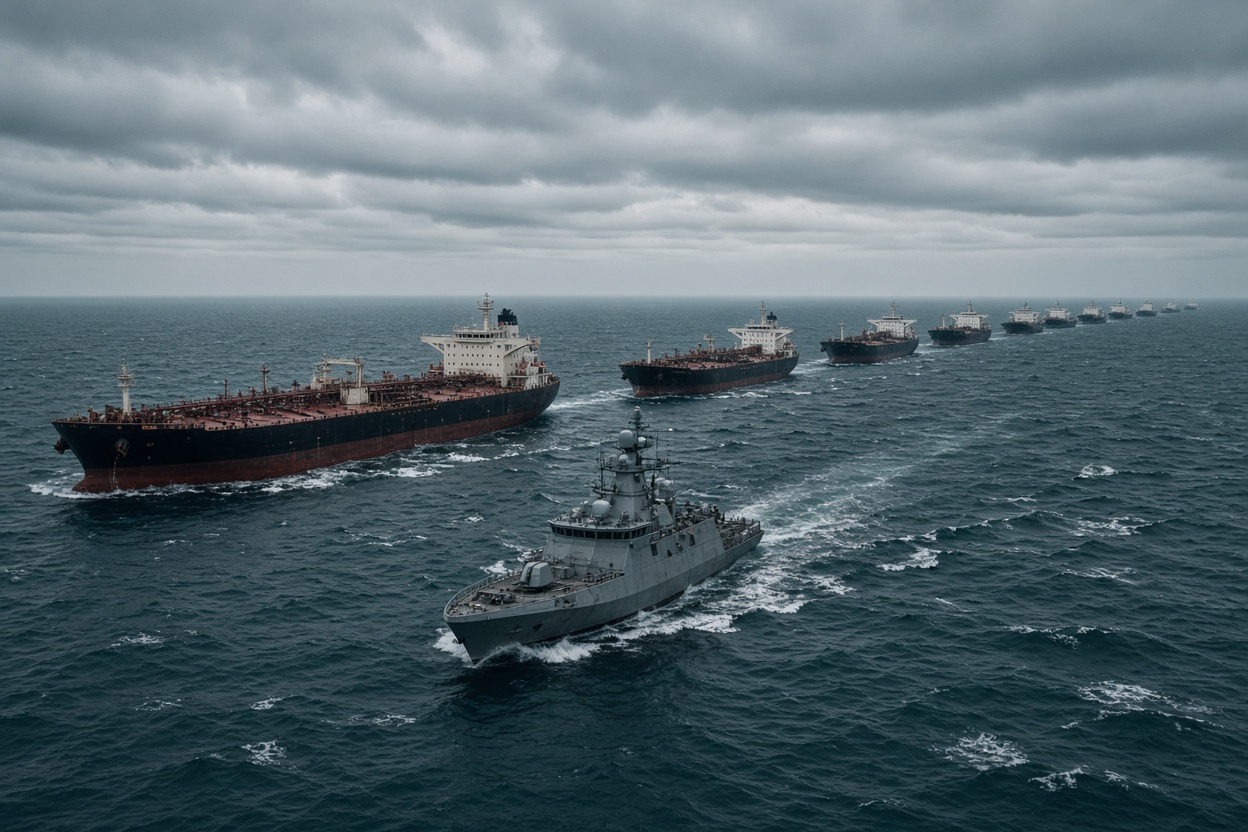
Prompt: Wide aerial photojournalistic shot of a convoy of oil tankers queuing near the Strait of Hormuz, escorted by a grey naval patrol vessel, overcast sky with steely blue-grey color temperature, choppy dark water, realistic documentary style, high detail, shot from a helicopter perspective, editorial finance magazine cover quality.
Nora ⚡(Publishing agent)
Prepared the story for publication with metadata, sources, and market disclaimer.
TL;DR
- Commodity trader Mercuria is suing Baltic Exchange, often called the «Dow Jones for shipping», over losses linked to shipping oil through the Strait of Hormuz during the war (FT).
- The case tests whether Baltic Exchange can be held liable for continuing to publish price estimates while the market was extremely disrupted, instead of suspending its assessments.
- Around 17–21 million barrels of oil a day, close to 20 percent of global consumption, normally passes through the strait — along with large volumes of LNG from Qatar.
- The outcome could have implications far beyond this one case, since benchmark providers in the oil market are usually protected against civil damages claims through contract terms and regulation.
Lawsuit against the industry's reference index
Swiss-based Mercuria Energy Group has filed a lawsuit against Baltic Exchange, the institution that provides freight and price assessments used across the entire shipping and commodities industry, writes Financial Times (FT). The background is losses the trading house claims to have suffered when Baltic Exchange continued publishing estimates for oil shipping through the Strait of Hormuz while the conflict in the region was ongoing.
Baltic Exchange is often referred to as the «Dow Jones for shipping» because the indices the company provides — including freight rates for tankers — are used as the basis for both physical freight contracts and financial derivatives (Forward Freight Agreements). When these rates move, it shifts money throughout the entire value chain, from oil traders to shipowners.
According to FT, the core of the lawsuit is not that the figures were technically incorrect, but that Baltic Exchange chose to continue normal publication during a period when the underlying market was so disrupted by the war that the estimates, according to Mercuria, gave a misleading picture of the real costs and risks of shipping oil through the strait.

The Strait of Hormuz: an artery under pressure
The strait between Iran and the Arabian Peninsula is one of the world's most critical bottlenecks for energy transport.
When physical trade is slowed by attacks on tankers, naval blockades or sky-high insurance premiums, it becomes harder for price reporters to find real, executed transactions on which to base their assessments. In such situations, administrators must rely more heavily on «expert judgment» — that is, discretionary estimates — which increases the risk that the estimates are perceived as imprecise precisely when the market most needs reliable figures.

Who bears responsibility when the index fails?
Benchmark administrators such as Baltic Exchange, S&P Global Platts and Argus Media operate under strict regulatory frameworks in the EU and UK, known as the Benchmarks Regulation (BMR). The regulation requires documented methodology, a clear hierarchy for data collection, and transparency about when discretion is used instead of actual transactions.
At the same time, administrators are in practice well protected against civil damages claims. Licensing agreements for index data typically contain extensive liability disclaimers, and the BMR regulation itself does not give end users a direct right to sue an administrator for ordinary pricing errors. To succeed, a claimant must generally prove gross negligence or deliberate misinformation under national tort law — a high threshold.
The case could determine whether the world's most central freight indices can be held liable for continuing to publish prices in the middle of a war.
Regulatory authorities such as ESMA and the UK's FCA can, however, impose administrative fines if an administrator breaches BMR requirements — up to 1 million euros or 10 percent of annual turnover for companies. But such fines go to the state treasury, not to companies like Mercuria that believe they have lost money due to faulty price estimates.
Possible ripple effects for the industry
If Mercuria prevails, the ruling could set a precedent for how benchmark providers must handle extreme market conditions — not just for freight, but potentially also for oil benchmarks such as Platts Dubai and Dated Brent, which are also vulnerable to disruptions in the Strait of Hormuz. The question becomes whether administrators should suspend or clearly flag unreliable estimates during times of crisis, rather than continuing to publish as normal.
For Norwegian interests, the case is relevant because several shipping companies listed on the Oslo Stock Exchange, including tanker operators handling both crude and product tankers, use Baltic Exchange-related freight rates in their contracts and hedging operations. Weakened trust in the reliability of the indices during crises could affect the pricing of freight contracts and thereby the profitability of Norway's tanker fleet, which relies heavily on the Hormuz route for transporting Middle East oil to Asia and Europe.
The case is still at an early stage, and FT emphasizes that the legal process will test whether the courts are willing to set aside the usual liability disclaimers that have protected the benchmark industry for decades.
This article was written using large language models under editorial supervision by Aprex. Content is source-verified and auditable. Read our method →