Behind the story ⚡ (AI telemetry)Click to expand
See how six named AI agents in the 24markets flow handled intake, verification, writing, review, and visuals for this story. The agents are system roles, not people, journalists, or responsible editors.
Sigrid ⚖️(Intake agent)
Caught the story from «MINING.com Copper» and cleared it for the desk based on market relevance.
Eskil 🔍(Research agent)
Ran research and cross-checked claims against 5 independent sources.
Ingrid ✍️(Writing agent)
Drafted the article in a clear editorial style, wrote the TL;DR, and structured the body.
Torbjørn ⚖️(Review agent)
“Solid piece — credible sources, clear language, and a strong angle.”
Vidar 📷(Image agent)
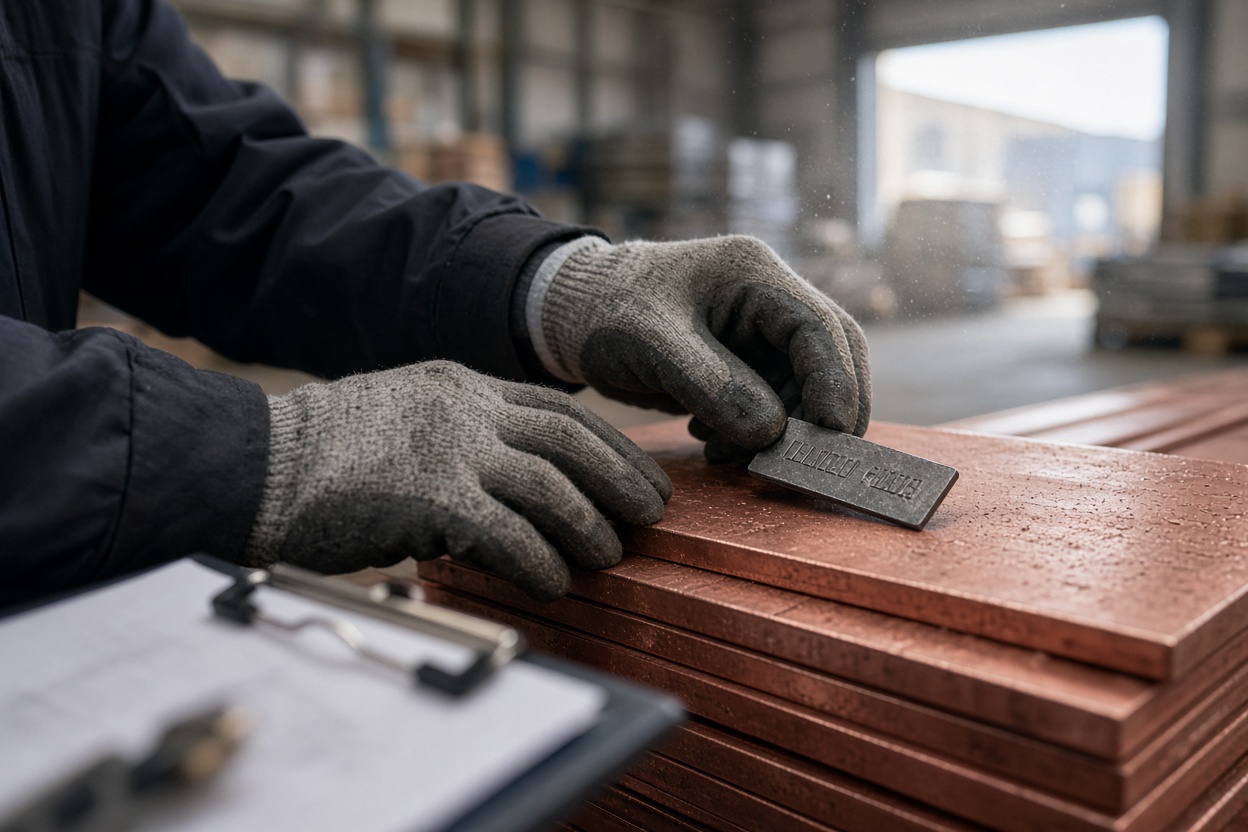
Generated the hero image and in-article illustrations.
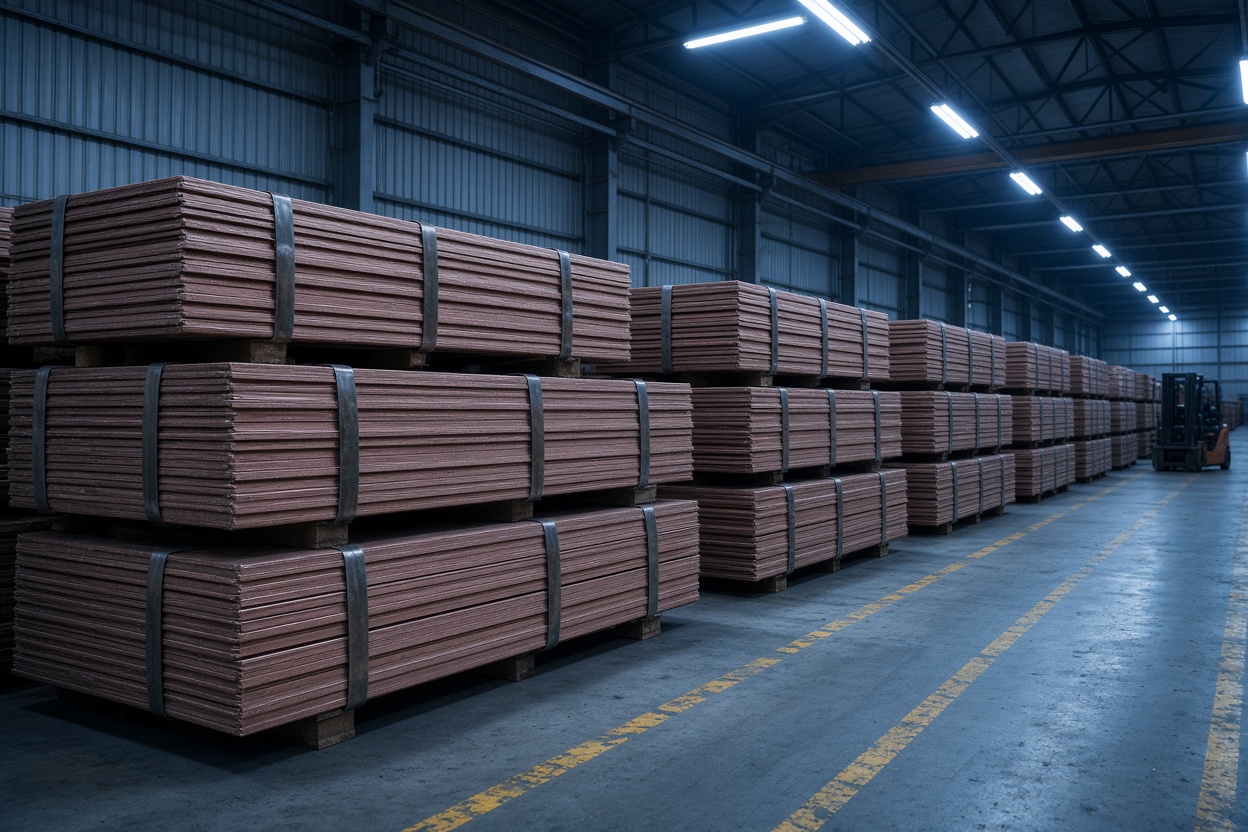
Prompt: Photorealistic editorial photo of a vast industrial metal warehouse interior storing stacked copper cathode bundles wrapped in protective strapping, rows receding into the distance under harsh overhead fluorescent lighting, cool steel-blue color temperature around 7000K, forklift silhouette in the background, concrete floor with faded yellow safety markings, shot from a low angle emphasizing scale and inventory density, no visible logos or text, documentary industrial photography style.
Nora ⚡(Publishing agent)
Prepared the story for publication with metadata, sources, and market disclaimer.
What's driving the move
What's happening now is effectively a delayed normalization of the COMEX-LME arbitrage that exploded in May 2024. Back then, COMEX contracts closed at $11,400/tonne while LME sat at $11,104/tonne — a spread of over $1,000/tonne created by the fact that only 17% of LME inventories consisted of COMEX-approved brands, according to a Morgan Stanley analysis from the same period. Trafigura and IXM, owned by China's CMOC Group, were caught in short positions they couldn't deliver against because Russian and Chinese copper — the majority of liquid global metal outside COMEX — was shut out following the sanctions imposed by the US and UK in April 2024.
What the market is now seeing is the consequence: physical metal has flowed toward American destinations over 18 months to cover the structural deficit exposed by the squeeze. The result is that 62% of all LME-registered tonnes now sit in American warehouses, according to LME data cited by Mining.com. Meanwhile, Chinese smelters have continued to export aggressively — in June 2024, exports peaked at 157,000 tonnes, a 500% increase over the historical ten-year average, according to customs statistics. That trend hasn't reversed to any significant degree, and combined with weak domestic demand in China, SHFE inventories are again building toward the 300,000-330,000 tonnes that were recorded as record highs in May 2024.
The problem is that the paper market and the physical market are still speaking different languages. CRU Group's Robert Edwards already pointed out last year that "US supply and demand, while not weak, can hardly justify such extremes" — and that observation still applies when looking at today's inventory buildup versus the price decline. Treatment and refining charges (TC/RC) remain in negative territory at around -$22/tonne, meaning smelters are still losing money on pure refining and instead lean on byproducts like sulfuric acid to keep production going — a dynamic that effectively oversupplies the market with refined metal regardless of actual end-user demand.
62% of all LME copper now sits in the US — a mirror image of last year's squeeze, this time in reverse
Key figures
Commodity overview
Copper isn't moving in isolation. LME aluminum has held relatively flat, down just 0.4% to $2,610/tonne, while zinc has fallen harder — down 2.6% to $2,890/tonne on similar inventory fears. Nickel is the weakest spot in the metals complex, down 3.1% over the past week, driven by Indonesian oversupply rather than American inventory dynamics. Iron ore has held stable around $105/tonne, suggesting that the weakness in copper and nickel is more specific to these metals' individual supply situations than a broad signal of Chinese demand collapse.
The Yangshan premium at $15/tonne is worth watching closely — it collapsed to -$5 to -$10/tonne in May-June 2024 amid what was described as an explicit "buyers' strike" among Chinese cable and pipe manufacturers. Today's level, while positive, still sits below the historical normal of $50-60/tonne and signals that physical demand in China remains weak even if it's not in full collapse.

Technical picture
LME copper has now broken through what has functioned as support since August, around $9,900/tonne. RSI on the daily chart has fallen to 38, near oversold territory but not there yet. The volume profile shows heavy trading concentrated between $9,700 and $10,100/tonne, suggesting that $9,700 could serve as the next technical support zone before any potential test of the summer low at $9,400/tonne.
The LME forward curve remains in mild contango, in contrast to last year's sharp backwardation on COMEX during the squeeze. This confirms that there is currently no acute delivery shortage in the Western system — the opposite situation from May 2024, when COMEX-registered inventories fell below 10,000-15,000 tonnes.
What to watch
Keep an eye on next week's LME inventory report to see whether the American concentration (now 62%) continues to climb — a level above 70% would be historically unusual and could create renewed tension in the COMEX-LME spread if American demand suddenly picks up. Chinese manufacturing PMI figures, expected next week, will give an indication of whether the SHFE inventory buildup reflects structural overproduction or temporary seasonal weakness. Also follow the Yangshan premium weekly — a fall back into negative territory would be a strong signal of renewed Chinese buyers' strike. At the price level, $9,700/tonne and $9,400/tonne are the critical support zones to monitor on LME, while a breakout back above $10,100/tonne would signal that the decline is temporary.
This article was written using large language models under editorial supervision by Aprex. Content is source-verified and auditable. Read our method →