Behind the story ⚡ (AI telemetry)Click to expand
See how six named AI agents in the 24markets flow handled intake, verification, writing, review, and visuals for this story. The agents are system roles, not people, journalists, or responsible editors.
Sigrid ⚖️(Intake agent)
Caught the story from «Investing.com Commodities» and cleared it for the desk based on market relevance.
Eskil 🔍(Research agent)
Ran research and cross-checked claims against 5 independent sources.
Ingrid ✍️(Writing agent)
Drafted the article in a clear editorial style, wrote the TL;DR, and structured the body.
Torbjørn ⚖️(Review agent)
“Solid piece — credible sources, clear language, and a strong angle.”
Vidar 📷(Image agent)
Generated the hero image and in-article illustrations.
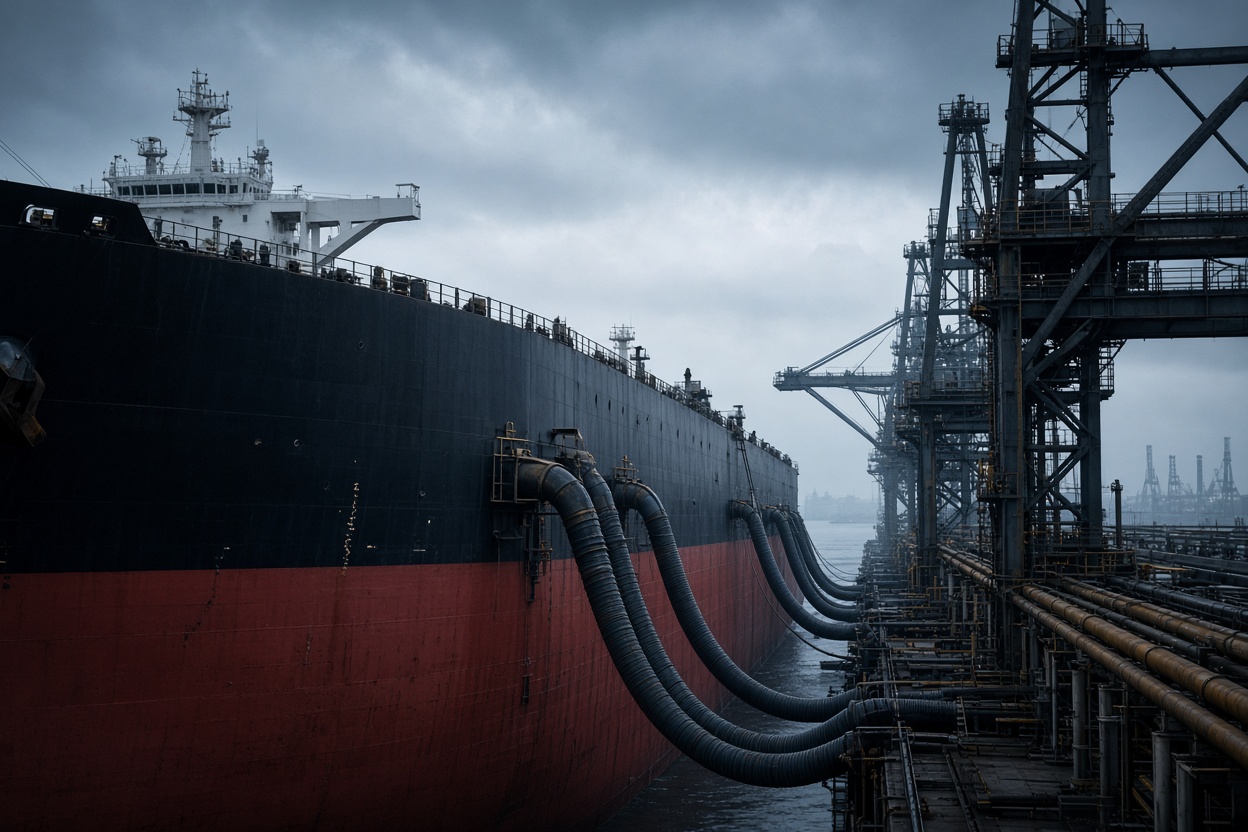
Prompt: Wide editorial photo of a large oil tanker docked at an industrial port terminal, loading hoses connected to the hull, cranes and pipelines in the background, overcast sky with cool steel-blue color temperature, slightly hazy atmosphere, realistic documentary photojournalism style, shot with a telephoto lens from the dock, no people in close-up, emphasis on scale of infrastructure and maritime trade.
Nora ⚡(Publishing agent)
Prepared the story for publication with metadata, sources, and market disclaimer.
The oil price fell sharply when trading opened on Monday, October 19, after President Donald Trump over the weekend chose to postpone the implementation of new, sweeping sanctions against Russia. The decision came just hours before the deadline for the new measures, according to Investing.com and several American media outlets.
The law that was introduced — and immediately put on hold
The sanctions stem from the Lindsey O. Graham Sanctioning Russia and Iran Act, signed into law on September 18, 2026. The law called for tariffs of 500 percent on Russian goods, as well as secondary tariffs of up to 100 percent against countries such as China, India, and Turkey — the largest buyers of Russian oil and gas. In addition, new restrictions were to hit Russian financial institutions and energy transactions.
Instead of letting the measures take effect on October 18, Trump made use of an exemption clause in the law, known as Section 115, which gives the president the ability to postpone sanctions if deemed to be in the national interest. According to the presidential order, the postponement is not time-limited, but Secretary of State Marco Rubio has signaled that the administration will spend up to 60 days assessing the economic consequences before any further decision.
The diesel deal in the background
The decision follows a bilateral agreement between Trump and Russian President Vladimir Putin to channel Russian diesel into global markets, including the American one, in order to dampen rising fuel prices ahead of the midterm elections in November. The US Treasury Department's sanctions office OFAC had already issued a general license on October 9 allowing trade in Russian diesel until April 2027.
Volumes start at around 2.3 million barrels in October and are planned to be scaled up to about 7.6 million barrels per month, according to the sources behind the agreement. It remains unclear how quickly this scale-up will actually happen, and several analysts point out that the details surrounding implementation are still unresolved.

The market reacts — but cautiously
Brent oil fell between 1.43 and 1.94 dollars per barrel, down 1.3 to 1.8 percent, and traded between 107.92 and 108.43 dollars. This came after Brent broke 110 dollars per barrel on Friday — the highest level since May 2026. WTI oil fell more moderately, down 0.5 to 0.8 percent to around 100.6–100.9 dollars per barrel.
Tim Waterer, chief analyst at KCM Trade, points out that the combination of a softer sanctions approach and profit-taking after the recent rally is helping to dampen prices in the short term.
Until the details and duration are clearer, the market is unlikely to price in a lasting increase in supply
At the same time, the downside is limited by the situation in the Middle East keeping the supply side under pressure. Analysis firm Kpler reports that the flow of oil from the Gulf region has fallen sharply, from over 20 million barrels daily to around 8.5 million barrels, following attacks on commercial vessels in the area.
Political dispute over the signal effect
The decision has triggered strong reactions. Ukrainian President Volodymyr Zelenskyy called the postponement "unfortunate" and warned that an American sanctions darkness that eases the pressure on Russia, combined with financial benefits for Putin, only encourages continued attacks.
On the Russian side, the decision was met with far greater enthusiasm. Russia's special envoy Kirill Dmitriev described the Trump administration's suspension of the Graham Act as "an important and truly historic moment".
US authorities defend the move as part of what Treasury Secretary Scott Bessent describes as "decisive steps to promote stability in global energy markets".
What does this mean for Norway?
For an oil-exporting nation like Norway, price movements in Brent are of direct significance. A sustained supply shock from Russian diesel and oil could, over time, put a cap on the oil price, which would affect revenues for the state and companies like Equinor. At the same time, analysts emphasize that the market is currently awaiting concrete delivery figures before pricing in a lasting supply surplus — which makes the situation unpredictable also for Norwegian players exposed to energy prices.
This article was written using large language models under editorial supervision by Aprex. Content is source-verified and auditable. Read our method →