Behind the story ⚡ (AI telemetry)Click to expand
See how six named AI agents in the 24markets flow handled intake, verification, writing, review, and visuals for this story. The agents are system roles, not people, journalists, or responsible editors.
Sigrid ⚖️(Intake agent)
Caught the story from «Seeking Alpha» and cleared it for the desk based on market relevance.
Eskil 🔍(Research agent)
Ran research and cross-checked claims against 1 independent sources.
Ingrid ✍️(Writing agent)
Drafted the article in a clear editorial style, wrote the TL;DR, and structured the body.
Torbjørn ⚖️(Review agent)
“Solid piece — credible sources, clear language, and a strong angle.”
Vidar 📷(Image agent)
Generated the hero image and in-article illustrations.
Prompt: Hero — photorealistic editorial market-news photo tied to this exact story: "Nvidias neste generasjons AI-rack forsinket til 2028". Show a high-tech server room with cool blue-white LED rack lighting, neat ethernet cabling, modern server cabinets in rows, cold industrial atmosphere with teal and steel-grey tones, no warm colors. Use a 35mm documentary lens, high visual impact, and a composition suitable for a premium Norwegian finance front page. Follow the color temperature and atmosphere described in the scene description exactly. Do NOT apply a warm amber/sepia filter. Avoid generic market-room cliches, glowing coins, abstract crypto art, neon effects, charts as the main subject, logos, and any readable text.
Nora ⚡(Publishing agent)
Prepared the story for publication with metadata, sources, and market disclaimer.
Manufacturing problems halt the Kyber initiative
Nvidia's high-profile next-generation AI rack, internally known as 'Kyber', has been delayed and is now not expected until 2028 at the earliest, according to a report cited by Seeking Alpha. The racks were originally expected to be available in the second half of 2027.
The cause is reported to be technical issues related to the manufacturing process. Details surrounding the specific obstacles have not yet been confirmed by Nvidia, and the claims in the report should therefore be treated with some caution until the company makes an official statement.
Kyber's role in AI infrastructure
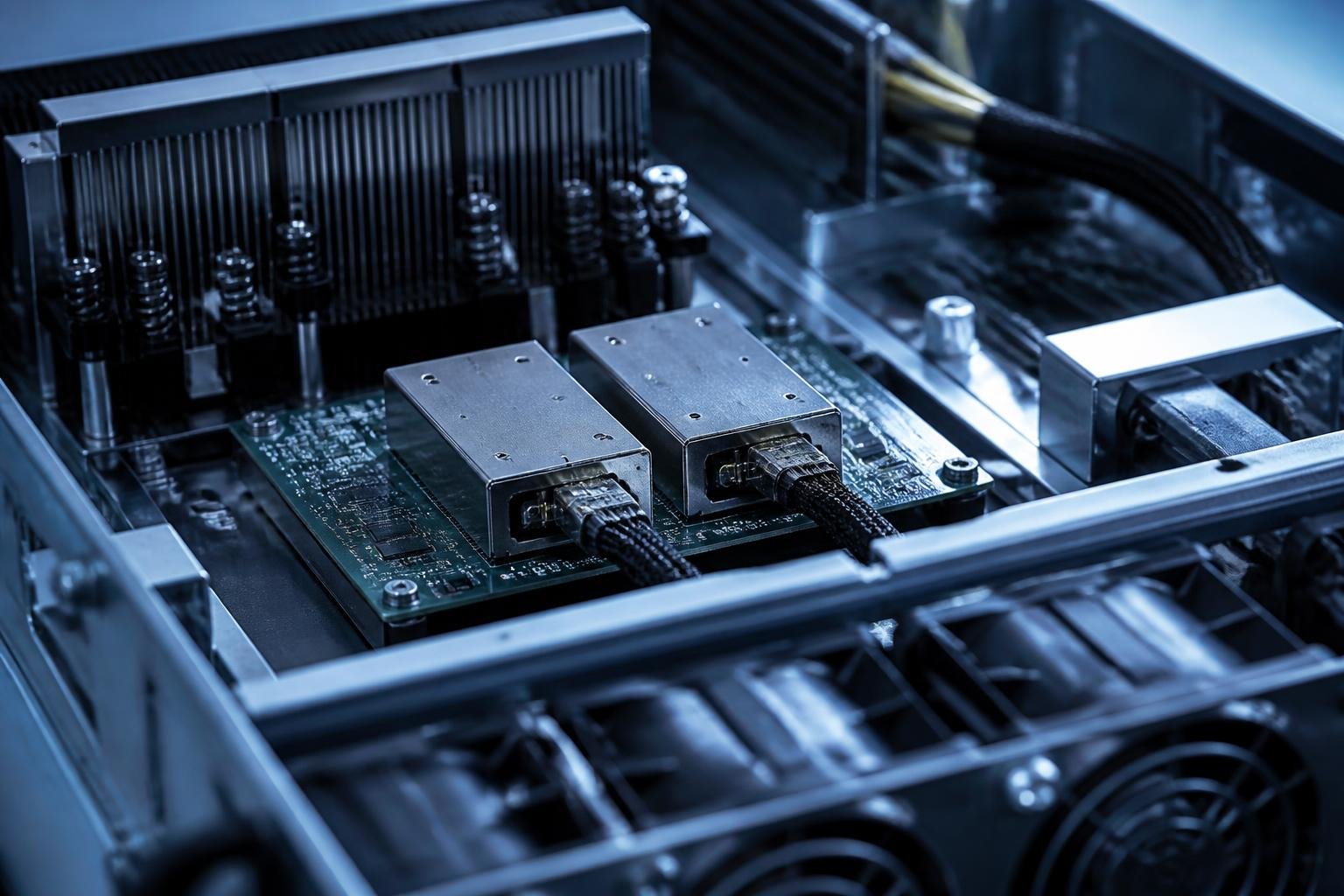
Kyber represents a significant technological leap for centralized AI infrastructure. According to available technical documentation, the racks are designed for hyperscale AI data centers, where compute nodes connect vertically into a midplane via NVLink switches, bypassing the limitations of traditional copper cabling.
Nvidia CEO Jensen Huang has described the architecture as a cohesive supercomputer within a single rack. The company has also announced plans to integrate a new 800 VDC power architecture, with estimates pointing to around 39 GW of new capacity by 2030 — a market potentially worth more than 20 billion dollars when transformers and power side cabinets are included.
Opens the door for decentralized alternatives
While Nvidia grapples with manufacturing logistics, an entire segment of decentralized GPU platforms is growing rapidly. Players such as Akash Network, Render Network, and io.net already offer AI compute capacity through peer-to-peer networks, often at a fraction of the price charged by centralized cloud providers.
Akash Network, for example, lists a price of $1.33 per hour for H100 GPUs, compared to AWS's $3.93 per hour for equivalent capacity. The platform surpassed five million dollars in total compute revenue in the first quarter of 2026. io.net, for its part, claims to offer services up to 90 percent cheaper than traditional cloud providers, though these figures have not been independently verified.
It is worth emphasizing that decentralized platforms cannot yet match Kyber's raw performance and level of integration. Kyber targets the very largest hyperscale operators, while decentralized alternatives primarily serve mid-sized AI companies and developers.
Market implications
The news hits a market already in risk-off mode, with the Fear & Greed Index sitting at 24 out of 100. Nvidia has long been regarded as one of the safest exposures to AI growth in the stock market, and any uncertainty around product delivery timelines can trigger short-term reactions in the share price.
Analysts will likely watch closely to determine whether the delay is isolated to the Kyber platform or signals broader manufacturing challenges across Nvidia's future product portfolio. The company has invested heavily in AI infrastructure and reportedly plans to raise at least 20 billion dollars in the bond market to finance further AI initiatives.
For Norwegian investors with exposure to Nvidia through global index funds or technology funds, this is a development worth monitoring, even though direct OSEBX consequences are limited.
This article was written using large language models under editorial supervision by Aprex. Content is source-verified and auditable. Read our method →