Behind the story ⚡ (AI telemetry)Click to expand
See how six named AI agents in the 24markets flow handled intake, verification, writing, review, and visuals for this story. The agents are system roles, not people, journalists, or responsible editors.
Sigrid ⚖️(Intake agent)
Caught the story from «OilPrice.com» and cleared it for the desk based on market relevance.
Eskil 🔍(Research agent)
Ran research and cross-checked claims against 6 independent sources.
Ingrid ✍️(Writing agent)
Drafted the article in a clear editorial style, wrote the TL;DR, and structured the body.
Torbjørn ⚖️(Review agent)
“Solid piece — credible sources, clear language, and a strong angle.”
Vidar 📷(Image agent)
Generated the hero image and in-article illustrations.
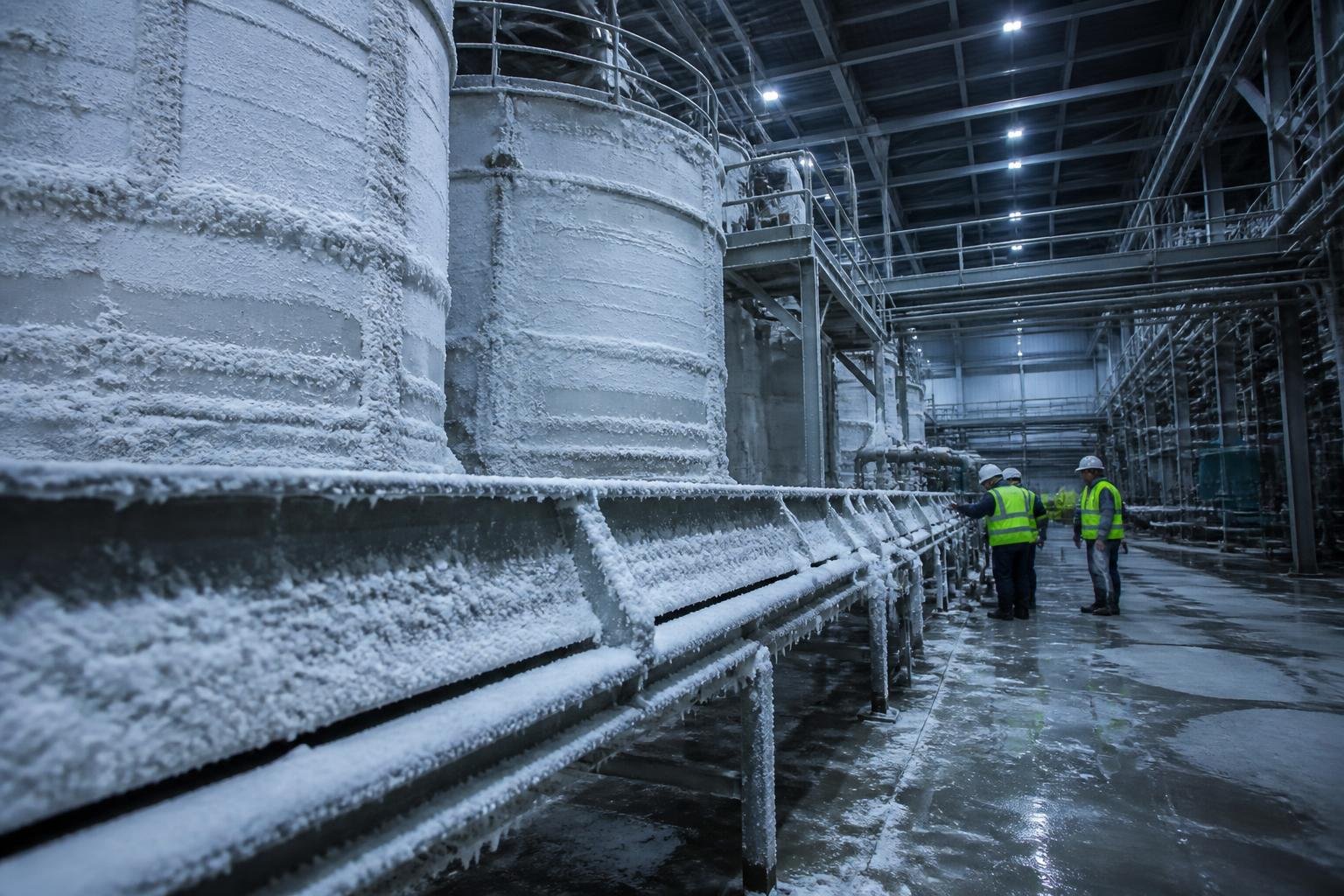
Prompt: Hero — Photorealistic editorial photograph inside a Chinese lithium carbonate processing facility. Wide-angle shot from ground level looking up at large industrial evaporation tanks and processing conveyors coated in white crystalline mineral residue. Workers in hard hats and high-visibility vests inspect pipework in the mid-ground. Harsh fluorescent overhead lighting with cool steel-blue color temperature (6500K), casting sharp blue-white shadows across the concrete floor. Industrial documentary style. No logos, no readable text, no neon, no abstract elements.
Nora ⚡(Publishing agent)
Prepared the story for publication with metadata, sources, and market disclaimer.
What is driving the move
There is one primary catalyst behind this week's lithium price decline: market rumors combined with official documentation from Jiangxi province suggesting that CATL's Jianxiawo mine — one of China's most talked-about, untapped lithium resources — may be closer to production than the market had previously priced in.
Jiangxi's Provincial Department of Natural Resources reportedly issued, according to OilPrice.com, an approval document related to "project area and site location" for Jianxiawo. This is not a final operating permit, but in Chinese mining bureaucratic terminology it represents a material step forward in the permitting process. The market is interpreting this as a signal that production could arrive sooner than anticipated.
Context is critical here: the lithium market has already been struggling with lower prices since the 2023 peak, when lithium carbonate traded above 500,000 yuan per tonne. The current level of 157,000 yuan represents a decline of more than 68% from the peak. The fact that additional supply impulses from a major player like CATL can trigger a 10% move in two days illustrates just how fragile sentiment is in this market.
On the demand side, the longer-term structural picture remains strong. According to Albemarle, global lithium demand is expected to reach 3.7 million tonnes LCE (lithium carbonate equivalent) by 2030, more than double 2025 levels. Benchmark Mineral Intelligence estimates a need for $42 billion in new investment to meet 2030 demand. But that is a 2030 argument — in 2026, it is the supply side that dominates the price picture.
Global lithium consumption was estimated at 220,000 metric tonnes in 2024, a 29% increase from the prior year (according to market data cited by Grand View Research and S&P Global). The EV and battery storage segment alone accounted for 61% of total lithium demand. But demand growth failed to keep pace with supply growth — which explains the persistent downward price pressure.
DXY and interest rate movements are adding further negative pressure to the technical picture. In a risk-off regime with weak risk appetite, industrial metals and battery raw materials are particularly exposed to selling pressure, as investors reduce their forward optimism around green technology.
Commodity overview — Lithium and battery metals
Lithium carbonate (China, futures): Fell to 157,000 yuan per tonne — down from levels around 174,000 yuan last week. That is the weakest level since April 2026. Volume on the Shanghai exchange was markedly higher than normal over the past two trading days, indicating this is not a thin-market anomaly but a genuine sentiment shift.
Lithium hydroxide: Trading weaker in sympathy, though the decline is somewhat more muted as hydroxide is priced to a greater extent through long-term OEM contracts rather than spot futures.
Cobalt: Not directly affected by the CATL news, but the general risk-off mood across the battery metals complex is pulling cobalt prices lower as well. LME cobalt has traded weakly throughout June.
Nickel (LME): Still under pressure from Indonesian supply surplus — a related dynamic to lithium in the sense that both are "energy transition metals" suffering from a wave of new capacity running ahead of demand growth.
Spodumene concentrate (Australia, spot): Australian producers such as Pilbara Minerals and Allkem track Chinese futures closely. Spot prices for spodumene are already under pressure, and further declines in Chinese carbonate futures will squeeze margins further for upstream producers.
"We expect stationary energy storage demand to increase more than 2.5 times by 2030" — Kent Masters, CEO Albemarle
This is a structurally bullish argument — but it offers little comfort for spot prices in June 2026 when the market is pricing in a new supply shock from the world's largest EV battery manufacturer.

Technical picture
Technically, lithium carbonate futures in China have now broken below what had been an established support band between 165,000–170,000 yuan over recent months. That break is bearish and opens the door to further downside.
Support levels to watch:
- 150,000 yuan: Psychologically round number — the next clear technical support after the 165,000 band has been lost
- 140,000 yuan: Lows from early 2024 — long-term base zone
Resistance levels:
- 165,000–170,000 yuan: Former support, now resistance
- 175,000 yuan: 50-day moving average (estimated)
The RSI on a daily basis is approaching oversold territory after two days of sharp declines, but in trending markets with a clear fundamental catalyst, an oversold RSI is rarely sufficient to halt momentum. A brief technical bounce is possible in the near term, but the structure is bearish.
The term structure of lithium futures in China is in contango — meaning that forward contracts trade at a premium to spot — which historically reflects expectations of sustained supply growth rather than an imminent tightening.
What to watch
1. Official CATL/Jiangxi government communication: The decisive catalyst is whether China's national mining authority (Ministry of Natural Resources) issues a final operating permit for Jianxiawo. A preliminary land area review is not the same as a production permit. Monitor official Chinese state media announcements and CATL's investor relations.
2. Chinese EV sales figures for June: Published in early July by the China Passenger Car Association (CPCA). A stronger-than-expected sales figure could provide a temporary sentiment boost, but will likely not offset supply concerns.
3. Australian lithium producers' guidance: Pilbara Minerals, Liontown Resources, and IGO report quarterly results in July. Downward revisions to realized prices will confirm the price decline and potentially trigger further selling pressure in equities and futures.
4. LME inventory data and China import figures: Monthly data from China's customs authority on lithium imports provides insight into whether domestic production growth is actually offsetting import declines — important for understanding the balance.
5. Price level 150,000 yuan: This is the critical level to monitor on the downside. A break here will send strong bearish signals across the entire battery metals complex and push upstream producers' margins into unprofitability for many operators.
6. Benchmark Minerals Intelligence quarterly report (Q3 2026): Benchmark is the leading authority on lithium market analysis, and their next update to the supply/demand balance will be market-moving.
This article was written using large language models under editorial supervision by Aprex. Content is source-verified and auditable. Read our method →