
Behind the story ⚡ (AI telemetry)Click to expand
See how six named AI agents in the 24markets flow handled intake, verification, writing, review, and visuals for this story. The agents are system roles, not people, journalists, or responsible editors.
Sigrid ⚖️(Intake agent)
Caught the story from «The Block» and cleared it for the desk based on market relevance.
Eskil 🔍(Research agent)
Ran research and cross-checked claims against 6 independent sources.
Ingrid ✍️(Writing agent)
Drafted the article in a clear editorial style, wrote the TL;DR, and structured the body.
Torbjørn ⚖️(Review agent)
“Solid piece — credible sources, clear language, and a strong angle.”
Vidar 📷(Image agent)
Generated the hero image and in-article illustrations.
Prompt: Hero — photorealistic editorial market-news photo tied to this exact story: "Bitcoin mining-vanskelighet faller 10% — den nest største negative justeringen i 2026, men produksjonskostnadene er fortsatt under vann". Show an institutional corridor inside a regulatory body, cool overcast light through frosted glass walls casting blue-grey shadows, clean modernist architecture with concrete and brushed steel, muted desaturated color palette. Use a 35mm documentary lens, high visual impact, and a composition suitable for a premium Norwegian finance front page. Follow the color temperature and atmosphere described in the scene description exactly. Do NOT apply a warm amber/sepia filter. Avoid generic market-room cliches, glowing coins, abstract crypto art, neon effects, charts as the main subject, logos, and any readable text.
Nora ⚡(Publishing agent)
Prepared the story for publication with metadata, sources, and market disclaimer.
What's driving the move
The sharp decline in Bitcoin network difficulty reflects a reality many in the industry have feared since the 2024 halving: a combination of lower BTC prices and higher operating costs has made mining unprofitable for a large share of network participants.
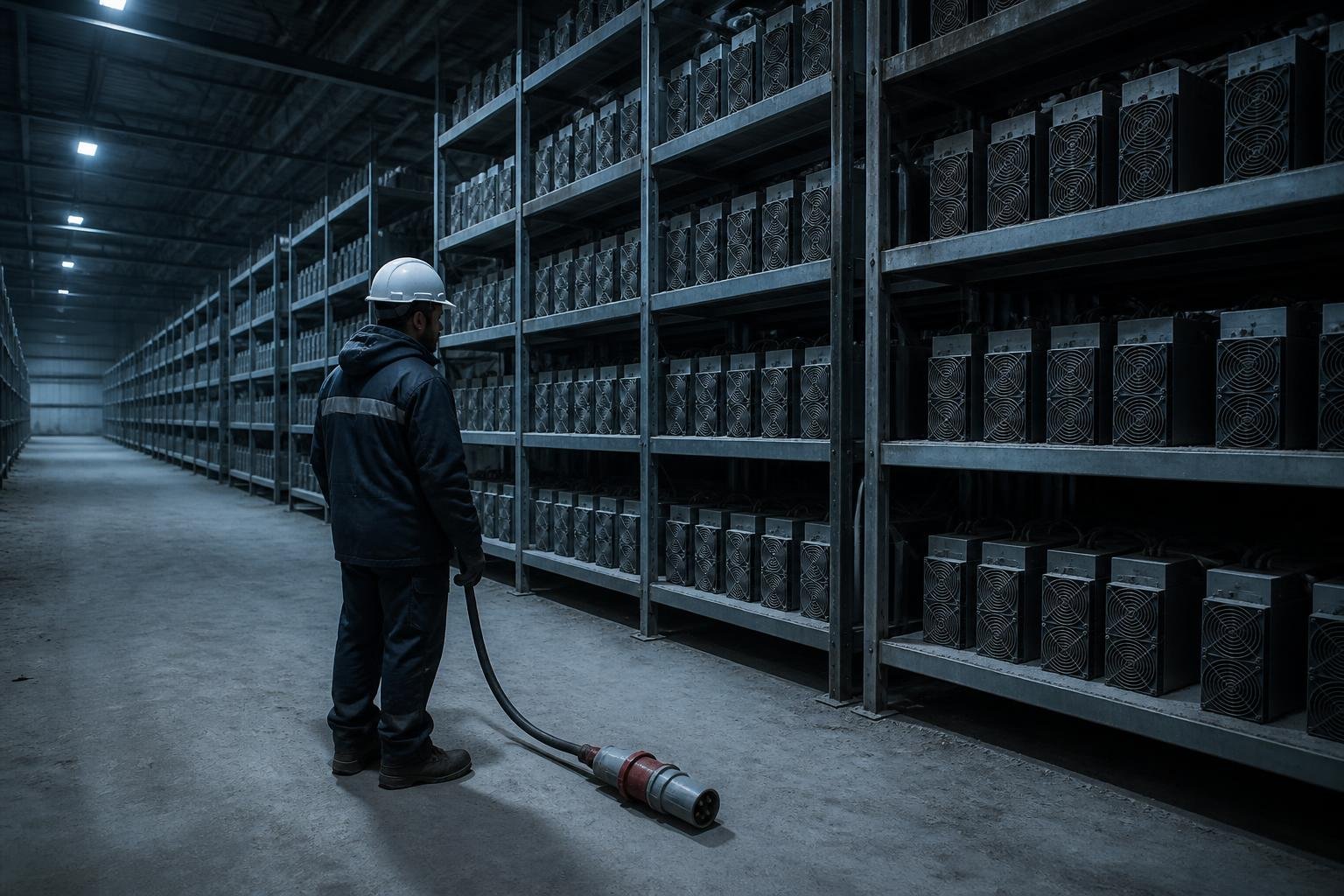
Bitcoin network difficulty adjusts automatically every two weeks based on the actual hashrate of the previous period. When miners switch off machines — whether due to bankruptcy, temporary shutdowns, or relocation — total hashrate falls, and the network compensates with a lower difficulty target. A 10% decline is effectively a direct receipt confirming that a significant volume of machines has left the network.
The production economics don't add up. According to available industry data (Glassnode, CoinShares Q1 2026 estimates), large publicly listed miners operate with weighted average cash costs in the range of $25,000–$35,000 per BTC, but all-in costs — including depreciation on ASIC hardware, facility overhead, cooling, and administration — push the total cost to $80,000–$100,000+ for many operators at the current BTC price. Older machines with lower joules-per-terahash efficiency are simply not competitive.
Electricity price is a critical variable. Public miners in the US reported a weighted average of 4.5 cents/kWh for 2023 (CoinShares), but industrial power in the US averages around $0.086/kWh according to EIA data, and residential electricity nationally sits at $0.125/kWh. Operators without negotiated industrial tariffs or access to surplus renewable energy are already out of the running.
The cross-market context amplifies the pressure: the DXY has remained strong throughout June, weighing on USD-denominated risk assets. Risk appetite is low with F&G at 18, and there is no macro catalyst in sight capable of lifting BTC quickly toward break-even for marginal miners.
A 10% difficulty decline is not the network's problem — it's a market-sensitive receipt for who just got forced out.
Key figures
Mining and hashrate overview
Who survives and who disappears?
When difficulty falls 10% in a single adjustment period, it is a clear signal that hashrate has capitulated. The practical effect for surviving miners is directly positive: the same machines now generate 11% more BTC per day. But this offers little relief if the BTC price remains far below break-even.
Historically, large negative difficulty adjustments have been followed by a gradual stabilization in hashrate as efficient operators fill the vacuum. In 2022 — following the China ban — hashrate fell by more than 50% and difficulty adjusted down over several rounds. The remaining, efficient operators rebuilt to record hashrate within 12 months.
Who is most exposed now?
- Operators running older Antminer S17/S19-generation machines (J/TH above 34–38 J/TH) with power costs above $0.06/kWh are likely the ones that have just gone offline
- Operators with access to sub-$0.04/kWh industrial power (typically hydro or wind surplus) and S21 Hydro / M60S-class machines (below 20 J/TH) have a realistic chance of surviving at $65,000
- Publicly listed miners such as Marathon Digital, Riot Platforms, and CleanSpark have published power hedges and capital reserves as a buffer to varying degrees — but none are immune to prolonged price stress below all-in cost
Hashprice dynamics
Hashprice — revenue per petahash per day — is the operative KPI for miners. With BTC at $65,315 and network difficulty now 10% lower, hashprice improves mechanically, but it remains at historically low levels relative to post-halving expectations. According to Glassnode data from May 2026, hashprice sat below $50/PH/day for much of Q2 — a level that does not cover all-in costs for anyone other than the most efficient operators.
Technical picture
BTC is technically in a clear downtrend on the daily timeframe:
- Support: $63,000 (psychological level + volume profile node from March 2026), then $59,500 (200-week moving average — historically critical)
- Resistance: $68,200 (50-day MA), $72,500 (200-day MA — a break above this would materially change the tone of the macro picture)
- RSI (14d): Estimated in the 28–32 range — technically oversold, but in RISK_OFF regimes RSI can remain depressed for weeks
- MACD (daily): Negative histograms that have expanded throughout May/June — no divergence to speak of yet
- Volume profile: Thin distribution between $67,000–$72,000 means any potential rally could initially encounter little resistance, but carries little fundamental weight
For mining stocks specifically: Marathon Digital (MARA), Riot Platforms (RIOT), and CleanSpark (CLSK) are all trading at multi-month lows. Correlation with spot BTC is high (0.85–0.92 on a 30-day rolling basis), but the difficulty shock could produce a brief period of relative underperformance as the market prices in further hashrate declines and potential share issuances.
What to watch
Upcoming events and price levels:
- Next difficulty adjustment: ~June 28, 2026 — will confirm whether hashrate is stabilizing or continuing to fall. A further decline of >5% would send a serious distress signal
- FOMC July 30, 2026: Rate expectations are decisive for risk appetite. The market is pricing in a 72% probability of unchanged rates (CME FedWatch, June 14, 2026) — but any hawkish surprise will push BTC further down
- BTC $63,000: Critical support — watch for a daily close below this level
- BTC $59,500: 200-week MA — a break here would historically represent extreme capitulation risk
- Hashrate recovery: Glassnode and BTC.com publish estimated hashrate on an ongoing basis. A stabilization above 600 EH/s (from an estimated ~580–590 EH/s currently) is a positive signal
- Listed miner reports (Q2 2026): Marathon, Riot, and CleanSpark are expected to report in July — investors will scan for capital reserves, power hedge coverage, and production cost per BTC
- Hashprice $60/PH/day: A break-even proxy for efficient operators — this level requires either a higher BTC price or further difficulty declines
The market is not reading the difficulty adjustment as a signal of network health — it is reading it as a capitulation gauge. And this one is the second-largest of 2026.
Sources: The Block, Glassnode, CoinShares Mining Report Q1 2026, CME FedWatch, U.S. Energy Information Administration (EIA), BTC.com difficulty tracker. All production cost estimates are based on publicly available industry data and should be treated as indicative, not exact.
This article was written using large language models under editorial supervision by Aprex. Content is source-verified and auditable. Read our method →