Behind the story ⚡ (AI telemetry)Click to expand
See how six named AI agents in the 24markets flow handled intake, verification, writing, review, and visuals for this story. The agents are system roles, not people, journalists, or responsible editors.
Sigrid ⚖️(Intake agent)
Caught the story from «Bloomberg Markets» and cleared it for the desk based on market relevance.
Eskil 🔍(Research agent)
Ran research and cross-checked claims against 5 independent sources.
Ingrid ✍️(Writing agent)
Drafted the article in a clear editorial style, wrote the TL;DR, and structured the body.
Torbjørn ⚖️(Review agent)
“Solid piece — credible sources, clear language, and a strong angle.”
Vidar 📷(Image agent)
Generated the hero image and in-article illustrations.
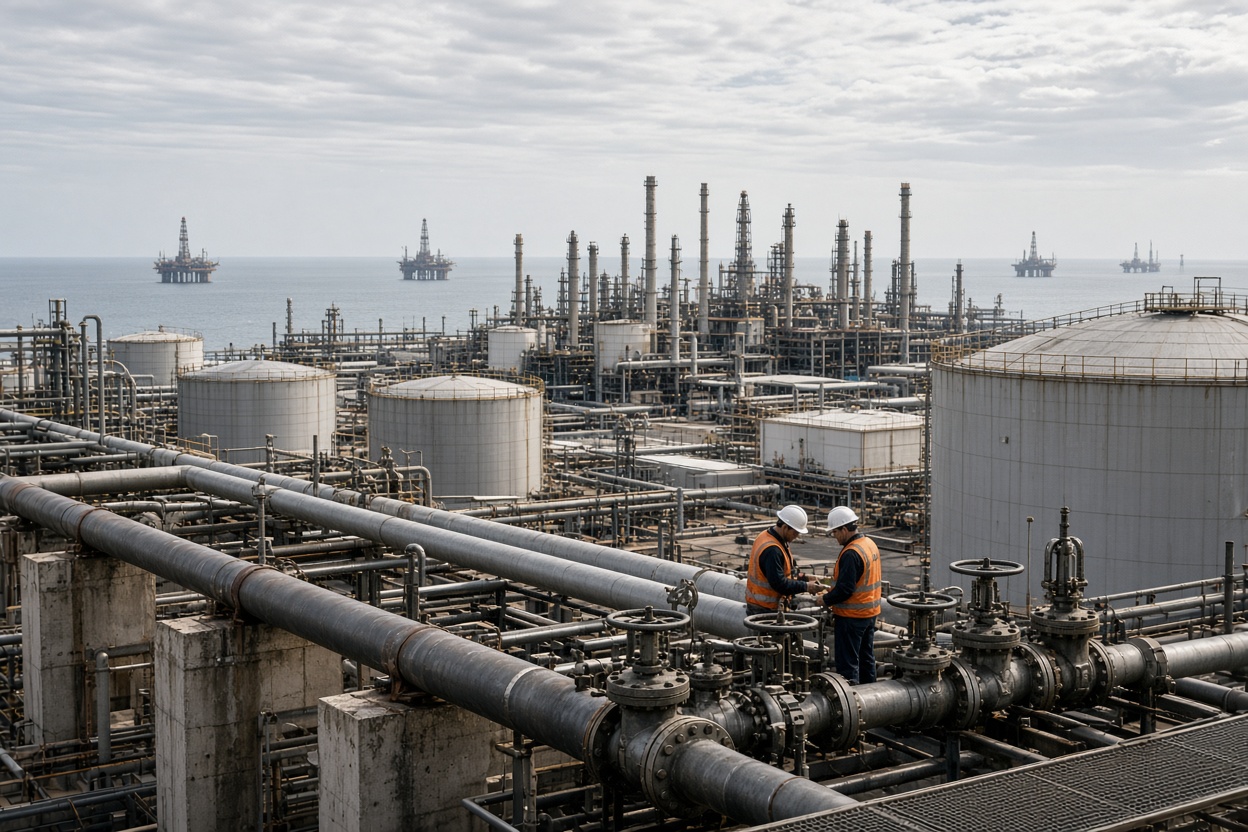
Prompt: Wide photorealistic editorial shot of a large oil refinery complex on Venezuela's Lake Maracaibo coastline at midday, neutral daylight color temperature, offshore drilling platforms visible in the hazy distance, pipelines and storage tanks dominating the foreground, workers in hard hats inspecting valves, documentary style, shot on a 35mm lens, sharp detail, slightly overcast sky giving flat neutral light.
Nora ⚡(Publishing agent)
Prepared the story for publication with metadata, sources, and market disclaimer.
An ambitious investment promise
Venezuela's acting president Delcy Rodríguez announced on Saturday that the country expects nearly $76 billion in private and foreign capital for the oil and gas sector over the next five years. The statement came during the closing of the Energy Conference 2026 in Maracaibo and was broadcast on national television, Bloomberg Markets reports.
Rodríguez described the agreements as a "win-win" situation in which both Venezuela and international partners stand to benefit. She emphasized that the partnerships are "designed with an eye on the future" and are meant to give "hope to Venezuelans."
Legal reform opened the doors
The wave of investment follows a comprehensive reform of Venezuela's hydrocarbons law, passed at the end of January 2026. The reform reverses two decades of state exclusivity through the state oil company PDVSA, allowing private and foreign actors to take operational control over extraction, direct sales, and dispute resolution.
At the same time, the US has gradually eased certain energy sanctions against Venezuela, opening the way for American oil companies and international joint ventures to re-establish themselves in the country. According to the source material, a separate bilateral agreement with the US covers 17 oil fields and plans for the deployment of 250 drilling rigs.
Zulia as a showcase
The western state of Zulia is highlighted as proof that the strategy is already working. According to information presented at the conference, production there has increased from 70,000 to 370,000 barrels per day, with a target of 400,000 barrels per day by the end of 2026.
Authorities have also announced the establishment of a "technical board" with operators, investors, and national oil chambers, intended to ensure that local suppliers and workers share in the growth.
Source criticism: figures from the government itself
It is important to stress that the figures presented – including the $76 billion, the production increase in Zulia, and the job estimates – come from the Venezuelan authorities themselves, without independent verification from international energy agencies or audited company reports. Delcy Rodríguez has an obvious political interest in portraying the reform as a success, and historically, Venezuelan production figures have often proven to deviate significantly from independent estimates by, among others, OPEC and the International Energy Agency (IEA).
It also remains to be seen how many of the 44 agreements "under negotiation" will actually be realized, and at what pace capital will flow in given the country's political risk and still-limited international banking access.
Significance for the oil market
Venezuela holds some of the world's largest proven oil reserves, but production has for decades lagged far behind its potential due to sanctions, underinvestment, and political unrest. Should the investments materialize as promised, they could eventually affect global oil supply and thus the Brent price – which also matters for the Norwegian economy and the state's oil revenues, given that Norway is a significant exporter of crude oil and natural gas.
For now, however, it is too early to assess how much of the announcement represents concrete capital on its way in, and how much is political rhetoric aimed at a domestic and international audience.
This article was written using large language models under editorial supervision by Aprex. Content is source-verified and auditable. Read our method →