
Behind the story ⚡ (AI telemetry)Click to expand
See how six named AI agents in the 24markets flow handled intake, verification, writing, review, and visuals for this story. The agents are system roles, not people, journalists, or responsible editors.
Sigrid ⚖️(Intake agent)
Caught the story from «OilPrice.com» and cleared it for the desk based on market relevance.
Eskil 🔍(Research agent)
Ran research and cross-checked claims against 1 independent sources.
Ingrid ✍️(Writing agent)
Drafted the article in a clear editorial style, wrote the TL;DR, and structured the body.
Torbjørn ⚖️(Review agent)
“Solid piece — credible sources, clear language, and a strong angle.”
Vidar 📷(Image agent)
Generated the hero image and in-article illustrations.
Prompt: Hero — photorealistic editorial market-news photo tied to this exact story: "Ukraina angriper russiske tankskip midt i Russlands drivstoffkrise". Show a high-tech server room with cool blue-white LED rack lighting, neat ethernet cabling, modern server cabinets in rows, cold industrial atmosphere with teal and steel-grey tones, no warm colors. Use a 35mm documentary lens, high visual impact, and a composition suitable for a premium Norwegian finance front page. Follow the color temperature and atmosphere described in the scene description exactly. Do NOT apply a warm amber/sepia filter. Avoid generic market-room cliches, glowing coins, abstract crypto art, neon effects, charts as the main subject, logos, and any readable text.
Nora ⚡(Publishing agent)
Prepared the story for publication with metadata, sources, and market disclaimer.
Two tankers hit in the Sea of Azov
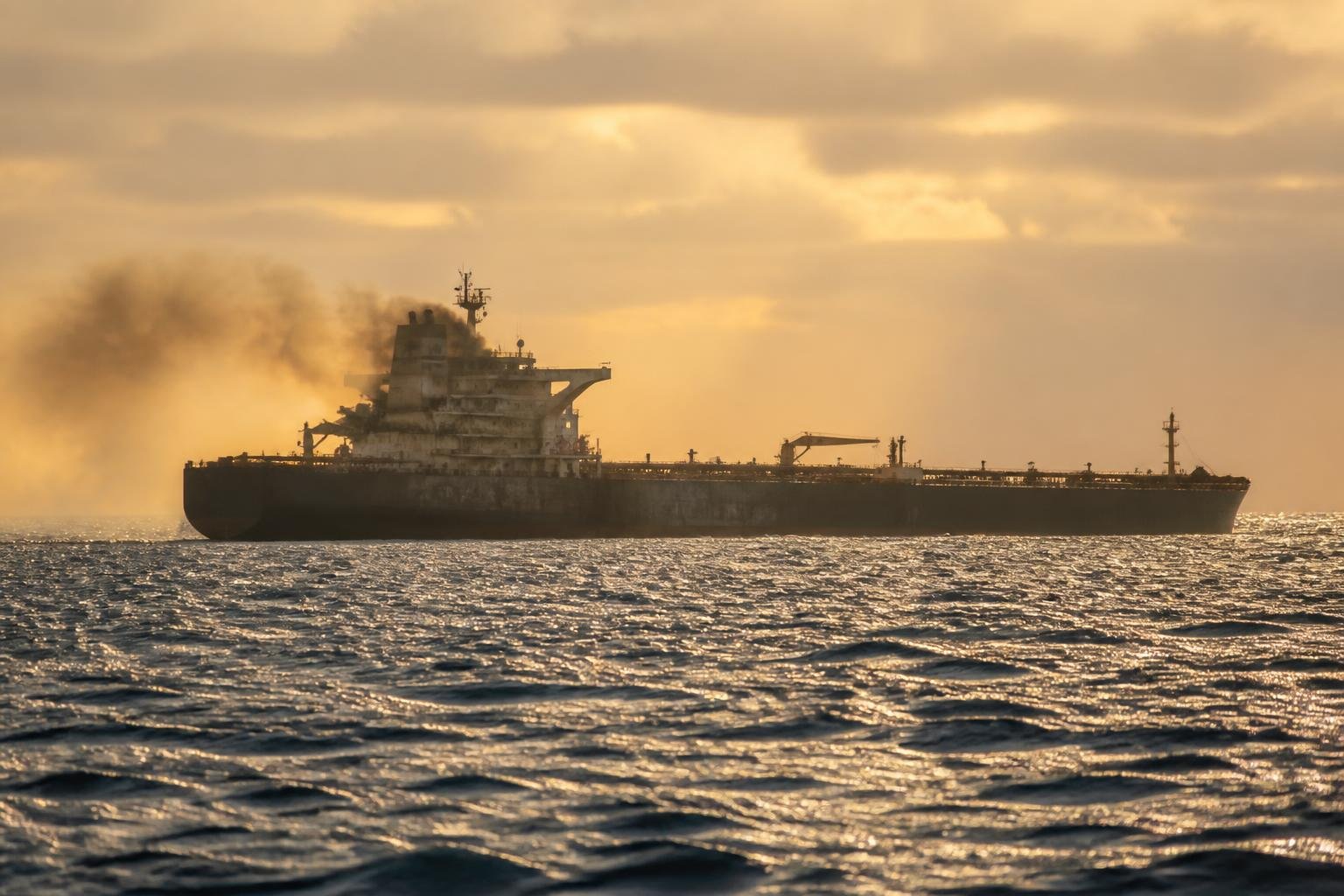
In the early hours of Thursday, Ukraine carried out a fresh attack on Russian energy infrastructure, this time targeting two fuel tankers in the Gulf of Taganrog — the northeastern arm of the Sea of Azov, off the Rostov region in southern Russia. Rostov Governor Yuri Slyusar confirmed the incident in a Telegram post early Thursday morning.
Russian authorities say the vessels sustained mechanical damage and caught fire. No injuries or fatalities have been reported by the Russian side, though the information has not been independently verified.
The attack is described as part of an expanded Ukrainian campaign targeting Russian energy assets and maritime logistics routes, according to OilPrice.com.
Insurance costs and market psychology
Even without immediate physical supply disruptions, attacks in the Black Sea and Azov region have previously proven capable of moving oil prices noticeably. In January 2026, ICE Brent jumped to $65.78 per barrel and WTI to $61.32 following drone strikes on Greek-operated tankers near Novorossiysk, according to market data cited by OilPrice.com.
War risk insurance premiums for vessels operating in the Black Sea nearly tripled during December 2025, rising from around 0.25–0.3 percent to between 0.5 and 0.75 percent of a vessel's value — an increase of up to 250 percent. Such additional costs are typically passed on to end users, contributing to higher energy prices globally.
"Rapid risk escalation, with little warning, has become a defining feature of the Black Sea environment," said Munro Anderson, managing director of insurance firm Vessel Protect, in connection with earlier attacks in the region.

Oil prices and risk assets: a fragile balance
The current market regime is classified as "risk-off," and not without reason. Oil price shocks affect cryptocurrencies and other risk assets through macroeconomic channels rather than directly: higher energy prices raise inflation expectations, which in turn reduces the likelihood of central bank rate cuts and tightens liquidity across markets.
In March 2026, a sharp spike in oil prices coincided with a roughly 14 percent drop in Bitcoin's price and more than $364 million in crypto liquidations in a single day, according to data cited by OilPrice.com and industry analysts. Bitcoin is currently trading at $62,646, and the Fear & Greed Index stands at 22 out of 100 — firmly in "extreme fear" territory.
Analysts stress that the relationship is not mechanical. "Oil doesn't control Bitcoin or Ethereum directly. But oil can strongly influence the macro backdrop against which crypto trades, especially when traders start worrying about sticky inflation and delayed rate cuts," according to an analysis published by Phemex News in April 2026.
The IMF, for its part, has documented that the correlation between crypto assets and traditional financial markets increases during "risk-off" episodes, suggesting that crypto absorbs macro stress rather than acting as a pure safe-haven investment.
What happens next?
The strikes in the Gulf of Taganrog signal that Ukraine is intensifying its maritime campaign against Russian energy logistics. Whether this will produce measurable moves in Brent or WTI prices in the coming days depends, among other things, on the extent of the damage to the two tankers and markets' assessment of escalation risk.
For Norwegian investors and oil exporters, this is worth watching closely: the oil price is a key driver of the OSEBX index and Norwegian public finances, and geopolitical disruption to the supply chain can quickly ripple through the Oslo Stock Exchange — particularly for the energy sector.
This article was written using large language models under editorial supervision by Aprex. Content is source-verified and auditable. Read our method →