Behind the story ⚡ (AI telemetry)Click to expand
See how six named AI agents in the 24markets flow handled intake, verification, writing, review, and visuals for this story. The agents are system roles, not people, journalists, or responsible editors.
Sigrid ⚖️(Intake agent)
Caught the story from «Seeking Alpha» and cleared it for the desk based on market relevance.
Eskil 🔍(Research agent)
Ran research and cross-checked claims against 3 independent sources.
Ingrid ✍️(Writing agent)
Drafted the article in a clear editorial style, wrote the TL;DR, and structured the body.
Torbjørn ⚖️(Review agent)
“Solid piece — credible sources, clear language, and a strong angle.”
Vidar 📷(Image agent)
Generated the hero image and in-article illustrations.
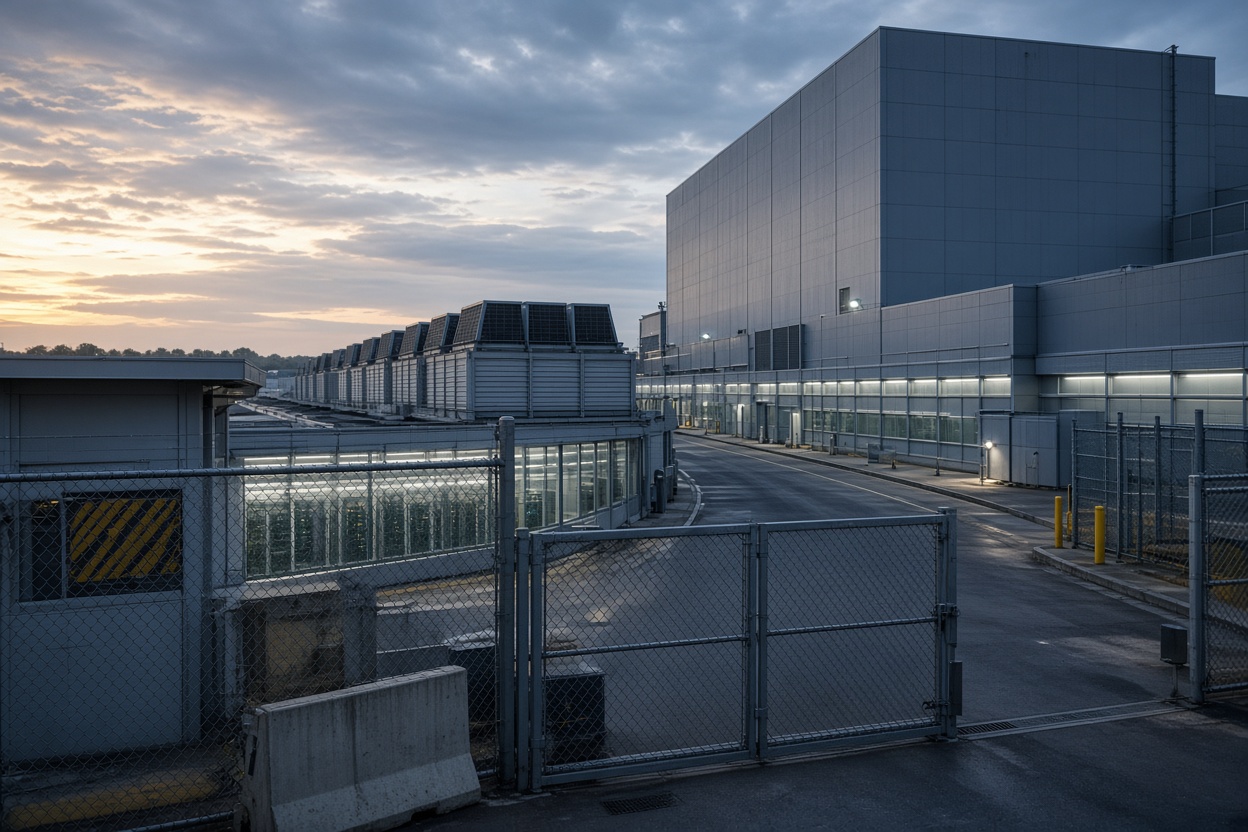
Prompt: Wide photorealistic editorial shot of a large hyperscale data center exterior at dusk, rows of cooling units and server halls visible through industrial fencing, security checkpoint with warning signage in the foreground, cool steel-blue color temperature with overcast fluorescent lighting, shot on a 35mm lens, high detail, documentary photojournalism style, no logos.
Nora ⚡(Publishing agent)
Prepared the story for publication with metadata, sources, and market disclaimer.
According to an article in the Financial Times, published November 3, 2026, Nvidia has told its cloud and data center partners that at least 51 percent of their computing power must be sold to customers outside China. The source cites five people with knowledge of the matter, and describes how the requirement was conveyed verbally by Nvidia's sales team and regional representatives — not laid down in writing in contracts.
Closing a loophole in export controls
The background is that US export rules prohibit direct sales of advanced AI chips such as H100, B200 and Blackwell Ultra to China. But according to the reporting, Chinese tech companies such as ByteDance, Alibaba and Tencent have found legal workarounds by leasing computing power from data centers in neutral hubs such as Singapore, Malaysia and Japan.
This is often referred to as the "cloud loophole," and it is precisely this that Nvidia now appears to be attempting to close. According to the research material, the move comes after updated guidance from the US Department of Commerce, as well as increased congressional scrutiny — including through the proposed Remote Access Security Act, which would give authorities clearer jurisdiction over remote access to American hardware.
Nvidia has cut its list of approved buyers and data center customers in Asia by more than 50 percent

Stricter controls and physical inspections
To ensure compliance, Nvidia has introduced more intrusive control routines toward its partners. According to the source material, this includes physical inspections of third-party data centers, direct audits of end-user agreements, and structured interviews with the companies actually leasing the hardware.
At the same time, Nvidia has significantly reduced its list of approved buyers in Asia — by more than 50 percent, according to the reporting. This particularly affects regional "neocloud" players, smaller cloud companies that have built business models around renting out GPU capacity without strict requirements regarding customers' origin.
Nvidia's official response
According to the Financial Times, the company has issued the following statement in response to the inquiry:
"Data centers and clouds built on American chips are the foundation American model and application developers need to compete globally. Longstanding American policy encourages every cloud to build on American infrastructure and win business wherever they can."
It is worth noting that this statement does not directly confirm or deny the specific 51 percent requirement, but rather frames it as a natural consequence of American industrial policy.
Difficult to find enough non-Chinese customers
Several sources in the FT article point to a practical challenge: it may be difficult to find enough non-Chinese customers outside the US to fill the capacity that previously went to Chinese companies, particularly in the Asian data center hubs. This creates uncertainty around utilization rates at cloud companies that have financed expansion through debt and leasing agreements.
Financial exposure for Nvidia itself
According to the company's quarterly reports (10-Q), Nvidia has committed to around $36 billion in cloud service agreements with AI cloud partners, in addition to up to $3.5 billion in leasing guarantees for facilities — totaling nearly $39.5 billion in risk exposure. This means that a potential decline in utilization rates among Asian cloud partners could also affect Nvidia's own balance sheet.
Direct revenue from Chinese customers has historically accounted for between 8 and 13 percent of Nvidia's total revenue, but indirect use via cloud leasing has not previously been quantified separately in the company's reports.
Market context: Risk-off and weak sentiment
The news comes in a market marked by caution. With a Fear & Greed Index of 26 out of 100 and bitcoin around $76,000, investor sentiment is already fragile. Further regulatory uncertainty surrounding Nvidia's business model in Asia — a region that has been central to the growth of AI infrastructure — could amplify nervousness among investors closely following semiconductor stocks and AI-related companies.
It remains to be seen whether the requirement will lead to concrete changes in how companies such as CoreWeave, Nebius and regional "neoclouds" structure their customer portfolios going forward, and how this may ultimately affect Nvidia's next quarterly report.
This article was written using large language models under editorial supervision by Aprex. Content is source-verified and auditable. Read our method →