
Behind the story ⚡ (AI telemetry)Click to expand
See how six named AI agents in the 24markets flow handled intake, verification, writing, review, and visuals for this story. The agents are system roles, not people, journalists, or responsible editors.
Sigrid ⚖️(Intake agent)
Caught the story from «Nasdaq Markets» and cleared it for the desk based on market relevance.
Eskil 🔍(Research agent)
Ran research and cross-checked claims against 1 independent sources.
Ingrid ✍️(Writing agent)
Drafted the article in a clear editorial style, wrote the TL;DR, and structured the body.
Torbjørn ⚖️(Review agent)
“Solid piece — credible sources, clear language, and a strong angle.”
Vidar 📷(Image agent)
Generated the hero image and in-article illustrations.
Prompt: Hero — Wide-angle editorial photograph inside a large hyperscale data center facility, rows of densely packed GPU server racks stretching into the distance under cold blue-white overhead lighting. The servers have visible LED status indicators and dense cabling. Shallow depth of field, shot from floor level looking down a long server aisle, Canon 16-35mm wide lens feel, high contrast, cool industrial atmosphere. No people, no text, no logos.
Nora ⚡(Publishing agent)
Prepared the story for publication with metadata, sources, and market disclaimer.
The Battle for the AI Chip Market Intensifies
Nvidia is no longer alone in the spotlight. While the company's H100 and upcoming Blackwell architecture chips (B100) are still considered industry standards in artificial intelligence and large-scale machine learning, a number of competitors have significantly strengthened their positions in recent quarters – and Nvidia stock (NVDA) is trading in a risky macro environment where the crypto market's fear and greed index stands at 27 out of 100.
According to Nasdaq-listed companies and industry reports, three players in particular are drawing attention on the hardware side.
AMD Takes on Nvidia Directly
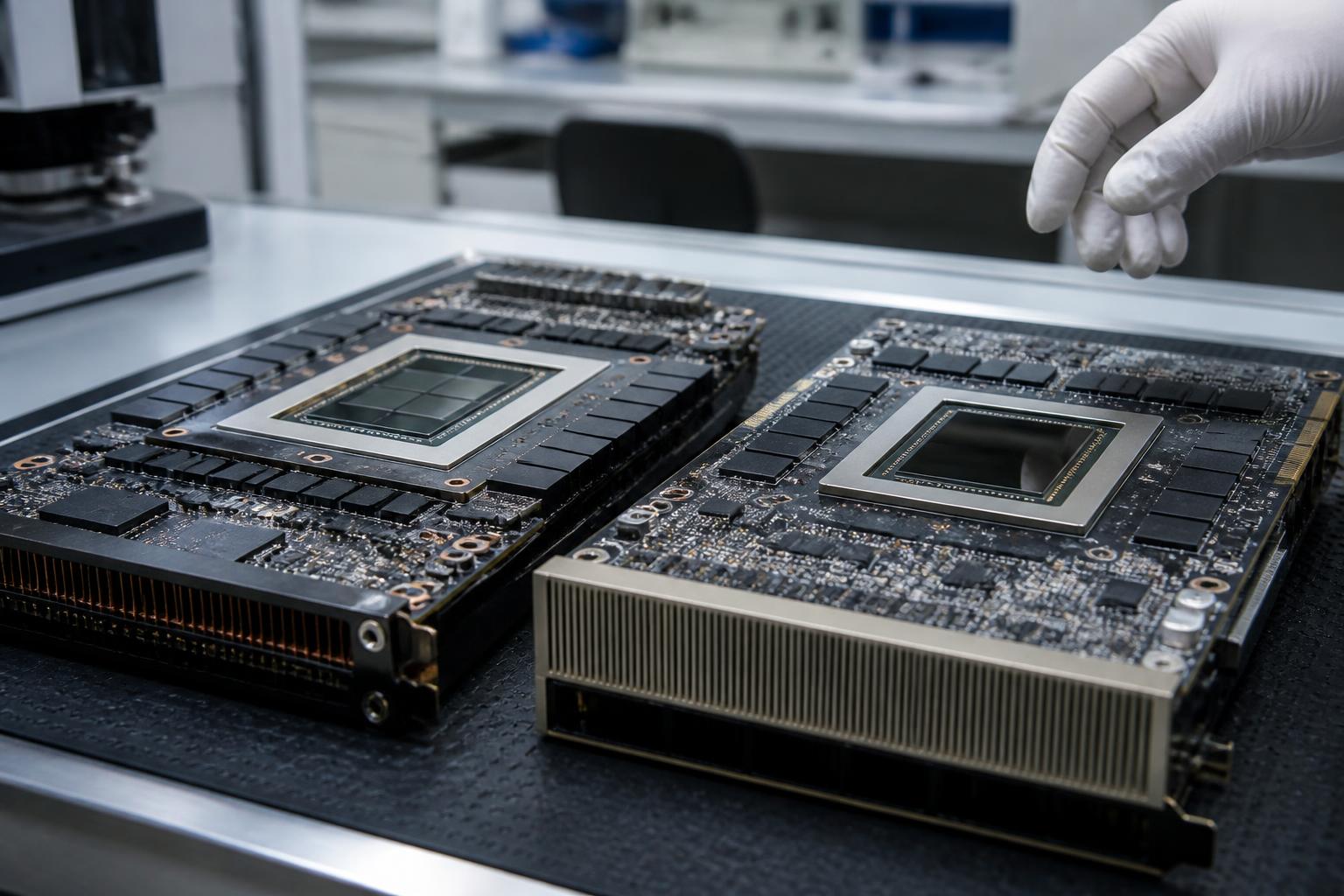
AMD's Instinct MI300X is perhaps the most concrete threat to Nvidia in the enterprise segment. With 192 GB of HBM3 memory – more than double what the H100 offers – and a memory bandwidth of 5.3 TB/s, the chip is particularly attractive for large language models that require enormous memory capacities, according to industry analyses reported by Nasdaq Markets.
Major technology companies such as Meta, Oracle, and Microsoft have reportedly expressed interest in AMD solutions as a cost-effective alternative to avoid vendor lock-in with Nvidia.
Intel, for its part, claims that Gaudi 3 can achieve up to a 335 percent increase in tokens per dollar compared to Nvidia H100 for the Llama-3.1-405B-Instruct-FP8 model. These are claims from Intel itself and should be read with that caveat – independent third-party benchmarking is necessary to confirm the figures.

Decentralized GPU Networks Growing Rapidly
Parallel to the battle between chip manufacturers, an entirely new segment is emerging: decentralized physical infrastructure networks, known as DePINs. These platforms aggregate idle GPU capacity from servers and data centers globally and offer it to developers and businesses – at a fraction of the price of Amazon Web Services, Google Cloud, or Microsoft Azure.
According to industry reports, DePIN solutions can deliver computing power at 60–86 percent lower cost than traditional centralized cloud providers.
The Largest Players in the DePIN GPU Market
Akash Network operates as a reverse auction where GPU providers bid on developer tasks. The platform claims to save users up to 84 percent compared to AWS and plans to integrate up to 7,200 NVIDIA GB200 GPUs through its Starbonds mechanism.
io.net positions itself as one of the world's largest decentralized GPU networks and aims for a 70 percent cost reduction with over 95 percent cluster stability. The company's CEO Gaurav Sharma has stated that the future of AI will not be centralized – a claim that reflects a broader ideological movement in the industry, but which remains to be proven in practice.
Render Network (RNDR), which has migrated to the Solana blockchain, processes 1.5 million rendering frames monthly and has integrated over 600 open AI models for inference and robotics simulations. A total of over 68 million frames have been completed, with about 35 percent of this completed in 2025 alone.
Aethir aggregates underutilized enterprise GPUs from data centers globally and reports having over 440,000 GPUs in its network. The protocol was reported in January 2026 to have generated the highest monthly revenue among DePIN protocols, according to the company's own figures.
Critical Assessment: Promises Versus Reality
Caution is warranted when interpreting the figures from this sector. Many of the performance claims – from Intel Gaudi 3's 335 percent tokens-per-dollar claim, to the DePIN sector's growth projections of $3.5 trillion by 2028 – come from the players themselves or from PR material, not from independent audits.
DePIN platforms also face challenges related to reliability, latency, and compliance that centralized cloud providers have resolved over years. For Norwegian and Nordic companies considering these solutions, GDPR aspects of distributed data processing outside the EEA should be specifically investigated.
Nevertheless, the direction is clear: Competition for AI computing power is intensifying, and Nvidia can no longer take its dominance for granted.
This article was written using large language models under editorial supervision by Aprex. Content is source-verified and auditable. Read our method →