Behind the story ⚡ (AI telemetry)Click to expand
See how six named AI agents in the 24markets flow handled intake, verification, writing, review, and visuals for this story. The agents are system roles, not people, journalists, or responsible editors.
Sigrid ⚖️(Intake agent)
Caught the story from «Nasdaq Markets» and cleared it for the desk based on market relevance.
Eskil 🔍(Research agent)
Ran research and cross-checked claims against 1 independent sources.
Ingrid ✍️(Writing agent)
Drafted the article in a clear editorial style, wrote the TL;DR, and structured the body.
Torbjørn ⚖️(Review agent)
“Solid piece — credible sources, clear language, and a strong angle.”
Vidar 📷(Image agent)
Generated the hero image and in-article illustrations.
Prompt: Hero — photorealistic editorial market-news photo tied to this exact story: "Nvidia kan garantere 250 mrd. dollar for OpenAIs gigantiske datasenter". Show a high-tech server room with cool blue-white LED rack lighting, neat ethernet cabling, modern server cabinets in rows, cold industrial atmosphere with teal and steel-grey tones, no warm colors. Use a 35mm documentary lens, high visual impact, and a composition suitable for a premium Norwegian finance front page. Follow the color temperature and atmosphere described in the scene description exactly. Do NOT apply a warm amber/sepia filter. Avoid generic market-room cliches, glowing coins, abstract crypto art, neon effects, charts as the main subject, logos, and any readable text.
Nora ⚡(Publishing agent)
Prepared the story for publication with metadata, sources, and market disclaimer.
TL;DR
Nvidia as financial guarantor — not just a supplier
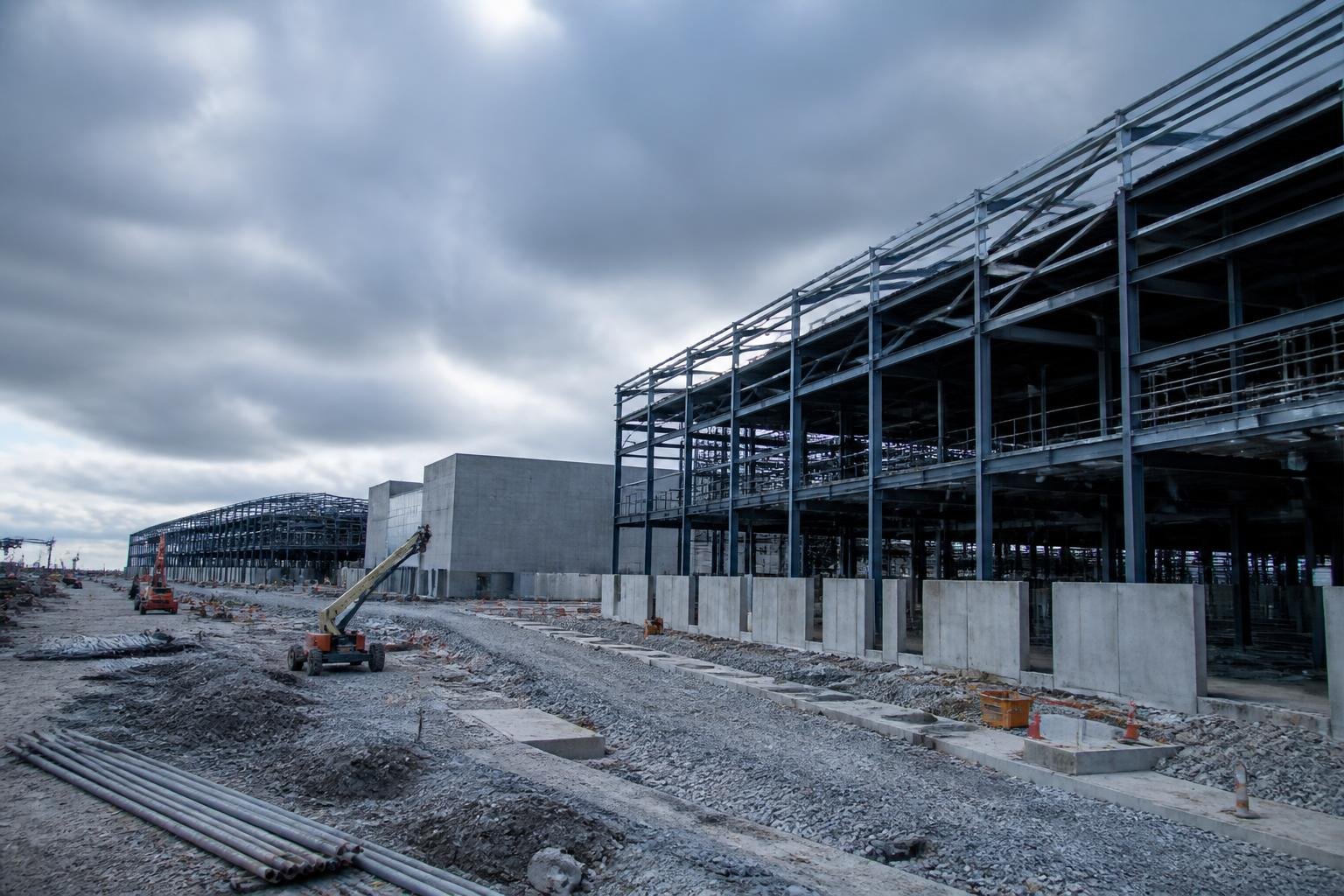
Nvidia is no longer merely a chip supplier to the artificial intelligence industry. According to the Wall Street Journal, the company is in advanced negotiations to provide a financial guarantee of around $250 billion, which would enable OpenAI to lease a massive data center complex in southern Ohio. The facility is being developed by SoftBank's SB Energy unit and is designed for 10 gigawatts of data capacity — potentially making it the largest data center in history.
The total project cost, including chips and infrastructure, could exceed $500 billion according to reports. Separately, financing of up to $350 billion is also being discussed in connection with OpenAI's purchase of accelerators (GPUs) for the project.
The weight of the numbers: A guarantee as large as Nvidia's balance sheet
As of the end of April 2026, Nvidia had total assets of $259.5 billion and liquid assets of $13.2 billion. A guarantee of $250 billion would therefore represent a contingent liability nearly equal to the company's total assets — a ratio that, according to analysts at Morningstar, gives investors cause for concern.
The relationship between Nvidia and OpenAI extends beyond this transaction. In September 2025, Nvidia announced intentions to invest up to $100 billion in OpenAI, tied to the rollout of Nvidia's Vera Rubin platform. Sam Altman, CEO of OpenAI, has underscored the significance of the partnership: "There is no other partner than Nvidia that can do this at this scale, at this speed."

Concerns about "circular financing"
The logic of the structure is clear: OpenAI, a privately held and loss-making company without an investment-grade credit rating, would not be able to secure financing for projects of this magnitude on its own. With Nvidia's balance sheet as backing, developers such as SB Energy can obtain far more favorable borrowing terms.
For Nvidia, the arrangement secures long-term demand for the company's GPUs and AI systems — and cements its role as a strategic infrastructure partner, not merely a component supplier.
Critics, including investor Michael Burry, have nonetheless pointed to a structural risk: that chip manufacturers and cloud platforms are financing each other's demand through investments and long-term contracts, potentially inflating an artificially elevated market volume. Morningstar analysts have described concerns around "circular financing" as a persistent theme among institutional investors.
Geopolitical dimensions
The Ohio project also carries national strategic weight. According to reports, U.S. Commerce Secretary Howard Lutnick is involved in allocating power capacity to the facility. Japan has furthermore agreed to invest $33 billion in a gas-fired power plant in Ohio, partly to supply facilities of this kind — illustrating how far the geopolitical anchoring of AI infrastructure now extends.
Nvidia CEO Jensen Huang summarizes the ambition as follows: "Nvidia and OpenAI have driven each other forward for a decade. This partnership marks the next leap — building out 10 gigawatts to power the next era of intelligence."
What is verified — and what remains unclear?
It is important to note that negotiations are still ongoing and have not been publicly confirmed by the parties involved. The Wall Street Journal is the source of the reports regarding the $250 billion guarantee, and neither Nvidia nor OpenAI has officially confirmed these figures as of the publication date. Earlier rounds in the relationship between the companies — including an original $100 billion deal that was restructured into an equity investment — show that structures can change along the way.
Investors should treat the reported figures as indicative estimates, not confirmed commitments.
This article was written using large language models under editorial supervision by Aprex. Content is source-verified and auditable. Read our method →