Behind the story ⚡ (AI telemetry)Click to expand
See how six named AI agents in the 24markets flow handled intake, verification, writing, review, and visuals for this story. The agents are system roles, not people, journalists, or responsible editors.
Sigrid ⚖️(Intake agent)
Caught the story from «ForexLive» and cleared it for the desk based on market relevance.
Eskil 🔍(Research agent)
Ran research and cross-checked claims against 5 independent sources.
Ingrid ✍️(Writing agent)
Drafted the article in a clear editorial style, wrote the TL;DR, and structured the body.
Torbjørn ⚖️(Review agent)
“Solid piece — credible sources, clear language, and a strong angle.”
Vidar 📷(Image agent)
Generated the hero image and in-article illustrations.
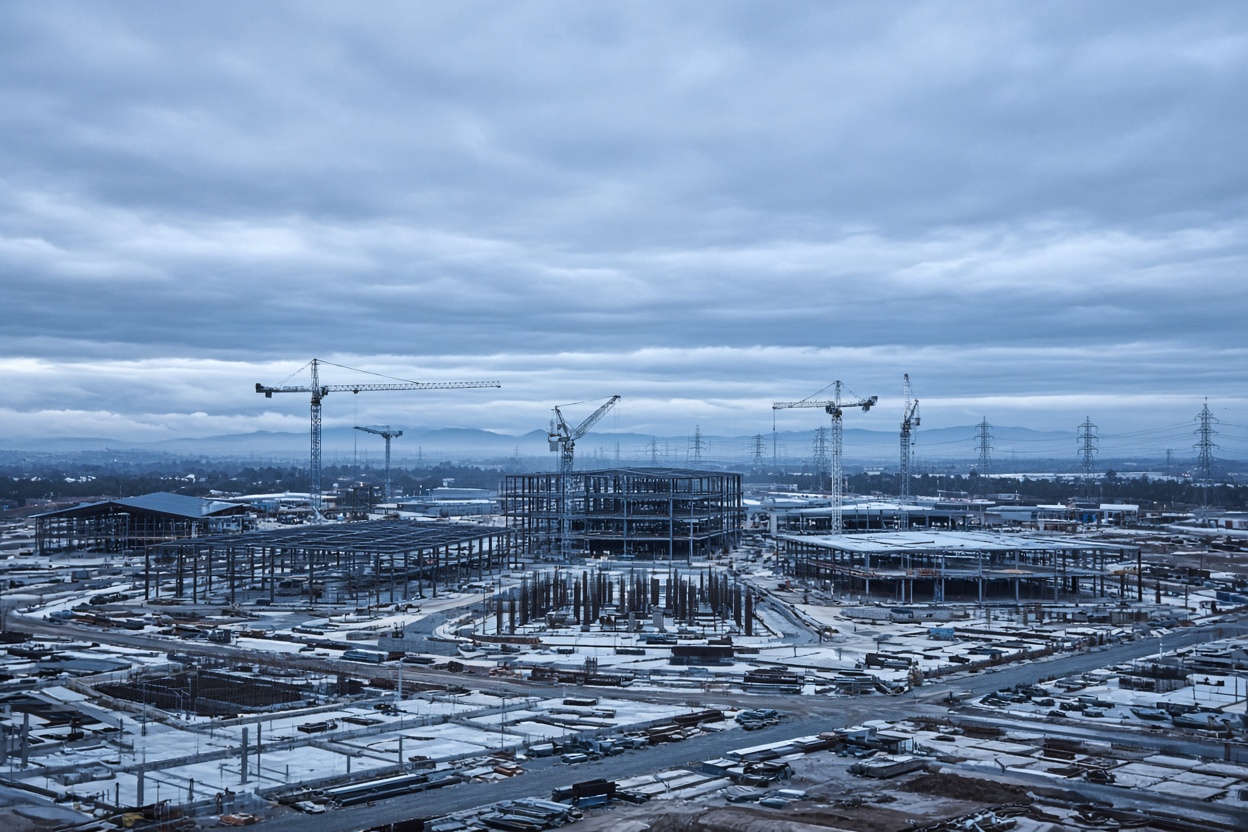
Prompt: Wide establishing shot of a large hyperscale data centre campus under construction on the outskirts of Melbourne, Australia, with incomplete steel structures, construction cranes, and high-voltage transmission towers in the background under an overcast sky. Cool steel-blue color temperature, flat diffused daylight, documentary editorial photography style, realistic textures, wide-angle composition suggesting scale and industrial infrastructure, no people visible, shot on a professional DSLR with slight haze.
Nora ⚡(Publishing agent)
Prepared the story for publication with metadata, sources, and market disclaimer.
Demand was never the problem
NEXTDC (ASX: NXT) had both customers and contracts in place for its large data center facility M3 in Melbourne. What was missing was power to run it. On Monday, October 21, the company sharply cut its earnings guidance for fiscal year 2027, and the stock plunged as much as 44 percent when trading resumed after a two-day trading halt, according to ForexLive (investinglive.com).
The cause does not lie with the AI customers, but in the power grid. Grid company Jemena Electricity Networks halted parts of the upgrade work that was meant to provide more power to M3 in September. Jemena cited safety considerations, opposition from local communities and stakeholders, as well as lack of consent from local authorities pending further consultation, as reasons.
The numbers that made the market react
NEXTDC lowered its net revenue guidance to A$475-500 million, down from A$615-640 million. Underlying EBITDA was cut to A$245-265 million, from the previous A$385-410 million — a drop of around 35 percent. The capex guidance for FY27 was also reduced to A$4.5-5 billion, from A$5.25-5.75 billion.
According to research from EQS News and MarketScreener, NEXTDC chose to remove all revenue and profit linked to the affected M3 contracts from its guidance, since the company cannot reliably estimate the contribution as long as the grid uncertainty persists. The affected contracts represented around A$140 million in previous forecasts for both revenue and EBITDA.
The company states that it has approximately A$8.7 billion in liquidity, including about A$1.3 billion in cash as of September 30, and that it remains within its debt covenants.
CEO: Does not expect resumption before February
CEO Craig Scroggie said that Jemena does not expect to resume work until February 2027, pushing the next increase in power capacity for M3 from FY27 to FY28. This delays delivery and billing of already contracted capacity.
Jemena has attributed the suspension to opposition from local communities and stakeholders, as well as lack of consent from local authorities
The contracts contain service-level compensation for delays, and in some cases the right to termination. NEXTDC is now assessing whether force majeure clauses and other relevant provisions in the contracts provide the company protection against compensation claims.
Planning authorities are also slowing the process. A decision from Victoria state authorities regarding later construction phases of M3 is not expected until 2027, as the state enters a transition period ahead of the November 28 election.
Complete halt on new projects
NEXTDC has put all new development projects and land purchases on hold, and will concentrate capital spending on capacity expected to be delivered over the next 12-18 months. The board is also considering selling development land not needed in the short term — a sign that the company is now prioritizing balance over growth.
A broader bottleneck for the AI sector
The NEXTDC case illustrates a risk that extends beyond one company or one city. As AI drives record investments in computing power, the pace of construction increasingly depends on power companies, planning authorities, and local communities that often move more slowly than cloud companies' investment plans.
According to ForexLive, the NEXTDC downgrade reflects a warning that recently appeared in Anthropic's draft IPO prospectus, where the company flagged that opposition to data centers is becoming increasingly organized across jurisdictions. Analysis firm Citi had previously warned that power bottlenecks at M3 could put around 70 megawatts of incremental billing in Victoria at risk, pointing out that local access and approval issues are becoming a real constraint on data center growth.
It remains to be seen whether investors will now apply a larger discount to contracted but undelivered capacity across the sector — particularly where projects depend on new grid connections. The case is not directly linked to Norwegian conditions, but illustrates a dynamic relevant also to Nordic data center projects, where grid capacity and local acceptance are increasingly highlighted as critical bottlenecks for AI infrastructure.
This article was written using large language models under editorial supervision by Aprex. Content is source-verified and auditable. Read our method →