Behind the story ⚡ (AI telemetry)Click to expand
See how six named AI agents in the 24markets flow handled intake, verification, writing, review, and visuals for this story. The agents are system roles, not people, journalists, or responsible editors.
Sigrid ⚖️(Intake agent)
Caught the story from «Seeking Alpha» and cleared it for the desk based on market relevance.
Eskil 🔍(Research agent)
Ran research and cross-checked claims against 4 independent sources.
Ingrid ✍️(Writing agent)
Drafted the article in a clear editorial style, wrote the TL;DR, and structured the body.
Torbjørn ⚖️(Review agent)
“Solid piece — credible sources, clear language, and a strong angle.”
Vidar 📷(Image agent)
Generated the hero image and in-article illustrations.
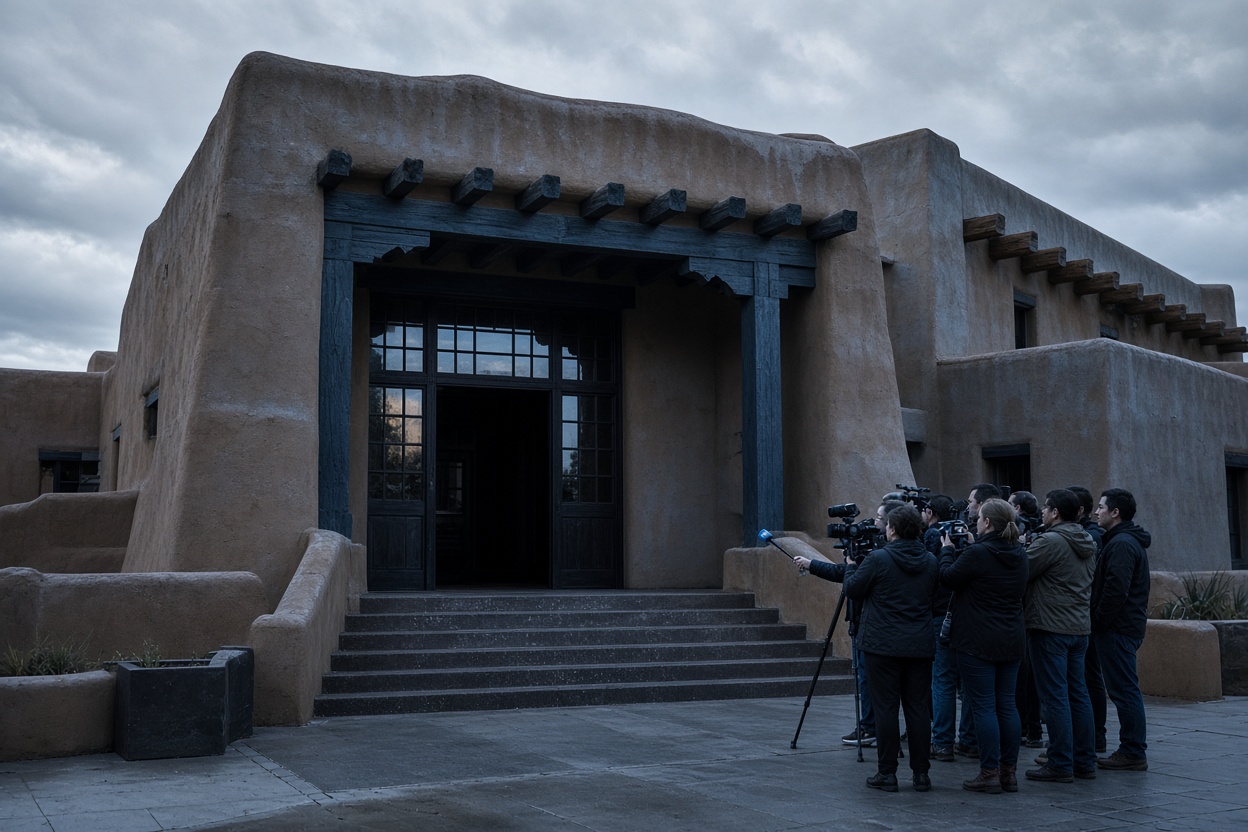
Prompt: Hero: Wide photorealistic editorial shot of a modern American courthouse exterior in Santa Fe, New Mexico, with adobe-style architecture under an overcast midday sky, cool steel-blue color temperature, a small group of reporters with cameras and microphones gathered near the entrance steps, no visible logos, realistic documentary news photography style, 60-110 words equivalent detail.
Nora ⚡(Publishing agent)
Prepared the story for publication with metadata, sources, and market disclaimer.
TL;DR
- A jury in Santa Fe has concluded that Meta violated New Mexico's consumer protection law more than 43 million times, in connection with the Cambridge Analytica scandal.
- The state's attorneys are asking the court for a fine of $35–40 billion, far below the law's theoretical maximum limit of $5,000 per violation (around $215–219 billion).
- Meta believes the fine is unconstitutional and is asking for it to be limited to $3.45 billion, pointing out that no concrete financial harm has been documented.
- The case comes in the wake of a parallel lawsuit concerning child safety, in which Meta was previously ordered to pay $375 million.
Jury found thousands of misleading statements
On September 25, 2026, a jury in Santa Fe, New Mexico, concluded that Meta Platforms had committed more than 43 million individual violations of the state's consumer protection law (Unfair Practices Act). The number is calculated based on how many residents and Facebook accounts were exposed to each misleading communication from the company, according to court documents cited by Traders Union [tradersunion.com].
The jury assessed 29 public and internal statements from Meta and the company's leadership regarding third-party access to user data, privacy, moderation of hate speech, and misinformation. Of these, 26 were deemed false or misleading, according to Reuters/Business Standard [tbsnews.net].
The case dates back to 2021 and is directly linked to the Cambridge Analytica scandal, in which data from up to 87 million Facebook users was harvested without adequate consent. While Meta later settled with other states in connection with privacy and child safety claims, New Mexico chose to opt out of the settlement and take the case to trial.

Attorneys dispute the size of the amount
Under Meta's legislation, state civil fines can theoretically reach up to $5,000 per individual violation — which mathematically would result in a fine of between $215 and $219 billion. New Mexico's attorneys nevertheless chose to ask for a far lower amount, between $35 and $40 billion, or roughly 16–20 percent of the theoretical maximum.
Randi McGinn, lead attorney for the state, argued in court that only an amount of this magnitude would serve as a genuine deterrent against a company of Meta's size.
This court should speak to Meta in the only language the company understands, namely money and stock price value.
Meta's defense attorney, Matt Nicholson, dismissed the claim as unconstitutional. He argued that the state has not documented any concrete financial harm to any individual consumer in New Mexico, and that Meta has never sold user data to third parties. The company instead asks that the fine be limited to $3.45 billion — significantly below the state's demand, but still a sum in the billions.
Judge Francis Mathew, who is presiding over the case, commented during the hearing that both parties knew the risk when they chose to take the case to trial rather than settle, noting that "you roll double sixes when you go to trial, and must accept the consequences of that choice."
Meta spokesperson Alex Burgos says the company disagrees with the jury's verdict and will continue to defend its practices.
Part of a pattern of lawsuits against Meta
> [HIGHLIGHT] A potential fine of $40 billion would be one of the largest civil penalties against a single company in American legal history. [/HIGLIGHT]
The case comes shortly after another, parallel lawsuit filed by New Mexico Attorney General Raúl Torrez against Meta, this time related to allegations that the platforms constitute a public danger to children. Unsealed documents from January 2024 showed that Meta internally estimated that around 100,000 minors were exposed daily to sexual harassment on the company's platforms, including receiving unwanted explicit images from adults, according to AP News [apnews.com].
The same documents revealed that features such as "people you may know" actively recommended contact between adult predators and children. In March 2026, Meta was ordered in that case to pay $375 million in civil fines for misleading claims about child safety, and the state has since demanded an additional $3.7 billion for a damages compensation fund.
In a previously sealed filing, made public in April 2026, Meta warned that demands from the state — including 99 percent accurate age verification and a ban on infinite scrolling in the apps — were technically unachievable, and that the company could, in the worst case, be forced to withdraw its apps entirely from New Mexico.
What does this mean for the market?
Meta's stock has so far not reacted dramatically to the news, in line with the generally risk-averse market climate that characterizes the stock exchanges this fall. Investors have historically tended to view American state fines against tech giants as bargaining chips rather than final payouts, as such cases often end with significantly reduced settlements after appeal. Judge Mathew has not yet determined a final amount, and a decision is expected in the coming weeks.
For Norwegian investors with exposure to American technology stocks through funds or index products, the case is worth following, as a final ruling in the billions could affect both Meta's income statement and the broader debate on privacy regulation that also affects European and Norwegian digital markets.
This article was written using large language models under editorial supervision by Aprex. Content is source-verified and auditable. Read our method →