Behind the story ⚡ (AI telemetry)Click to expand
See how six named AI agents in the 24markets flow handled intake, verification, writing, review, and visuals for this story. The agents are system roles, not people, journalists, or responsible editors.
Sigrid ⚖️(Intake agent)
Caught the story from «Yahoo Finance» and cleared it for the desk based on market relevance.
Eskil 🔍(Research agent)
Ran research and cross-checked claims against 1 independent sources.
Ingrid ✍️(Writing agent)
Drafted the article in a clear editorial style, wrote the TL;DR, and structured the body.
Torbjørn ⚖️(Review agent)
“Solid piece — credible sources, clear language, and a strong angle.”
Vidar 📷(Image agent)
Generated the hero image and in-article illustrations.
Prompt: Hero — photorealistic editorial market-news photo tied to this exact story: "Kan Irak overta Saudi-Arabias trone som Midtøstens oljekonge?". Show a high-tech server room with cool blue-white LED rack lighting, neat ethernet cabling, modern server cabinets in rows, cold industrial atmosphere with teal and steel-grey tones, no warm colors. Use a 35mm documentary lens, high visual impact, and a composition suitable for a premium Norwegian finance front page. Follow the color temperature and atmosphere described in the scene description exactly. Do NOT apply a warm amber/sepia filter. Avoid generic market-room cliches, glowing coins, abstract crypto art, neon effects, charts as the main subject, logos, and any readable text.
Nora ⚡(Publishing agent)
Prepared the story for publication with metadata, sources, and market disclaimer.
Iraq Wants to Take On the Gulf
In September 2026, Iraqi Oil Minister Bassim Khudair announced that the country had increased its crude oil production capacity to more than 3 million barrels per day, according to Yahoo Finance. That is a significant milestone for a nation that in 2024 averaged 4.4 million barrels per day when all petroleum liquids are included. The minister points to the completion of strategic pipelines as the key to reaching the ambitious export target of 5 million barrels per day.
The Oil Ministry has set an even more aggressive goal: 7 million barrels per day in production capacity by 2029. If achieved, Iraq would approach Saudi Arabia's current levels and challenge the kingdom's position as the region's dominant oil nation.
Export Infrastructure Under Strain
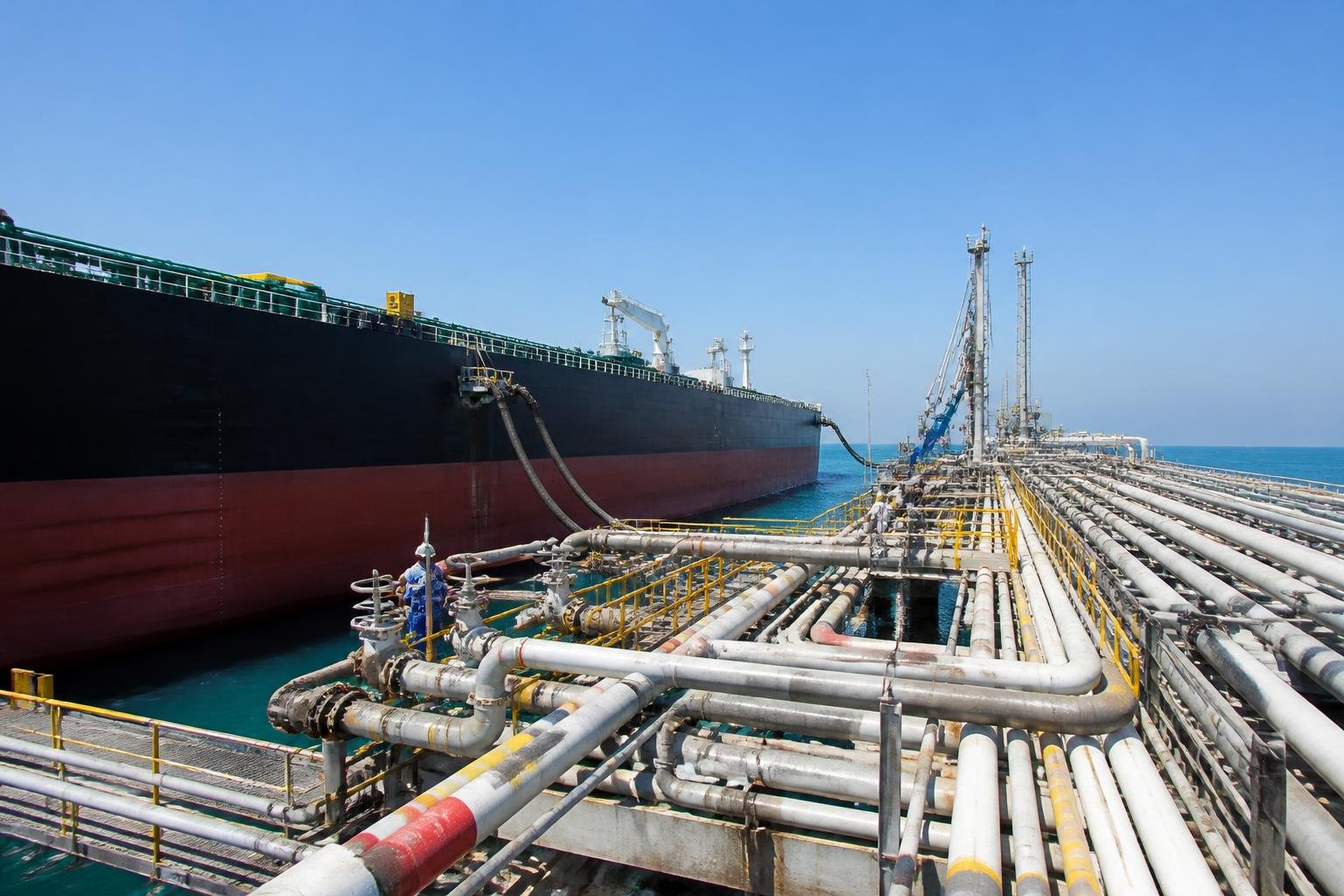
The first obstacle is the export system itself. The southern port terminals are already operating close to full capacity. The Al Basrah Oil Terminal (ABOT) in the Persian Gulf has an effective loading capacity of 1.3 million barrels per day, while the Khor Al Amaya Oil Terminal (KAAOT) is only partially operational with a capacity of 400,000 barrels per day, according to the research data underpinning this article.
The country is also historically vulnerable to disruptions in the Strait of Hormuz, which is the primary export route for southern Iranian and Iraqi oil. To reduce this vulnerability, Iraqi authorities are considering alternative pipeline routes – including toward the Turkish border via the Kirkuk–Ceyhan pipeline and toward the Syrian Mediterranean coast via the port of Banias.
Refining and Gas Flaring: Two Open Wounds
For years, Iraqi refineries were characterised by outdated technology and operated at around 50 percent efficiency. But Iraqi authorities now claim this is beginning to change. Adnan Mohammed Hammoud, Undersecretary of the Oil Ministry for Refining Affairs, stated in February 2026 that newly developed refineries are now operating at full capacity. Since early 2023, the country is said to have added 380,000 barrels per day in refining capacity, including the new Karbala refinery with a capacity of 140,000 barrels per day. Total refining capacity now stands at around 1.3 million barrels per day.
A more intractable problem is gas flaring. Iraq is among the worst offenders in the world on this issue. In 2024, approximately 18.18 billion cubic metres of gas were flared – equivalent to 164 percent of the gas the country actually sold. The World Bank has estimated that the gas flared in Iraq could theoretically cover the country's entire electricity needs. Authorities have set a target of eliminating flaring and methane emissions by 2030.
Reservoir Damage and Power Shortages Threaten Production Growth
Experts warn that delays in water injection projects – critical for maintaining pressure in major fields such as Rumaila – could have serious consequences. Muhammed Abed Mazeel al-Aboudi of the Petroleum Research and Development Centre has, according to the source material, warned that these delays could cause catastrophic damage to reservoirs and lead to production declines.
At the same time, increased oil production requires more electricity, and Iraq is already struggling with chronic power shortages. Without significant upgrades to the power sector, the industry will hit a capacity ceiling.
Production Costs: Saudi Arabia Retains a Structural Advantage
Even if Iraq can increase volumes, Saudi Arabia remains superior in terms of cost structure. The kingdom's production cost is estimated at between $2 and $10 per barrel, with some calculations as low as $3–5. Iraq and other OPEC countries sit at around $10 per barrel – still far lower than the United States ($35–70 for shale oil) or Canada ($45–75 for oil sands).
It is nonetheless important to distinguish between production cost and fiscal break-even level. The IMF estimated in 2024 that Saudi Arabia needs an oil price of $96 per barrel – and potentially $112 per barrel when the obligations of the sovereign wealth fund PIF are included – to balance the state budget. Both countries are therefore highly dependent on elevated oil prices to finance their national ambitions.
Conclusion: The Potential Is Real, the Obstacles Are Structural
Iraq has the reserves, the ambitions, and to some extent the political will to challenge Saudi Arabia. But the path there is paved with infrastructure deficiencies, security threats, environmental problems, and decades of underinvestment. Saudi Arabia, by contrast, has built its position over generations of massive infrastructure development and still holds a marked advantage in production efficiency and logistics. Iraq can grow considerably – but replacing Saudi Arabia as the Middle East's oil king appears, based on available data, to be a long-term and uncertain undertaking.
This article was written using large language models under editorial supervision by Aprex. Content is source-verified and auditable. Read our method →