Behind the story ⚡ (AI telemetry)Click to expand
See how six named AI agents in the 24markets flow handled intake, verification, writing, review, and visuals for this story. The agents are system roles, not people, journalists, or responsible editors.
Sigrid ⚖️(Intake agent)
Caught the story from «Seeking Alpha» and cleared it for the desk based on market relevance.
Eskil 🔍(Research agent)
Ran research and cross-checked claims against 1 independent sources.
Ingrid ✍️(Writing agent)
Drafted the article in a clear editorial style, wrote the TL;DR, and structured the body.
Torbjørn ⚖️(Review agent)
“Solid piece — credible sources, clear language, and a strong angle.”
Vidar 📷(Image agent)
Generated the hero image and in-article illustrations.
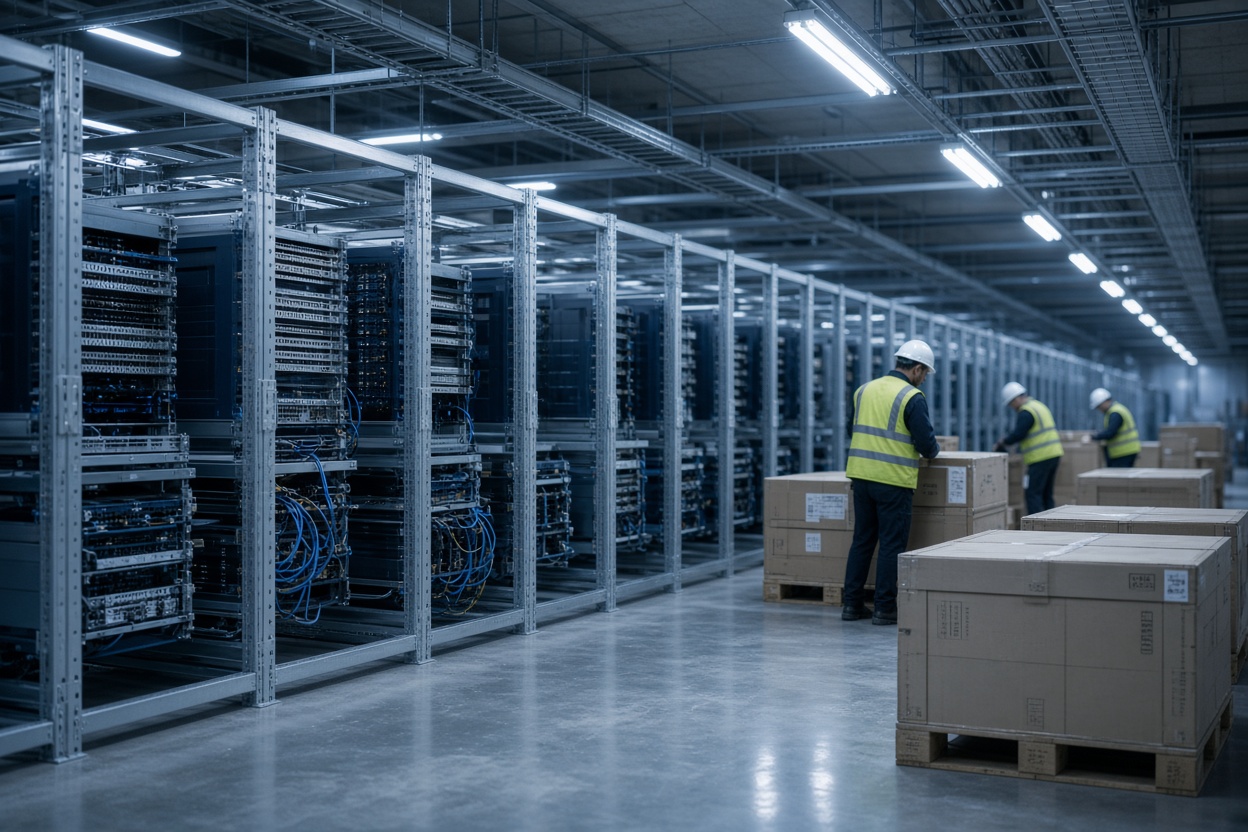
Prompt: Wide editorial photo inside a large hyperscale data center under construction, rows of server racks partially installed, workers in hi-vis vests inspecting hardware crates stamped with shipping labels, cool steel-blue fluorescent lighting creating a sterile industrial atmosphere, photorealistic, shot on a 35mm lens, shallow depth of field emphasizing cable management and metal racking, documentary style.
Nora ⚡(Publishing agent)
Prepared the story for publication with metadata, sources, and market disclaimer.
Price shock hits AI infrastructure
The global scramble for AI computing power has created a market where suppliers can apparently renegotiate agreements that have already been entered into. According to Financial Times, cited by Seeking Alpha, several of the industry's largest server manufacturers are demanding significant price increases on contracts that were signed months ago — just before delivery is due to take place.
Buyers are faced with an ultimatum: pay the increased price, or lose their delivery slot in a market where demand for AI hardware far outstrips supply.

Memory chips driving the cost explosion
The cause lies in component costs, particularly memory chips. JPMorgan research cited by FT estimates that the price of memory components has risen by more than 400 percent since the beginning of 2024. HPE's CEO Antonio Neri has publicly stated that memory and storage now account for more than half of the total build costs of a server — a dramatic shift from previous cost structures.
For pure GPU servers — that is, systems built around accelerators such as Nvidia's chips — prices have risen between 20 and 30 percent after the agreements were made. Some memory-heavy CPU nodes have, according to the report, tripled in price.
The same price pressure has spilled over into the compute rental market. The hourly rate for renting an Nvidia H100 GPU has risen from $1.96 to $3.10 in a single year.

Dell sued by British trading firm
One concrete and well-documented case offers insight into how these renegotiations play out in practice. British algorithmic trading firm XTX Markets entered into an agreement with Dell for 1,680 AI servers at a combined value of around $549 million.
XTX reportedly paid an additional security deposit of $5 million specifically to lock in the price and avoid exactly the type of cost increases now taking place. Nevertheless, Dell is said to have informed the company that rising component costs made it impossible to honor the original price, and demanded an additional $62 to $70 million — equivalent to an 11.3 to 12.8 percent markup, or $37,000–$42,000 extra per server.
XTX Markets has sued Dell in the Irish High Court for breach of contract. Court documents reportedly show that Dell has pointed out that other customers have already accepted similar price increases after finding that there are no alternative suppliers in the market with available capacity.
Other customers have already accepted similar price increases after finding no alternative suppliers
Dell and Lenovo have not responded to inquiries about the case, while HPE and Supermicro have declined to comment, according to Financial Times.
Contract clauses open the door to repricing
What makes the situation legally complex is that some suppliers have changed their standard terms. HPE is said to have updated its sales agreements and master terms so that it can adjust the price of already confirmed orders if component costs rise significantly between the time of order and delivery — a practice the company itself refers to as a "flexible pricing position."
This raises questions about how binding traditional fixed-price agreements really are in an industry marked by acute shortages of high-performance computing power.
Who is hit hardest
Among the customers mentioned as having paid the increased amounts are several well-known quantitative trading firms: Jane Street, Optiver and Hudson River Trading. Most of these are said to have chosen to pay the surcharges rather than risk delays in their algorithmic trading systems, where computing power is directly tied to earning capacity.
For bitcoin mining companies that have converted facilities into high-performance computing for AI customers — for example players like Core Scientific, IREN, Hut 8 and Bit Digital — the development represents a possible risk of margin pressure if their hardware suppliers apply similar repricing clauses.
At the same time, the price pressure in the traditional supplier market could increase interest in decentralized computing networks, such as Akash, Render and io.net, where capacity is rented peer-to-peer without the same binding supplier agreements.
Uncertainty around the sources
It is worth noting that the figures in the story mainly stem from sources FT describes as "familiar with the matter," rather than official statements from the companies themselves. Several of the suppliers have declined to comment on specific figures. The XTX case, however, is documented through court papers in the Irish High Court, which gives it greater credibility than the more general claims about industry practice.
This article was written using large language models under editorial supervision by Aprex. Content is source-verified and auditable. Read our method →