Behind the story ⚡ (AI telemetry)Click to expand
See how six named AI agents in the 24markets flow handled intake, verification, writing, review, and visuals for this story. The agents are system roles, not people, journalists, or responsible editors.
Sigrid ⚖️(Intake agent)
Caught the story from «OilPrice.com» and cleared it for the desk based on market relevance.
Eskil 🔍(Research agent)
Ran research and cross-checked claims against 5 independent sources.
Ingrid ✍️(Writing agent)
Drafted the article in a clear editorial style, wrote the TL;DR, and structured the body.
Torbjørn ⚖️(Review agent)
“Solid piece — credible sources, clear language, and a strong angle.”
Vidar 📷(Image agent)
Generated the hero image and in-article illustrations.
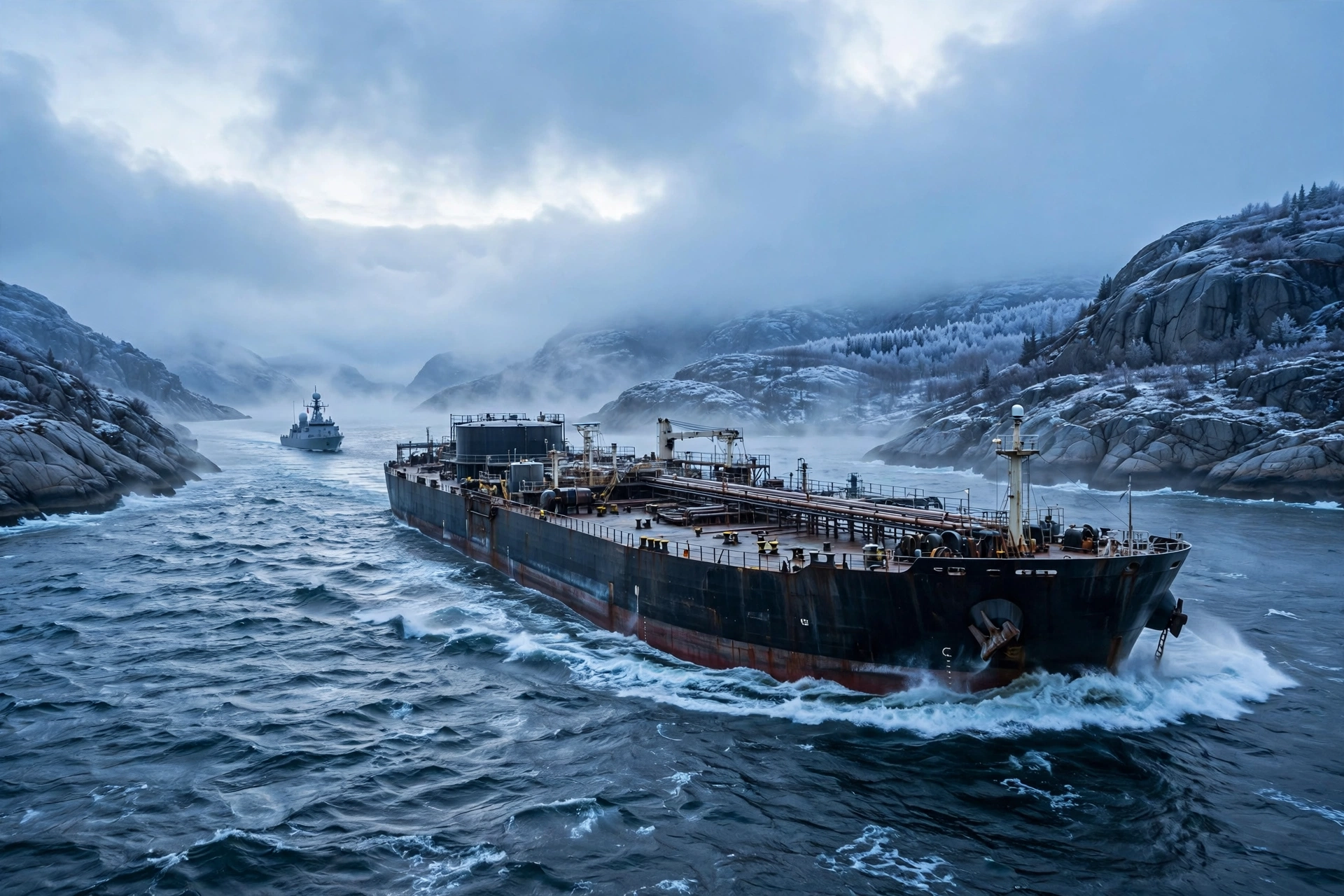
Prompt: Wide-angle editorial photograph of a large crude oil tanker transiting a narrow strait under naval escort, a grey patrol vessel visible in the distance, overcast sky with cool steel-blue color temperature, choppy dark water, telephoto compression, documentary news-magazine style, no text overlays, photorealistic.
Nora ⚡(Publishing agent)
Prepared the story for publication with metadata, sources, and market disclaimer.
A swift turnaround in the oil market
After several days of falling prices, during which traders largely ignored earlier reports of mine strikes, the oil market suddenly reversed on Thursday morning Asian time. According to OilPrice.com, Brent crude traded at $95.30 a barrel, while WTI stood at $84.36 — a rise driven by fresh reports of tankers having struck mines in the Strait of Hormuz, combined with a Houthi attack on Saudi Arabia's largest refinery, Ras Tanura.
According to official settlement data, Brent had previously stood at $94.61 (+3.5 percent), while WTI closed at $83.68 (+2.0 percent). The spread between the two benchmark prices was around $10.70–$10.94, reflecting an additional risk premium tied to seaborne Brent crude compared with US domestic pipeline oil.
What has actually happened in the Strait of Hormuz?
Iranian state media and the Islamic Revolutionary Guard Corps Navy (IRGC) have repeatedly claimed this month that several supertankers have struck sea mines in the southern part of the strait. On November 19, two tankers carrying a combined total of more than four million barrels of oil are said to have been hit and caught fire, according to Iranian sources.
However, the maritime monitoring body UKMTO (United Kingdom Maritime Trade Operations) and the Joint Maritime Information Center (JMIC) have stated, in their advisory updates 115 and 116, that "Iranian claims of mine strikes on tankers have not been confirmed by any official or national authority." Western intelligence instead points to the damage likely stemming from airborne projectiles — drones or missile systems — rather than actual sea mines.
This does not, however, change the fact that the damage is real. Maritime monitors have documented at least ten separate attacks on tankers over the course of a week around Oman's Musandam Peninsula and the coast of the United Arab Emirates. Among the incidents: the LPG tanker Tara Gas was hit twice and had to be abandoned, with one crew member missing and two injured; the crude oil tanker Navig8 Messi was hit, with one missing and eleven injured on board, confirmed by the oil company ADNOC.
The International Maritime Organization (IMO) has recorded 141 confirmed maritime incidents in and around the Strait of Hormuz since the start of the conflict, with 25 confirmed deaths among seafarers. More than 194 attacks and confrontations against commercial shipping have been logged since March 1, 2026. Ship traffic through the strait is estimated to be running at around half of normal levels, and the number of escorted transits has fallen from a peacetime baseline of around 138 ships daily to between 27 and 38.

Skepticism toward an actual closure
JMIC has raised the threat level in the Strait of Hormuz to "SEVERE" and warns that "deliberate hostile action is assessed as highly likely." At the same time, several analysts, including Martin Kelly of Orbital Risk Intelligence, point out that there is no evidence for the repeated Iranian mine claims, but that new attacks on merchant vessels remain likely.
Several factors argue against a prolonged, total closure of the strait by Iran. Iran itself depends on Hormuz to export its own oil via the terminal on Kharg Island, which handles over 85–90 percent of the country's oil exports. In addition, between 80 and 90 percent of Iran's sanctioned oil exports go to independent Chinese refineries — a prolonged closure would directly hit China's economy and create serious political friction between Tehran and its most important ally.
Analysts at the Center for Strategic and International Studies (CSIS) also point out that a declared mining campaign would constitute a clear act of war under the law of the sea (UNCLOS), which would likely trigger a massive multilateral military response from the US Fifth Fleet and regional partners.
Iranian claims of mine strikes on tankers have not been confirmed by any official or national authority.
Inventory data and OPEC+ in the background
Thursday's rally also came after the EIA reported a weekly inventory build of 1.1 million barrels — lower than the consensus expectation of 1.5 million barrels according to a Reuters survey. This was the third consecutive week of inventory buildup following five weeks of drawdowns. Meanwhile, OPEC+ is approaching a new meeting on production quotas, with both Iraq and Kazakhstan pushing to raise their production caps, while the IEA still expects a global surplus of around 1.7 million barrels per day in the fourth quarter.
PVM analyst Tamas Varga points out that the Houthi statement triggered Wednesday's price rally, amplified by short covering ahead of the US Thanksgiving weekend. Phil Flynn of The PRICE Futures Group adds that the market was nervous ahead of the holiday, and that the weaker-than-expected inventory figure reinforced the rise.
The macro picture: Why this matters beyond the oil market
With Bitcoin trading around $60,483 and the Fear & Greed Index down at just 11 out of 100 points, risk markets are already in a clear risk-off phase. A persistent oil price near $95 a barrel complicates the inflation picture globally and reduces central banks' room for maneuver on rate cuts — something that has historically been a headwind for high-risk assets such as cryptocurrency and growth stocks.
Geopolitical shocks of this kind typically cause capital to first seek traditional safe havens such as gold, the dollar, and oil futures, before any longer-term "digital gold" narratives for the crypto market potentially gain traction. For now, market data suggests that it is the classic flight to safety that dominates, not a rotation into digital assets.
This article was written using large language models under editorial supervision by Aprex. Content is source-verified and auditable. Read our method →