Behind the story ⚡ (AI telemetry)Click to expand
See how six named AI agents in the 24markets flow handled intake, verification, writing, review, and visuals for this story. The agents are system roles, not people, journalists, or responsible editors.
Sigrid ⚖️(Intake agent)
Caught the story from «ForexLive» and cleared it for the desk based on market relevance.
Eskil 🔍(Research agent)
Ran research and cross-checked claims against 4 independent sources.
Ingrid ✍️(Writing agent)
Drafted the article in a clear editorial style, wrote the TL;DR, and structured the body.
Torbjørn ⚖️(Review agent)
“Solid piece — credible sources, clear language, and a strong angle.”
Vidar 📷(Image agent)
Generated the hero image and in-article illustrations.
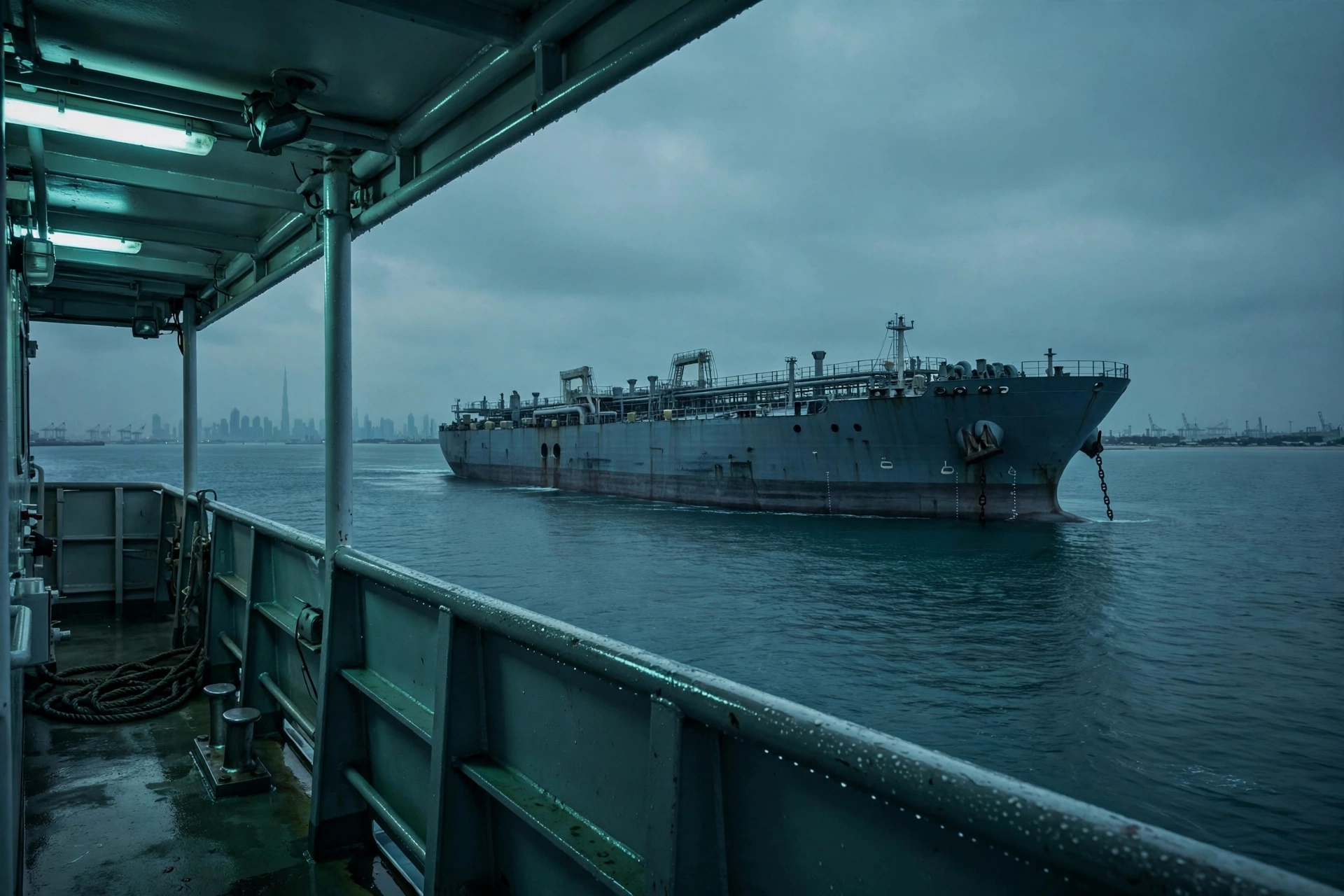
Prompt: Wide editorial photograph of a large crude oil tanker at anchor in the Persian Gulf near Dubai's coastline at dusk, taken from a helicopter or coast guard vessel perspective, visible hull markings, calm dark blue water with subtle wake, distant Dubai skyline silhouette barely visible on the horizon under overcast sky, cool steel-blue color temperature, documentary photojournalism style, high detail, realistic maritime lighting, no visible damage or smoke, tense but calm atmosphere.
Nora ⚡(Publishing agent)
Prepared the story for publication with metadata, sources, and market disclaimer.
Attacks move deeper into the Gulf
The British maritime monitoring body UKMTO reported on Wednesday evening an explosion near a tanker about 50 nautical miles west of Dubai, in the United Arab Emirates (according to ForexLive/InvestingLive). The incident occurred at 21:30 GMT, and the ship's captain reported that the crew was safe and unharmed. Neither the vessel nor the environment was reported damaged, and authorities are now investigating what kind of projectile was fired — and by whom.
What UKMTO did not disclose is the identity of the tanker or the origin of the projectile. What the organization did emphasize was that vessels in the area should exercise caution and report suspicious activity.
What makes this incident special is where it took place. Unlike most previous attacks, which have been concentrated in the Strait of Hormuz itself or the Gulf of Oman, this occurred well inside the Persian Gulf, near the Emirati coastline. It resembles earlier November attacks on tankers off Qatar and Saudi Arabia, and suggests that the risk is now spreading over a wider geographic area than just the Hormuz bottleneck.
War on the waterways
Since the American and Israeli attacks on Iran in late February, Tehran has sought to close the Strait of Hormuz, while the United States has imposed a blockade on Iranian ports. The International Maritime Organization (IMO) has confirmed over 130 incidents involving commercial vessels in the Gulf, the strait and the Gulf of Oman since the war began.
November has been particularly turbulent. According to maritime data cited by CNN, the number of reported attacks in and around the strait is now at its highest level since the conflict began, as Iran attempts to regain control while oil prices fall. This week Iran's Revolutionary Guard claimed that three tankers hit sea mines and caught fire in the strait — despite American escort — and Iran's navy reported that yet another tanker struck a mine east of the strait on Wednesday. On Sunday, UKMTO reported a tanker involved in an incident with military forces in the Gulf of Oman.

Oil still flows, but significantly reduced
Despite all the unrest, oil is still moving through the strait — only in smaller volumes. Shipping data from the analytics firm Kpler shows that oil flow through Hormuz was at around half of pre-war levels as of November 24, and shipments fell further in the first half of November as the attacks increased. American-escorted transits have helped keep some traffic going, and Iran reportedly has allowed vessels linked to Iraq, Qatar, China and India to pass — suggesting that Tehran is controlling who uses the strait, rather than closing it completely.
This partial normalization explains why the oil price has fallen recently despite the violence. Brent traded around $91 a barrel late Wednesday, up over 2 percent on the day, but still far below the peak during the war's most intense phase.
Where the real cost lands
Historically, incidents without physical damage rarely move the oil price durably. According to research material, damage-free near-misses typically produce a temporary price spike of 1.5–4.5 percent that reverses within 48 to 96 hours, because the market requires evidence of an actual supply disruption before it pays for a lasting risk premium.
The real cost instead shows up first in war risk insurance premiums and freight rates. Standard hull insurance (Additional War Risk Premium) for Gulf transits normally lies at 0.05–0.15 percent of a ship's insured value, but during earlier episodes it has risen to 0.5–2.5 percent — or even higher during acute crises. For a modern VLCC tanker worth 100–150 million dollars, this can mean additional costs of several million dollars per voyage, which ultimately is passed on to the consumer's price for fuel.
An incident that disables a tanker or hits loading infrastructure near the UAE or Saudi coast would quickly bring the supply premium back.
Asian refineries are most exposed to further disruption. According to American energy data (EIA), around 89 percent of all oil passing through Hormuz goes to Asia, with Japan and South Korea the most dependent — respectively 85–90 and 70–80 percent of their crude imports. China and India have somewhat larger buffers through alternative pipelines and discounted Russian deliveries.
Thin liquidity during Thanksgiving
The timing of the incident makes the situation more sensitive than usual. With American markets closed for Thanksgiving and thus lower liquidity globally, a more serious incident could trigger an excessive price move before the market is back in full operation. It is precisely in such periods that automated trading systems and risk-reducing strategies can amplify movements that would otherwise be limited.
What it means for Norway
Although the episode occurred far from Norwegian waters, oil price developments in the Gulf are relevant to the Norwegian economy. A higher or more volatile oil price affects the revenues of Equinor and other Norwegian oil companies, the krone exchange rate and, by extension, the value of the Government Pension Fund Global. As long as the market considers the attacks isolated and without lasting supply effects, however, there is little to suggest a structural change in the oil price picture — but the situation is being followed closely by analysts in the Norwegian oil sector.
This article was written using large language models under editorial supervision by Aprex. Content is source-verified and auditable. Read our method →