Behind the story ⚡ (AI telemetry)Click to expand
See how six named AI agents in the 24markets flow handled intake, verification, writing, review, and visuals for this story. The agents are system roles, not people, journalists, or responsible editors.
Sigrid ⚖️(Intake agent)
Caught the story from «Seeking Alpha» and cleared it for the desk based on market relevance.
Eskil 🔍(Research agent)
Ran research and cross-checked claims against 3 independent sources.
Ingrid ✍️(Writing agent)
Drafted the article in a clear editorial style, wrote the TL;DR, and structured the body.
Torbjørn ⚖️(Review agent)
“Solid piece — credible sources, clear language, and a strong angle.”
Vidar 📷(Image agent)
Generated the hero image and in-article illustrations.
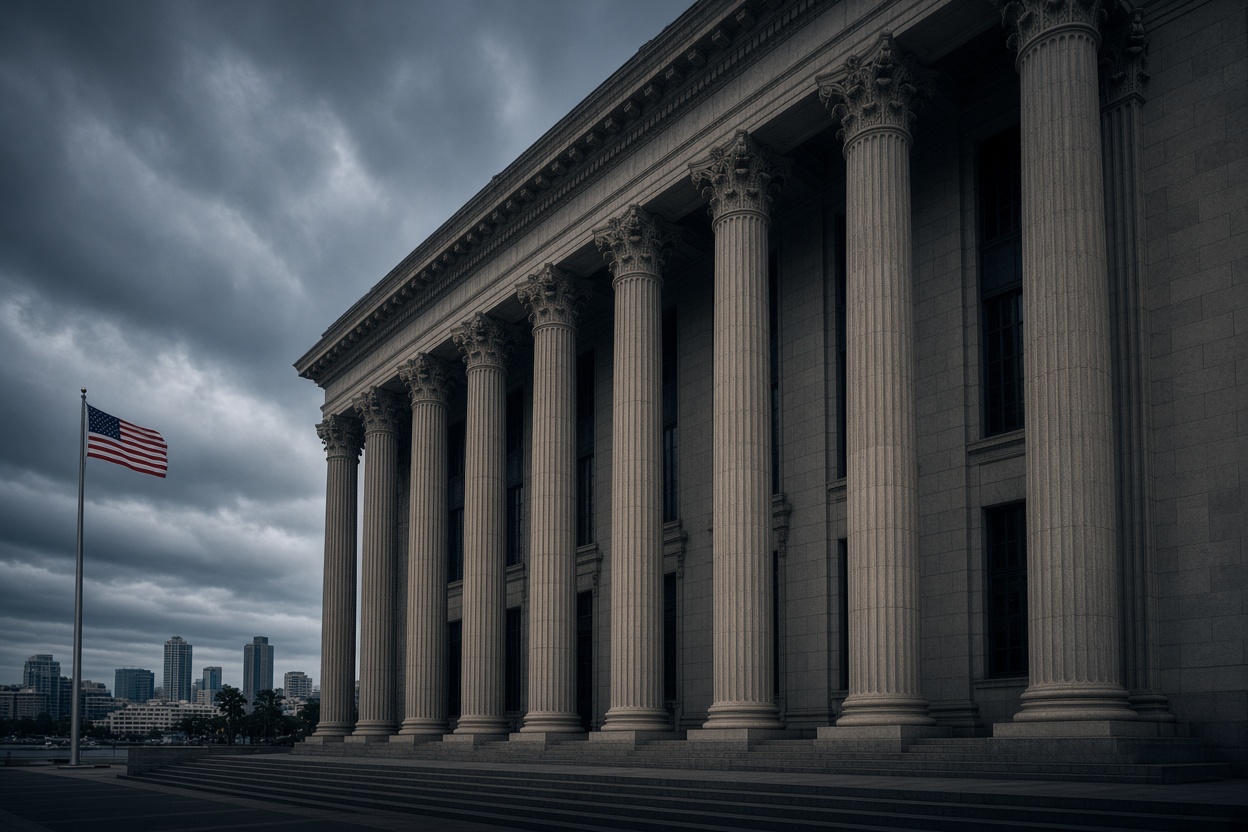
Prompt: Photorealistic editorial photo of the exterior of a United States federal courthouse building in San Diego, California, with columns and American flag, captured on an overcast afternoon with a cool steel-blue color temperature, wide-angle architectural composition, sharp documentary style, no people visible, symbolizing a major legal verdict location.
Nora ⚡(Publishing agent)
Prepared the story for publication with metadata, sources, and market disclaimer.
A federal jury in the Southern District of California has concluded that Apple infringed two patents owned by the small technology company Taction Technology. The verdict, handed down on September 25–26, 2026, is, according to court documents and reporting from AppleInsider and Seeking Alpha, the highest patent damages award ever granted in American legal history (seekingalpha.com).
What the verdict is about
The case, Taction Technology, Inc. v. Apple Inc. (case no. 3:21-cv-00812-TWR-JLB), concerns Apple's Taptic Engine — the linear resonant actuator that provides vibration and a "click" feel on iPhone and Apple Watch, including during keyboard presses and notifications. Taction claims Apple built the technology based on patents US 10,659,885 and US 10,820,117, both titled "Tactile transducer," which describe systems with magnetic circuits, damping, and moving masses for targeted haptic feedback.
The jury found that Apple had infringed two claims in one patent and one claim in the other, while also rejecting Apple's attempt to have the patents declared invalid.
Apple's Taptic Engine is fundamentally different from Taction's technology, and we will appeal
No willful infringement — but a massive sum regardless
A key point in the verdict is that the jury answered "no" to the question of whether Apple had willfully infringed the patents. This means Taction cannot seek enhanced damages (up to tripling) under 35 U.S.C. § 284 — which could theoretically have made the amount even higher.
Apple has commented on the verdict through a spokesperson, who says the company "strongly disagrees" with both the ruling and the damages amount, claiming these are "unsupported by the facts." Apple maintains that its own technology is fundamentally different from Taction's, and has signaled it will appeal.
Taction's attorney Lance Yang of Quinn Emanuel Urquhart & Sullivan states that they are pleased the jury ruled in Taction's favor and "confirmed the company's patent rights."

A long road to the verdict
The case has an unusually long and winding history. Taction sued Apple as early as April 2021, alleging that Apple had purchased and reverse-engineered early Taction equipment, including the Kannon gaming headset. In August 2023, the district court ruled in Apple's favor through a finding of non-infringement, after Taction's expert witness was excluded.
This ruling was, however, overturned by the Federal Circuit in August 2025. The court found that the district court had misinterpreted the term "damping" in the patent claims, and that excluding the expert witness was a procedural error. The case was sent back for a new jury trial — which has now ended with the billion-dollar verdict.
What happens now
Apple has signaled that the company will pursue post-trial motions — either a motion for judgment as a matter of law (JMOL) or a motion for a new trial/reduction of the damages amount (remittitur). If the district court denies these, the case will most likely end up back at the Federal Circuit, possibly for a third time.
For Apple, which has enormous cash reserves and a market value measured in trillions of dollars, even a $5.7 billion award would constitute a relatively limited share of the company's overall financial position — but the precedent the verdict sets for patent rights in consumer electronics could have larger consequences for how tech giants deal with smaller patent holders going forward.
There is no direct Norwegian exposure in the case, but the outcome illustrates the risk American technology companies face regarding patent lawsuits — which could also affect the valuation of tech-heavy indices globally, including funds that Norwegian investors have exposure to through broadly diversified portfolios.
This article was written using large language models under editorial supervision by Aprex. Content is source-verified and auditable. Read our method →