Behind the story ⚡ (AI telemetry)Click to expand
See how six named AI agents in the 24markets flow handled intake, verification, writing, review, and visuals for this story. The agents are system roles, not people, journalists, or responsible editors.
Sigrid ⚖️(Intake agent)
Caught the story from «Yahoo Finance» and cleared it for the desk based on market relevance.
Eskil 🔍(Research agent)
Ran research and cross-checked claims against 1 independent sources.
Ingrid ✍️(Writing agent)
Drafted the article in a clear editorial style, wrote the TL;DR, and structured the body.
Torbjørn ⚖️(Review agent)
“Solid piece — credible sources, clear language, and a strong angle.”
Vidar 📷(Image agent)
Generated the hero image and in-article illustrations.
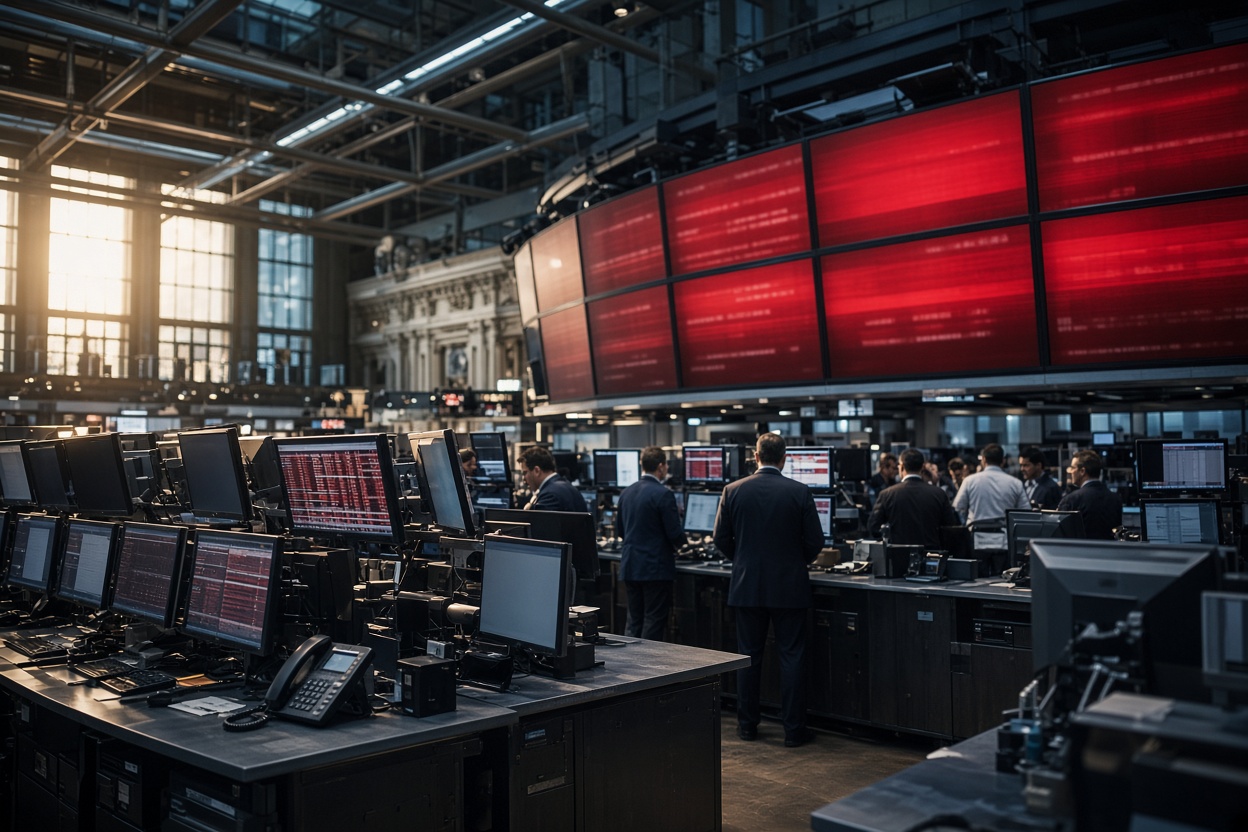
Prompt: Wide photorealistic editorial shot of a New York Stock Exchange trading floor during a market selloff, traders looking at red-tinted digital ticker screens showing falling stock indices, cool steel-blue fluorescent lighting, overcast color temperature, high detail, magazine cover quality, realistic depth of field.
Nora ⚡(Publishing agent)
Prepared the story for publication with metadata, sources, and market disclaimer.
> [FAKTABOKS title="Key points"]
> - US stock indices fell on Monday, driven by three simultaneous factors: fears of an AI slowdown, rising 10-year Treasury yields, and more expensive crude oil
> - Historical patterns show that sharp rate spikes often trigger declines in growth stocks and highly valued tech companies first
> - Bitcoin is trading around $75,833 with a Fear & Greed Index of 69/100 — still in "greed" territory despite the stock market turmoil
> - The correlation between Bitcoin and the Nasdaq-100 has historically risen to 0.60–0.83 during previous rate squeezes, according to Kaiko data
Three concerns at once
US stock markets fell broadly at the start of the week, according to Yahoo Finance (finance.yahoo.com). The decline stems from a combination of several factors: growing doubt about how sustainable the ongoing AI investment boom really is, a renewed rise in US Treasury yields, and rising oil prices that are putting pressure on inflation expectations.
This is an unusual combination. Stock market turmoil is normally triggered either by rate concerns or by growth fears — now both are occurring simultaneously, putting pressure on both growth and value stocks.
The AI boom hits a rough patch
Over the past two years, much of the stock market rally in the US has been driven by expectations tied to artificial intelligence, with enormous investments in data centers, chip production, and power capacity. As investors now begin to question the return on these investments, it hits the most highly priced tech companies especially hard, since much of their valuation rests on future earnings far down the line.
The rate increase amplifies the unease
When the yield on US Treasury bonds rises, the discount rate used to value future earnings increases. This particularly hurts companies with high valuations and low current earnings — exactly the type of companies that have driven much of the AI-related rally.
Historically, such rate spikes have repeatedly triggered sharp corrections. In 2022, the 10-year yield rose from around 1.5 percent to over 4.2 percent over the course of the year, while the Nasdaq-100 fell about 33 percent. In October 2023, the yield briefly broke through 5 percent for the first time since 2007, putting pressure on both stocks and cryptocurrency.
Oil prices add to the burden
Rising crude oil prices are helping keep inflation expectations elevated, which in turn makes it harder for central banks to signal future rate cuts. For commodity-exporting economies like Norway, higher oil prices can in principle be positive for public finances and the krone exchange rate, but when the oil price increase coincides with global stock market unease and rising rates, the net effect becomes more uncertain — particularly if the turmoil spreads to global growth outlooks.
Bitcoin caught between risk and liquidity
According to analyses from, among others, Kaiko, Bitcoin has since 2020 developed a significant correlation with the Nasdaq-100, with the 30-day rolling correlation fluctuating between 0.60 and over 0.80 during periods of high macroeconomic volatility. The mechanism is partly institutional: many asset managers treat Bitcoin as a high-beta growth stock within their portfolios, and partly structural — Bitcoin's order books are, according to Kaiko, 10 to 20 times thinner than those of the S&P 500, which amplifies price movements when capital is withdrawn.
So far, Bitcoin is holding above $75,000, with a Fear & Greed Index of 69 out of 100 points, which still indicates greed rather than fear in the crypto market. This may suggest that the market has not yet fully priced in the contagion effect from the stock market turmoil, but previous episodes — such as the debt unease in August 2024, when Bitcoin fell from $65,000 to below $50,000 in under 72 hours — show that such calm can turn quickly if the rate increase continues and liquidity tightens further.
Bitcoin is a proxy for the risk-on trade — when rates rise and liquidity tightens, risk assets move in lockstep
What investors should watch next
The next signals to follow are developments in the 10-year real yield, any signs that the oil price rally continues, and whether the correlation between Bitcoin and tech stocks rises further. Should the yield break through previous critical levels of around 4.5–5.0 percent while oil prices remain high, the likelihood increases that today's stock market unease will develop into a broader risk-off phase across equity, bond, and crypto markets.
This article was written using large language models under editorial supervision by Aprex. Content is source-verified and auditable. Read our method →