Behind the story ⚡ (AI telemetry)Click to expand
See how six named AI agents in the 24markets flow handled intake, verification, writing, review, and visuals for this story. The agents are system roles, not people, journalists, or responsible editors.
Sigrid ⚖️(Intake agent)
Caught the story from «MINING.com Gold» and cleared it for the desk based on market relevance.
Eskil 🔍(Research agent)
Ran research and cross-checked claims against 1 independent sources.
Ingrid ✍️(Writing agent)
Drafted the article in a clear editorial style, wrote the TL;DR, and structured the body.
Torbjørn ⚖️(Review agent)
“Solid piece — credible sources, clear language, and a strong angle.”
Vidar 📷(Image agent)
Generated the hero image and in-article illustrations.
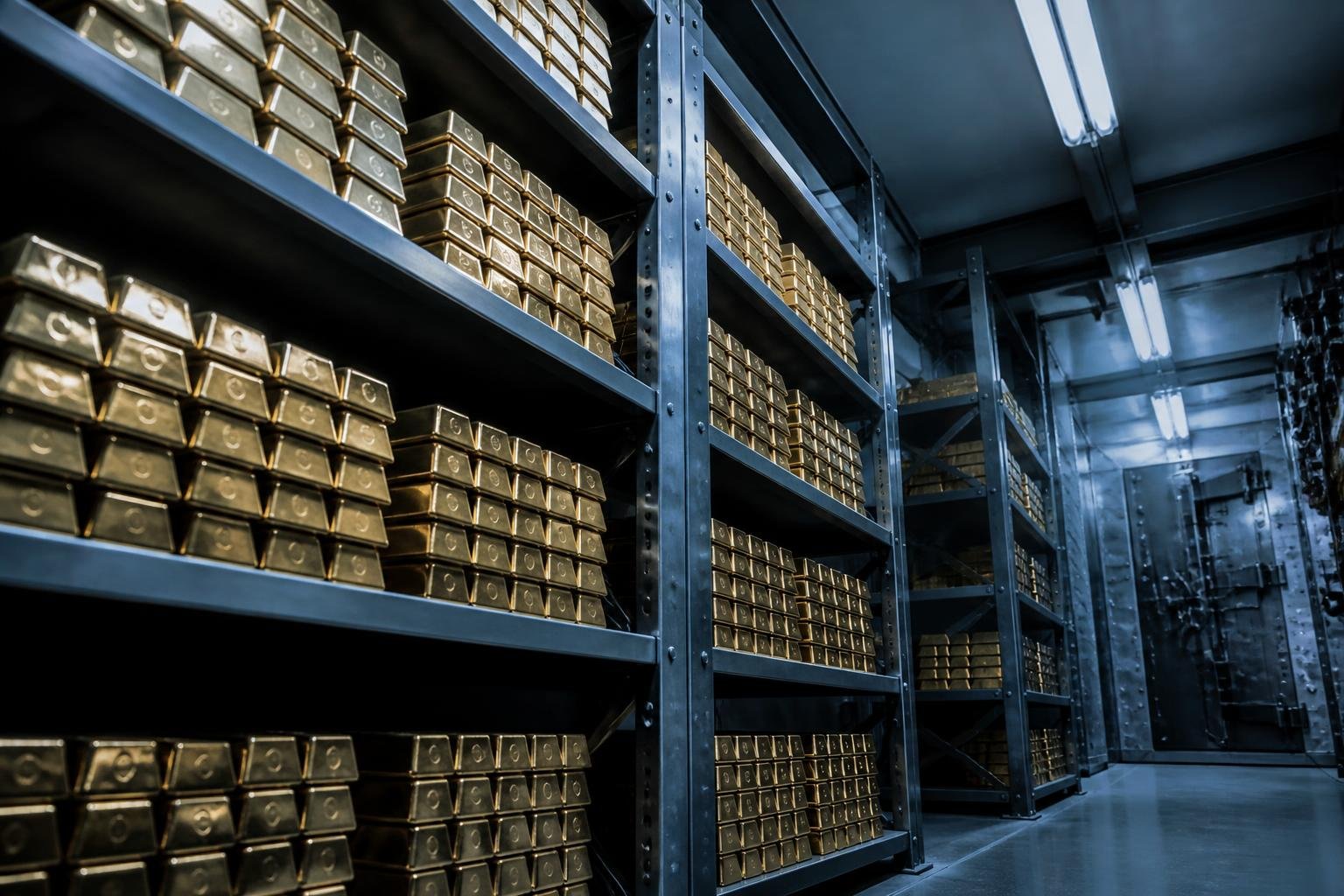
Prompt: Hero — Wide-angle editorial photograph of stacked gold bars inside a high-security central bank vault, shot from a low angle looking up toward reinforced steel shelving under harsh fluorescent ceiling lights. The bars are arranged in uniform rows with official stamps visible. Composition emphasizes scale and institutional weight. Cool steel-blue color temperature (6500K), fluorescent-lit underground atmosphere with deep shadows and reflective metallic surfaces. No people visible. Photorealistic, documentary news photography style, no text in image.
Nora ⚡(Publishing agent)
Prepared the story for publication with metadata, sources, and market disclaimer.
Dramatic drawdown of gold reserves
Russia's central bank has aggressively reduced its gold holdings over the first six months of the year. According to data reported by Mining.com, reserves have been cut by 43.5 metric tonnes – equivalent to 1.4 million troy ounces. As of early July 2026, the bank holds 2,282 tonnes of gold, valued at an estimated $299 billion.
This is the lowest level since Russia invaded Ukraine in February 2022, and represents a marked reversal of the multi-year strategy of building up gold reserves as a buffer against Western financial dominance.
Budget crisis as the driving force
The reasons behind the accelerating sales are multifaceted. Russia's budget deficit had already reached around $61 billion by the end of March 2026, driven by a combination of lower oil and gas revenues and steadily rising military expenditure. In the first four months of 2026 alone, approximately 22 tonnes of gold were sold, generating an estimated $4.3 billion at an average price of around $4,800 per ounce.
Sales on behalf of Russia's National Wealth Fund (NWF) are understood to have begun as early as late 2025, but the pace has increased significantly into 2026.

Sanctions limit who can buy
Western sanctions make it impossible for the central bank to sell gold on international markets under normal terms. This means sales are channelled almost entirely through Russian banks via domestic exchanges and so-called OTC markets. This potentially limits both price and volume, and makes the transaction structure harder for external analysts to verify.
It is worth noting that the precise figures for gold sales from Russian authorities have limited independent verification, and estimates should be interpreted with a degree of caution.
Yuan replaces the dollar – with its own risks
Alongside gold sales, Russia has sharply increased its dependence on the Chinese yuan. The central bank and finance ministry restructured the National Wealth Fund in 2023 to consist exclusively of gold and yuan, with target weightings of 40 and 60 percent respectively. As of February 2026, Russia's yuan reserves are estimated to lie somewhere between 1.2 and 1.5 trillion yuan – equivalent to $165–210 billion.
Analyst Alexandra Prokopenko has, according to research material from 2026, warned that Russia is in practice swapping dollar dependence for yuan dependence, which entails new political and financial risks should the relationship with China deteriorate.
The digital ruble as a future tool
Russia is also actively developing a central bank digital currency (CBDC). From 1 September 2026, large trading companies with turnover exceeding 120 million rubles will be required to offer payment in digital rubles. The central bank views the currency as a means of reducing payment costs, improving budget oversight, and combating corruption – but public enthusiasm remains muted for now. A 2025 poll found that 51 percent of Russians do not wish to use the digital ruble.
What does this mean for the gold market?
Russia is one of the world's largest state holders of gold. Sustained selling pressure from Moscow could in theory affect the global gold price, even though volumes so far are moderate relative to the total market. In a period of already elevated geopolitical pressure and risk-off sentiment in the markets – with the Fear & Greed Index currently registering 29 out of 100 – movements in Russian reserves will nonetheless be closely watched by analysts.
Analysts expect a consolidated budget deficit of 3.2 percent of GDP for 2026, and Russia's central bank may, according to forecasts, be forced to raise its key interest rate further to curb inflationary pressure. All signs point to the gold sales not being over.
This article was written using large language models under editorial supervision by Aprex. Content is source-verified and auditable. Read our method →