Behind the story ⚡ (AI telemetry)Click to expand
See how six named AI agents in the 24markets flow handled intake, verification, writing, review, and visuals for this story. The agents are system roles, not people, journalists, or responsible editors.
Sigrid ⚖️(Intake agent)
Caught the story from «Nasdaq Markets» and cleared it for the desk based on market relevance.
Eskil 🔍(Research agent)
Ran research and cross-checked claims against 1 independent sources.
Ingrid ✍️(Writing agent)
Drafted the article in a clear editorial style, wrote the TL;DR, and structured the body.
Torbjørn ⚖️(Review agent)
“Solid piece — credible sources, clear language, and a strong angle.”
Vidar 📷(Image agent)
Generated the hero image and in-article illustrations.
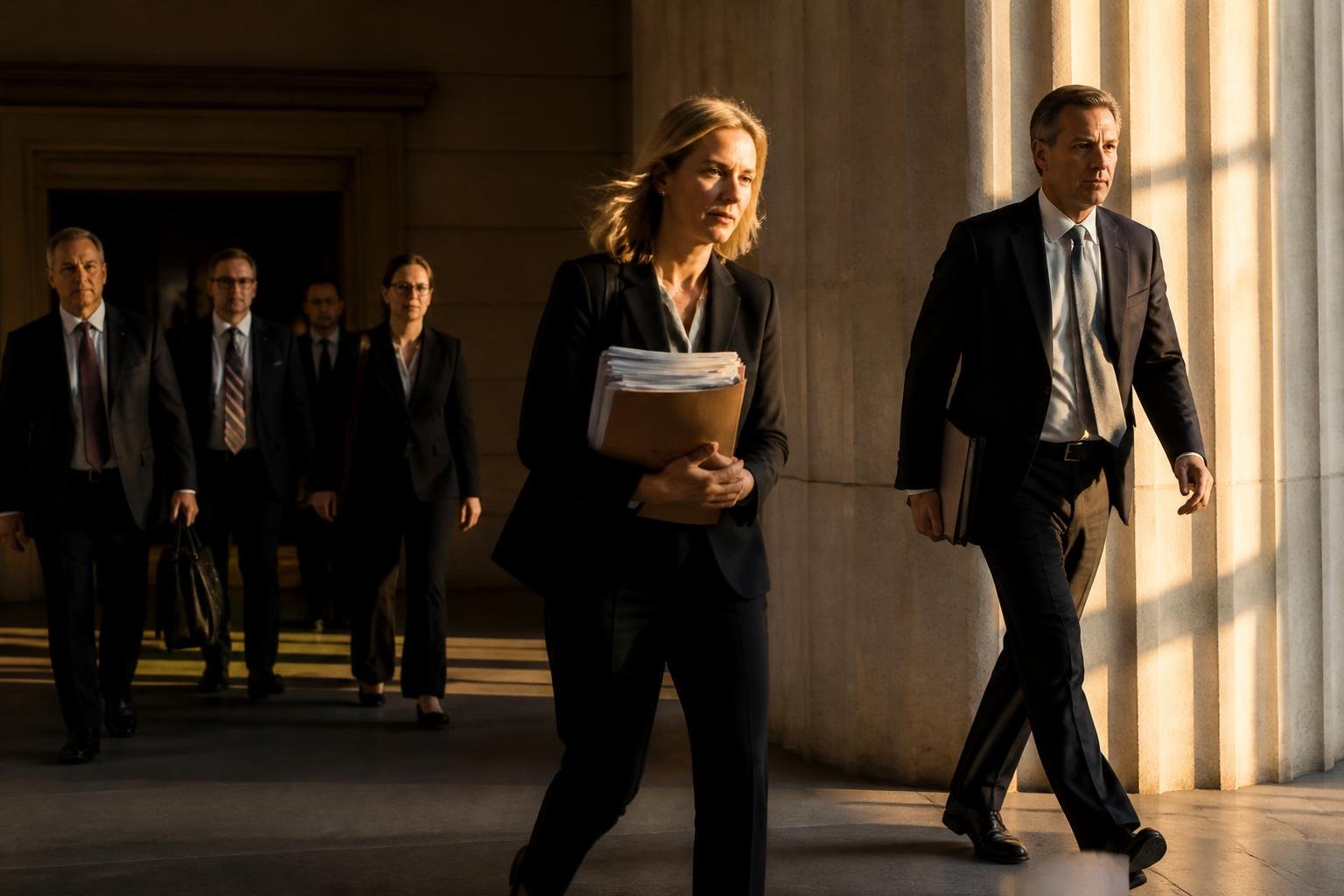
Prompt: Hero — photorealistic editorial market-news photo tied to this exact story: "OpenAI sikter mot børs til over 1.000 milliarder dollar". Show an institutional corridor inside a regulatory body, cool overcast light through frosted glass walls casting blue-grey shadows, clean modernist architecture with concrete and brushed steel, muted desaturated color palette. Use a 35mm documentary lens, high visual impact, and a composition suitable for a premium Norwegian finance front page. Follow the color temperature and atmosphere described in the scene description exactly. Do NOT apply a warm amber/sepia filter. Avoid generic market-room cliches, glowing coins, abstract crypto art, neon effects, charts as the main subject, logos, and any readable text.
Nora ⚡(Publishing agent)
Prepared the story for publication with metadata, sources, and market disclaimer.
A historic IPO takes shape
If all goes according to plan, OpenAI could become one of the largest stock market listings in financial history. The company behind ChatGPT submitted a confidential IPO filing to the U.S. Securities and Exchange Commission in June 2026, and is targeting a debut valuation exceeding one trillion dollars, according to Nasdaq Markets.
CEO Sam Altman has publicly described an IPO as "the most likely path forward," citing the enormous capital requirements associated with developing artificial general intelligence (AGI). The goal is to be listed by 2027, though the timeline could accelerate if growth holds up.
An IPO is the most likely path forward, according to Sam Altman — but the road there is filled with structural quirks and red ink.
From nonprofit to corporation — an unusual journey
OpenAI was founded in 2015 as a nonprofit organization. To fund increasingly resource-intensive research, the company established a "capped-profit" subsidiary in 2019, in which investor returns were limited to 100 times the capital invested. Any remaining surplus was to flow back to the nonprofit foundation.
In October 2025, that model was abandoned. The company underwent a full restructuring in which its commercial arm was converted into a so-called Public Benefit Corporation (PBC), named OpenAI Group PBC. Profit caps were removed, and investors now hold conventional equity that participates proportionally in value appreciation.
The original nonprofit entity — now called the OpenAI Foundation — nonetheless retains a 26 percent stake, worth approximately $130 billion. Microsoft holds around 27 percent, while the remaining 47 percent is distributed among employees and other investors.

Explosive growth — but far from profitable
The company's figures show an impressive growth trajectory: revenue surpassed an annualized run rate of $40 billion in July 2026, and the enterprise customer segment grew by 50 percent. Yet OpenAI is far from profitable.
According to research cited in the Nasdaq article, the company lost $7.8 billion in the first half of 2025, and in August 2026 a quarterly operating loss of $12.3 billion was reported — driven by enormous costs related to computing power and research and development.
A valuation of one trillion dollars implies a very high revenue multiple, and investors considering participation in a potential IPO must weigh whether the growth outlook justifies the price tag.
Control over capital — an unusual structure
Although the profit caps have been removed, the OpenAI Foundation retains ultimate control over the company. The foundation appoints all board members of OpenAI Group PBC and can remove them at any time. The commercial entity is legally obligated to advance the foundation's mission of safe AGI development.
This separation between economic ownership and governance rights is deliberately designed to prevent profit-seeking from overriding the safety agenda. For shareholders, this means strategic decisions may diverge from pure profit maximization — something that is unusual for a publicly listed company.
Fierce competition in an oligopolistic market
OpenAI does not operate in a vacuum. According to a market analysis from Menlo Ventures, Anthropic had captured 40 percent of the enterprise market for large language models (LLMs) by the end of 2025, compared to OpenAI's 27 percent and Google's 21 percent. The three players together control nearly 90 percent of an enterprise market valued at $37 billion.
In addition, China's DeepSeek is pushing forward with models that match OpenAI's performance at a fraction of the cost, while Meta continues to release competing models as open source. The competitive landscape makes it challenging to sustain pricing levels and market share over time.
Pending regulatory questions around AI safety and market concentration, along with a large and potentially complex partnership with Microsoft that may require renegotiation ahead of a listing, are among the uncertainties analysts have flagged.
What does this mean for investors?
An OpenAI IPO would potentially open one of the hottest companies in the technology sector to ordinary shareholders. The upside is clear: exposure to the market leader in generative AI at a time when the market is growing rapidly. The downside is equally apparent: heavy losses, a high valuation, unconventional corporate governance, and intense competition.
For Norwegian investors, OpenAI is not traded on the Oslo Stock Exchange, but a potential listing on Nasdaq or the NYSE would be accessible through most Norwegian brokerages. In a market characterized by a risk-on sentiment — with the Fear & Greed Index at 71 out of 100 — appetite for high-growth tech is clearly present.
The sources for this article are Nasdaq Markets and background research on OpenAI's corporate structure and competitive landscape. The company has not itself publicly confirmed all details of the IPO process, as the filing remains confidential at this stage.
This article was written using large language models under editorial supervision by Aprex. Content is source-verified and auditable. Read our method →