Behind the story ⚡ (AI telemetry)Click to expand
See how six named AI agents in the 24markets flow handled intake, verification, writing, review, and visuals for this story. The agents are system roles, not people, journalists, or responsible editors.
Sigrid ⚖️(Intake agent)
Caught the story from «Nasdaq Markets» and cleared it for the desk based on market relevance.
Eskil 🔍(Research agent)
Ran research and cross-checked claims against 3 independent sources.
Ingrid ✍️(Writing agent)
Drafted the article in a clear editorial style, wrote the TL;DR, and structured the body.
Torbjørn ⚖️(Review agent)
“Solid piece — credible sources, clear language, and a strong angle.”
Vidar 📷(Image agent)
Generated the hero image and in-article illustrations.
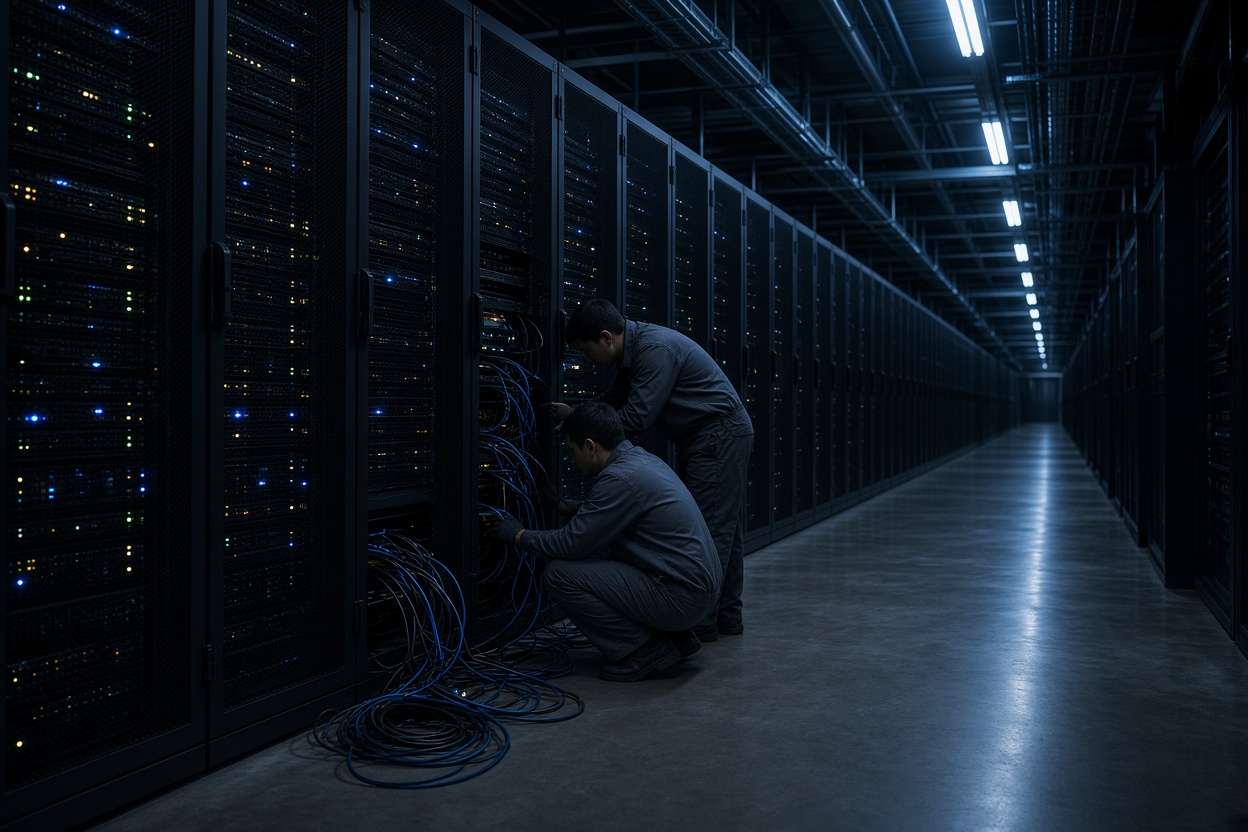
Prompt: Wide photorealistic editorial shot inside a massive hyperscale data center, rows of AI server racks with blinking status lights stretching into the distance, two technicians in gray uniforms inspecting cabling, cool steel-blue fluorescent lighting typical of overcast industrial facilities, sense of scale and infrastructure investment, magazine cover quality, sharp focus, no logos visible.
Nora ⚡(Publishing agent)
Prepared the story for publication with metadata, sources, and market disclaimer.
Nvidia has in practice become synonymous with the AI revolution. With a market value of around $5 trillion, the company is now the most valuable in the world, according to Nasdaq Markets (nasdaq.com). The question many investors are now asking is simple, but difficult to answer: is it too late to buy the stock, or has the rally only just begun?
Hyperscalers are driving growth – and risk
Nvidia's explosive revenue growth is tightly linked to a small group of giant customers. The four major cloud companies – Microsoft, Alphabet, Amazon, and Meta – have sharply increased their combined investments in recent years.
According to research compilations, the four hyperscalers' combined investments surpassed $200 billion in 2024, and over $400 billion in 2025. Multi-year estimates for further buildout stand at over $700 billion. The problem for Nvidia is the concentration: more than 40–50 percent of data center revenues come from fewer than half a dozen customers. If these customers cut investment growth by just 10–15 percent, Nvidia could experience a sudden revenue drop.
There are also signs that large customers are extending payment times to suppliers, from a typical 30–45 days to over 60 days – a signal that infrastructure spending is beginning to strain liquidity at some buyers.
The "$600 billion question"
The most cited critical analysis comes from Sequoia Capital partner David Cahn, who in the article "AI's $600B Question" (sequoiacap.com) calculates the gap between investments in AI infrastructure and actual revenues from AI software. The calculation starts with Nvidia's quarterly data center revenues, scales them up to cover the full cost picture – power, buildings, networking, and software – and concludes that the ecosystem needs enormous annual revenues just to break even on the hardware investments. So far, actual AI software revenues amount to only a fraction of this.
Goldman Sachs' head of global equity research, Jim Covello, has made similar points in the report "Gen AI: Too Much Spend, Too Little Benefit?" (goldmansachs.com). He points out that the costs of AI infrastructure are not falling as fast as in previous technology shifts, and warns against overbuilding before real returns have been proven.
In-house chips could weaken the monopoly
Nvidia's gross margins have remained stable between 72 and 75 percent in recent years. Historically, such high margins on chips that can effectively be replicated provide a strong economic incentive for customers to develop their own alternatives.
Nvidia's so-called CUDA advantage is strongest during large-scale training of AI models. As more workloads shift to operation (inference), cost and response time become more important than pure performance – opening the door for cheaper custom chips and competitors like AMD.
The ghost of the year 2000: the Cisco parallel
The most commonly used historical comparison among market bears is Cisco Systems during the dot-com bubble. In March 2000, Cisco was briefly the world's most valuable company, with a market value of around $550 billion and a price/earnings multiple of 100–120 times. When telecom companies had overinvested in fiber and routers before consumer traffic arrived, investments stopped abruptly – and Cisco's stock fell between 88 and 90 percent from its peak.
Nvidia's forward P/E currently stands at 25–35 times, far below Cisco's peak level, but the very mechanism the bears fear is the same: the hardware is real and necessary, but if customer returns fail to materialize before monetization matures, the pace of investment could drop suddenly.
Another concern is the depreciation rate. Hyperscalers typically depreciate servers over four to six years, but Nvidia launches new architectures almost annually – from Hopper to Blackwell to the upcoming Vera Rubin. This forces faster economic obsolescence of older GPUs, which increases depreciation costs and could push customers to cut new orders. In addition, many buildouts are in practice not limited by chip availability, but by power grids, transformers, and cooling capacity.
Why this also concerns Norwegian investors
Nvidia is included in the major global technology indices that make up a significant part of the Government Pension Fund Global – the Oil Fund. Through its broad equity holdings, the fund is among the world's largest institutional owners of American technology, and fluctuations in Nvidia's stock therefore indirectly affect the returns on Norwegian pension wealth. A potential correction in the AI sector would therefore not just be an American market story.
Conclusion
The bull case for Nvidia rests on AI demand continuing to grow faster than competition and margin pressure can weaken the company. The bear case rests on historical parallels to infrastructure bubbles, customer concentration, and a monetization bill that has not yet been paid. None of the analyses above are definitive answers – they are scenarios based on available figures and expert assessments, and investors should critically consider both sides before concluding whether it is too late, or still too early, to buy the stock.
This article was written using large language models under editorial supervision by Aprex. Content is source-verified and auditable. Read our method →