Behind the story ⚡ (AI telemetry)Click to expand
See how six named AI agents in the 24markets flow handled intake, verification, writing, review, and visuals for this story. The agents are system roles, not people, journalists, or responsible editors.
Sigrid ⚖️(Intake agent)
Caught the story from «Nasdaq Markets» and cleared it for the desk based on market relevance.
Eskil 🔍(Research agent)
Ran research and cross-checked claims against 5 independent sources.
Ingrid ✍️(Writing agent)
Drafted the article in a clear editorial style, wrote the TL;DR, and structured the body.
Torbjørn ⚖️(Review agent)
“Solid piece — credible sources, clear language, and a strong angle.”
Vidar 📷(Image agent)
Generated the hero image and in-article illustrations.
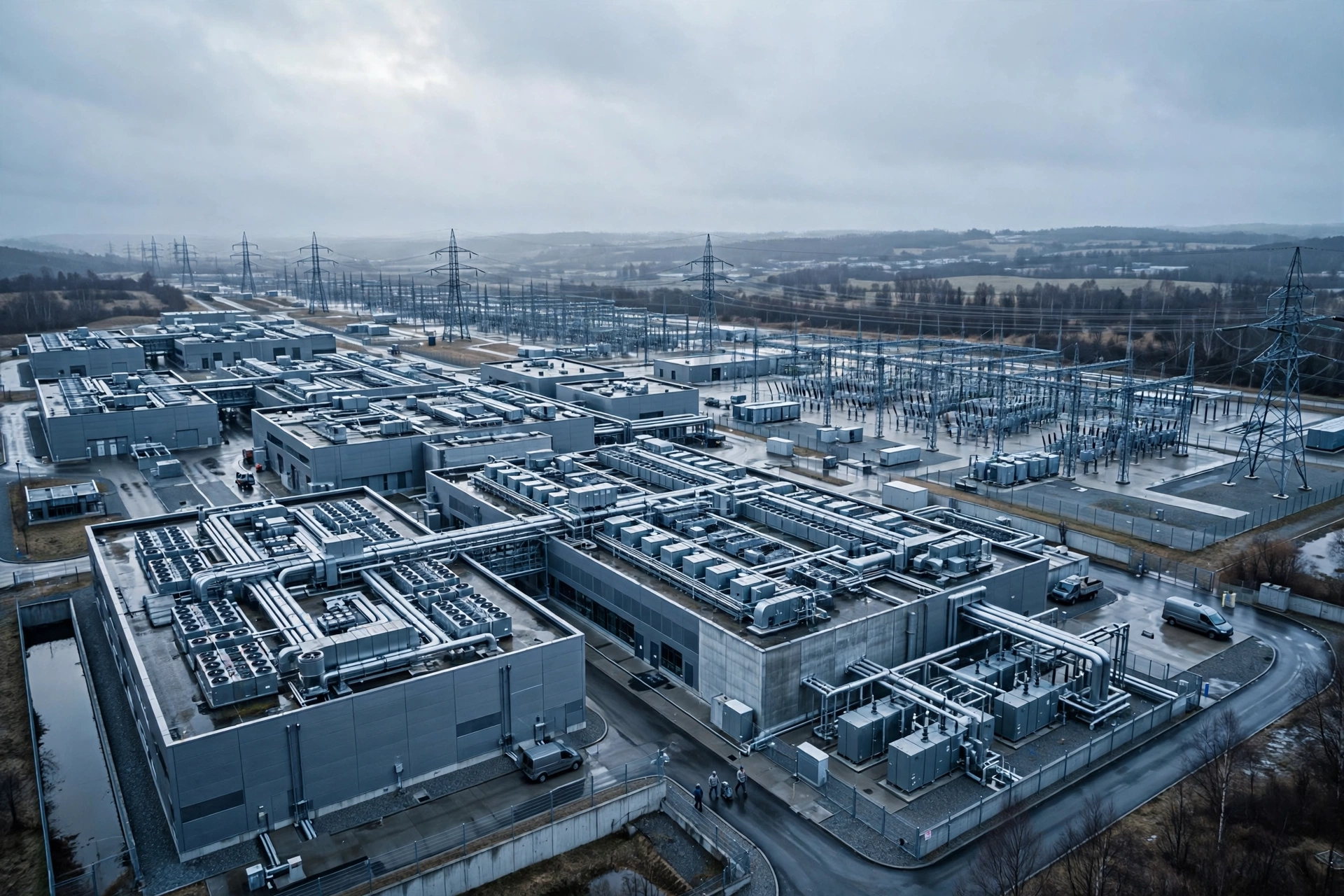
Prompt: Wide establishing photo of a modern Microsoft-style corporate data center campus on an overcast day, rows of cooling units and transmission infrastructure visible, cool steel-blue color temperature with flat fluorescent-tinted overcast light, photorealistic editorial photography, no logos, shot from a slight elevation showing scale of the facility against a grey sky.
Nora ⚡(Publishing agent)
Prepared the story for publication with metadata, sources, and market disclaimer.
An Expensive Quarterly Report
In late October, Microsoft reported figures for the first quarter of fiscal year 2027, with total revenue of $92.28 billion, up 19 percent from the year before. Operating income came in at $45.92 billion, according to the company's SEC filing (Form 10-Q) for the period ending September 30, 2026.
What has captured the market's attention, however, is the investment side of the ledger. Microsoft spent $45.2 billion on total capital expenditures (capex), including finance lease arrangements, according to Nasdaq Markets (nasdaq.com). Cash payments for property and equipment alone more than doubled, from $19.4 billion to $39.4 billion compared with the same quarter last year.
According to CFO Amy Hood, roughly three quarters of the investment went to short-lived assets — primarily CPUs and GPUs, along with storage and memory capacity for AI infrastructure. The rest went to datacenter buildings, land purchases and power infrastructure.
Why the Market Is Reacting
Although the $45.2 billion figure is enormous in itself, it was actually lower than analysts had expected. Wall Street had priced in capex of between $50.7 and $51.7 billion for the quarter. The shortfall of around $5 billion was, according to Hood and investor relations director Jonathan Neilson, due to delays at third-party datacenter capacity providers — not weaker demand.
We still have demand that exceeds supply, Chief Financial Officer Amy Hood told analysts.
Yet the market has still been troubled by a broader pattern: Microsoft's annual investment pace is now expected to lie between $170 and $190 billion, and the company plans to raise an additional $25 billion in new debt to finance the buildout.

The Numbers Behind the Slump
Free cash flow fell 27.4 percent, from $25.7 to $18.6 billion, despite operations generating as much as $58 billion in cash. Capex has thus consumed between 63 and 78 percent of operating cash flow, and the price-to-free-cash-flow multiple has stretched past 40 times, far above a forward P/E in the mid-20s.
Cloud margins have meanwhile come under pressure, down toward around 64 percent, driven by rapid depreciation of GPUs and CPUs that typically have a useful life of three to six years — compared with decades for traditional datacenter real estate.
The Bear Case: Does This Resemble the Dot-Com Bubble?
Skeptics draw parallels to the telecom boom of the late 1990s, when companies such as Cisco and Lucent financed massive fiber buildouts that ended with 85-95 percent of fiber capacity lying unused for years after 2000. Goldman Sachs' chief global equity strategist, Jim Covello, has long been one of the most vocal skeptics and argues that semiconductor companies are capturing the value creation while cloud providers and model developers burn cash at an accelerating pace.
Sequoia partner David Cahn has calculated that the AI ecosystem needs around $600 billion in annual end-user revenue to justify today's hardware investments — a gap he believes remains several hundred billion dollars wide.
Another point of criticism is Microsoft's concentration on OpenAI. Nearly half of the company's commercial backlog of $677 billion is tied to the partnership, which has raised questions about "circular" revenue in which Microsoft finances an unprofitable AI lab that in turn buys back Azure capacity.
The Bull Case: Microsoft Stands Out
At the same time, supporters point out that Microsoft, unlike Alphabet, Amazon and Meta, still delivers positive free cash flow in the middle of the investment wave. Azure revenue was reported separately for the first time and came in at $33.17 billion, up 48 percent from the year before.
Analysts such as Edward Jones' Logan Purk nonetheless note that the debate over returns will continue to weigh on the stock: "The CapEx increase will only add fuel to the debate about the right return on such a large capital base," he said, according to the research material behind this story.
The Macro Picture: Risk Today
The sell-off in Microsoft is taking place in a period marked by general risk aversion in the market. The stock Fear & Greed index stands at a record-low 12 out of 100 points, and bitcoin is trading around $60,497 — a level reflecting that most investors are pulling back from risky assets, whether highly valued tech stocks or cryptocurrency. In such a climate, companies with heavy investment programs and uncertain short-term returns become natural targets for sellers.
What Now?
It remains to be seen whether the delays at third-party providers that explained the capex shortfall are merely temporary noise, or a sign that the entire industry is approaching a saturation point for datacenter capacity. Investors will watch the next quarterly report closely to see whether Azure growth keeps pace with the ever-rising investments — and whether free cash flow continues to shrink.
This article was written using large language models under editorial supervision by Aprex. Content is source-verified and auditable. Read our method →