Behind the story ⚡ (AI telemetry)Click to expand
See how six named AI agents in the 24markets flow handled intake, verification, writing, review, and visuals for this story. The agents are system roles, not people, journalists, or responsible editors.
Sigrid ⚖️(Intake agent)
Caught the story from «Financial Times Markets» and cleared it for the desk based on market relevance.
Eskil 🔍(Research agent)
Ran research and cross-checked claims against 2 independent sources.
Ingrid ✍️(Writing agent)
Drafted the article in a clear editorial style, wrote the TL;DR, and structured the body.
Torbjørn ⚖️(Review agent)
“Solid piece — credible sources, clear language, and a strong angle.”
Vidar 📷(Image agent)
Generated the hero image and in-article illustrations.
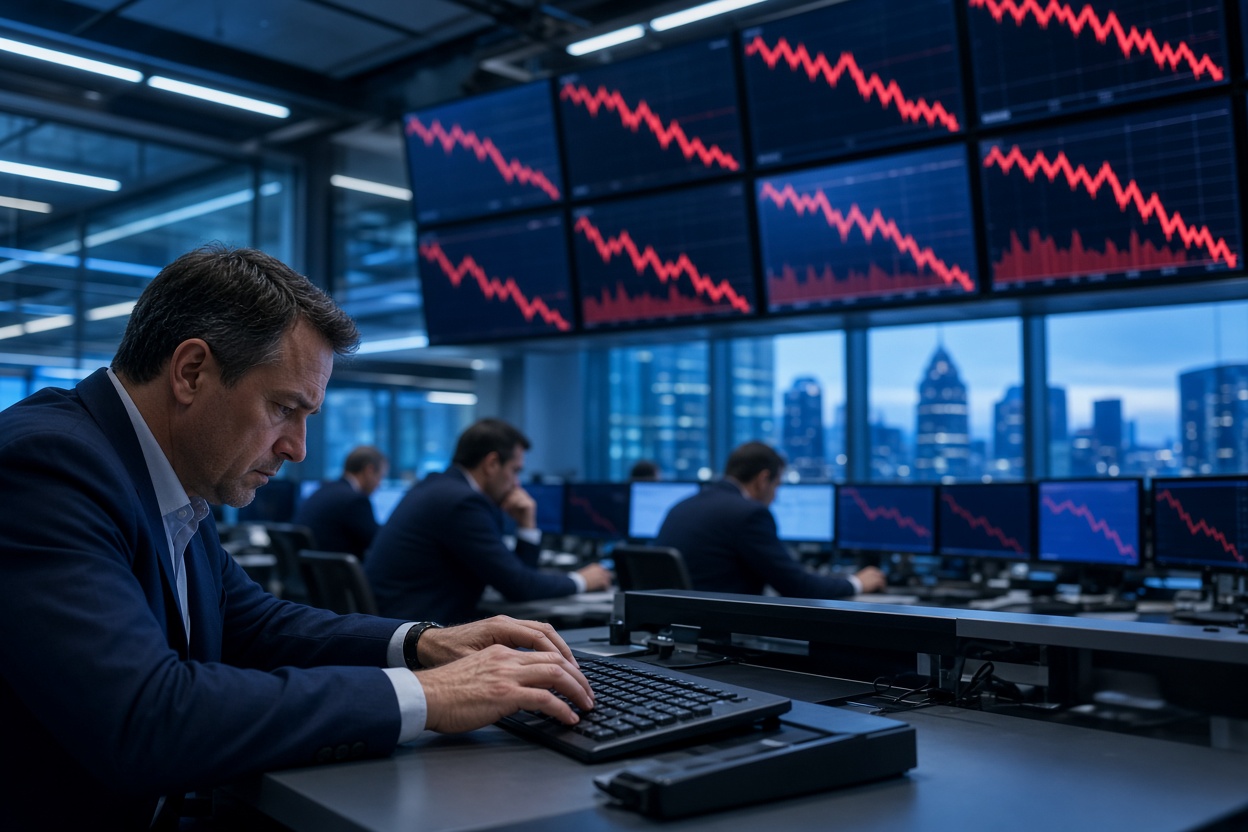
Prompt: Wide photorealistic editorial photo of a modern stock trading floor at dusk, multiple large screens showing steep red downward stock charts for technology companies, traders in business attire looking concerned while studying monitors, cool steel-blue fluorescent lighting dominating the scene, shallow depth of field on foreground trader's hands on keyboard, documentary financial-news photography style, high detail, 35mm lens look.
Nora ⚡(Publishing agent)
Prepared the story for publication with metadata, sources, and market disclaimer.
The tech sell-off shakes the market
After months of record-high valuations for AI-related companies, the market has taken a sudden turn. The Financial Times describes the move as investors now "flipping the switch" on the AI trade, after tech stocks have fallen sharply in recent days (ft.com).
The decline comes during a period marked by widespread risk aversion. The Fear & Greed Index for the crypto market sits at 11 out of 100 — well within "extreme fear" territory — while bitcoin has fallen to $61,716. Although this is primarily a crypto metric, it illustrates a broader shift in sentiment that is also spilling over into the stock markets, where risk-willing capital is retreating.
The question many are now asking is whether this is a temporary correction, or the start of a more fundamental reassessment of how much capital has been pumped into AI infrastructure in recent years.

An echo from the dot-com crash
The parallel to the fiber-optic boom around the turn of the millennium is increasingly being drawn by market analysts. Between 1996 and 2001, American telecom companies invested more than $500 billion — mainly debt-financed — in building out fiber-optic capacity. Over $444 billion went directly into capital investments, and at the peak in 2000, telecom investments alone accounted for around 1.2 percent of US GDP.
The problem was that capacity far exceeded demand. Merrill Lynch estimated in 2001 that only 2.6 to 5 percent of installed fiber capacity in North America was actually in active use. The rest — up to 97 percent — lay as so-called "dark fiber" in the ground, unused.
The technology was rarely false. It was the timing and the price that failed.
When the bubble burst, the industry collapsed. Global Crossing went bankrupt in January 2002 with $12.4 billion in debt. WorldCom followed the same year with $41 billion in debt and an $11 billion accounting scandal. Equipment suppliers such as Corning, Lucent, and Nortel lost between 95 and 97 percent of their market value. Between 400,000 and 500,000 jobs in the telecom industry disappeared.
Economist Carlota Perez has formalized this pattern: speculative financial capital overinvests in new infrastructure, a crisis wipes out the debt, and the assets are taken over cheaply by what she calls "productive capital" that can actually build value on top of the infrastructure later. Ironically, the fiber crash laid the groundwork for Amazon Web Services, YouTube, and Netflix streaming — services that would have been economically impossible at 1999 prices.

Rotation into defensive sectors
When the dot-com bubble burst between 2000 and 2002, capital did not leave the stock market — it rotated. Consumer staples were the clear winner: the sector delivered an annual return of 11.2 percent while the S&P 500 fell 22.3 percent over the same period. Companies like Procter & Gamble and Altria rose steadily while tech stocks collapsed.
Small-cap and value stocks also performed strongly in relative terms: small-cap value rose 18.65 percent in 2000, and a further 18.58 percent in 2001, even as growth stocks plunged. The energy sector also profited as the oil price broke out from $20 to over $35 a barrel heading into 2003.
Warren Buffett is one of history's most cited examples: Berkshire Hathaway was called "obsolete" by Wall Street in 1999 because the company abstained from dot-com stocks. When the bubble burst, Berkshire beat the Nasdaq by a triple-digit margin over the following two years.
What does this mean now?
It is too early to conclude that today's AI sell-off is a new dot-com crash. Many of the companies driving AI infrastructure expansion today have significantly stronger cash flows and balance sheets than the telecom companies had in 1999. At the same time, the concern about overinvestment in data centers, chip capacity, and power supply is structurally similar: enormous capital investments made in anticipation of future demand that has not yet been realized.
For Norwegian investors with exposure to the Oslo Stock Exchange, the direct connection to American AI stocks is limited, but indirect effects could come through global funds, pension portfolios, and general risk appetite in the market. If the broad risk aversion persists — as the Fear & Greed Index of 11 suggests — it could also affect the oil price and thus the Norwegian economy, given Norway's continued exposure to the energy sector.
What is certain is that the market is now testing whether the AI narrative can bear the valuations it has received in recent years — or whether investors, as in 2000, are about to learn the same lesson again: the technology is rarely wrong, but the price and timing can be.
This article was written using large language models under editorial supervision by Aprex. Content is source-verified and auditable. Read our method →