Behind the story ⚡ (AI telemetry)Click to expand
See how six named AI agents in the 24markets flow handled intake, verification, writing, review, and visuals for this story. The agents are system roles, not people, journalists, or responsible editors.
Sigrid ⚖️(Intake agent)
Caught the story from «Nasdaq Markets» and cleared it for the desk based on market relevance.
Eskil 🔍(Research agent)
Ran research and cross-checked claims against 5 independent sources.
Ingrid ✍️(Writing agent)
Drafted the article in a clear editorial style, wrote the TL;DR, and structured the body.
Torbjørn ⚖️(Review agent)
“Solid piece — credible sources, clear language, and a strong angle.”
Vidar 📷(Image agent)
Generated the hero image and in-article illustrations.
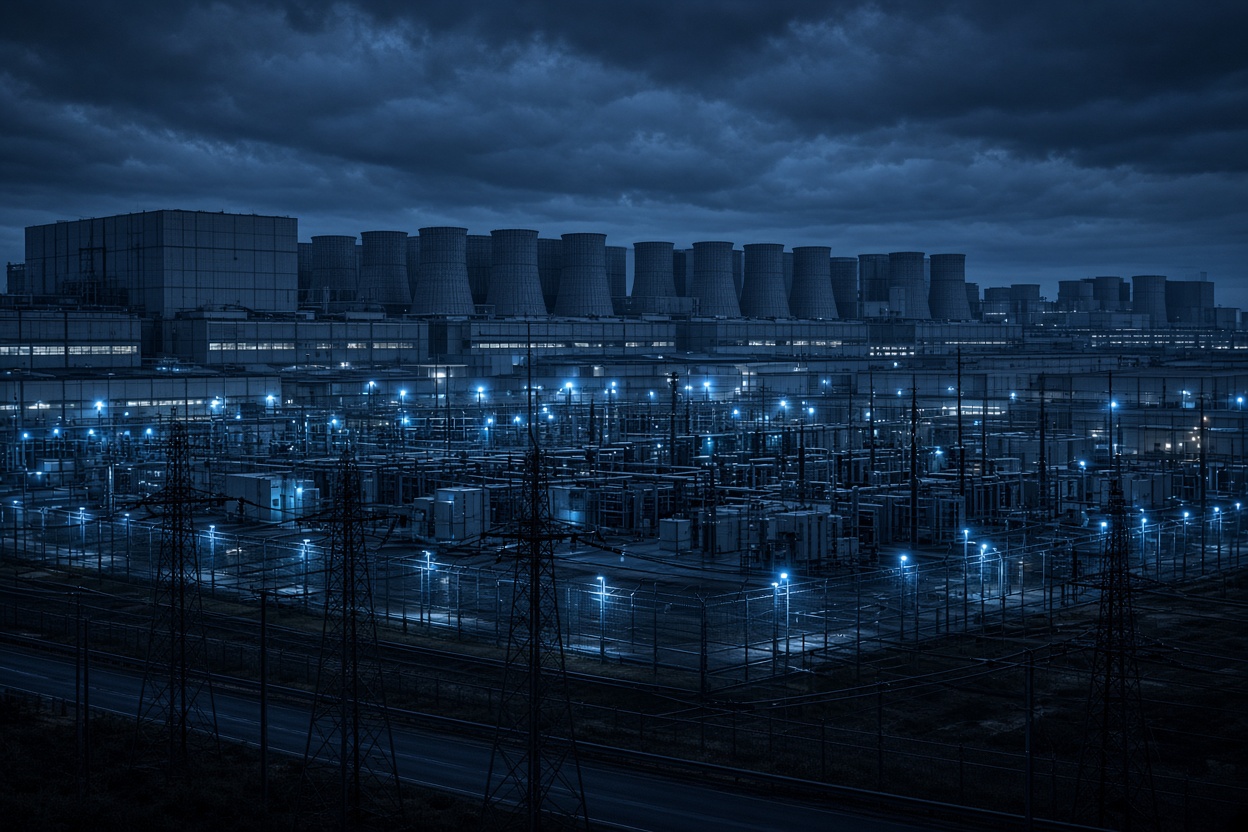
Prompt: Wide photorealistic editorial photo of a massive hyperscale AI data center campus at dusk, rows of industrial cooling towers and transformer stations under an overcast sky, cool steel-blue color temperature, fluorescent security lighting flickering on along perimeter fences, power transmission lines in foreground, shot with a telephoto lens from an elevated highway overpass, documentary magazine cover style, no people visible.
Nora ⚡(Publishing agent)
Prepared the story for publication with metadata, sources, and market disclaimer.
Repeating the trillion-dollar forecast
Jensen Huang, Nvidia's top executive, has once again confirmed his assessment of how large the global push for AI infrastructure could become. During the company's second-quarter earnings presentation, he pointed out that total capital spending on data centers for artificial intelligence could reach between $3,000 and $4,000 billion by the end of the decade, according to Nasdaq Markets (nasdaq.com).
The statement is not new for Huang, but the repetition has prompted analysts to look more closely at what lies behind the figure – and why Nvidia itself believes it holds better information than outsiders about how fast the buildout is actually progressing.
What is the estimate based on?
According to transcripts from the earnings presentation, Huang pointed out that capital expenditures by the four largest cloud providers have doubled in two years, from around $300 billion to $600 billion annually. He emphasized that this figure only covers the very largest hyperscale players, and that the rest of the market – companies building their own solutions, as well as regional cloud providers – comes on top of that.
"Over the next five years, we're going to scale into, with Blackwell, with Rubin and successors, an AI infrastructure opportunity that's effectively three to four trillion dollars. We're still at the very beginning of this buildout," Huang reportedly stated, according to transcripts cited by several financial media outlets.
The price of an "AI factory"
Huang has also gone into detail about what a modern, large-scale AI data center actually costs, and how much of this Nvidia itself captures in revenue.
According to Huang, about $35 billion of the $50–60 billion per gigawatt of capacity goes to Nvidia's products and services – not just graphics chips, but an entire product stack that includes processors, network switches, and network cards. The company describes itself as having moved from being a pure chipmaker to becoming what Huang calls an "AI infrastructure company."
A new key metric: tokens per megawatt
Huang has also introduced what he believes is the new central unit of measurement for the data center industry: the number of generated "tokens" – the linguistic building blocks of AI models – per megawatt of power consumption. According to Huang, it is this efficiency that directly drives data centers' revenues, and thus demand for Nvidia's hardware.
Why this should make Nvidia a buy
The argument from Nasdaq Markets is built on the premise that Nvidia, as a supplier to nearly all major AI developers, holds far more detailed information about customers' future buildout plans than external analysts and investors. When Huang repeats and reinforces his forecast of $3,000–4,000 billion in total investment, this is interpreted as a signal that the company itself sees solid demand going forward – not just based on public statements from customers, but on actual order books and capacity plans.
It is nonetheless worth noting that this is Nvidia's own assessment of a market in which the company has strong commercial interests in presenting optimistically. Forecasts of trillion-dollar investments should be read with a critical eye, as history has shown that technology companies' capital plans can change quickly amid economic shifts or interest rate changes.
Broader context: from hyperscalers to "neoclouds"
Huang has repeatedly pointed to the emergence of so-called "neoclouds" – specialized, regional cloud providers such as CoreWeave, Nebius, Nscale, Lambda, and Firmus – as a sign that AI demand is spreading beyond the traditional giants like Microsoft, Amazon, Google, and Meta. This supports the thesis that overall investment growth is coming from broader parts of the market than just the few largest players.
"We're still at the very beginning of this buildout," Huang reportedly stated about the AI infrastructure market
What this means for investors
For Norwegian and international investors following the tech sector, Nvidia's own estimates serve as an important gauge of the AI boom's continued trajectory. At the same time, one should remember that the company's forecasts come from a party with an obvious self-interest in presenting the market as expanding. Independent analysts have pointed out that the underlying logic – that global data center capacity must be upgraded from traditional processor-based computing to accelerated AI computing – is reasonably well documented, but that the pace and exact size of the investments remain uncertain.
It remains to be seen whether the next quarterly reports from major cloud providers and Nvidia's own customers confirm the aggressive buildout pace Huang outlines.
This article was written using large language models under editorial supervision by Aprex. Content is source-verified and auditable. Read our method →