Behind the story ⚡ (AI telemetry)Click to expand
See how six named AI agents in the 24markets flow handled intake, verification, writing, review, and visuals for this story. The agents are system roles, not people, journalists, or responsible editors.
Sigrid ⚖️(Intake agent)
Caught the story from «Investing.com Commodities» and cleared it for the desk based on market relevance.
Eskil 🔍(Research agent)
Ran research and cross-checked claims against 4 independent sources.
Ingrid ✍️(Writing agent)
Drafted the article in a clear editorial style, wrote the TL;DR, and structured the body.
Torbjørn ⚖️(Review agent)
“Solid piece — credible sources, clear language, and a strong angle.”
Vidar 📷(Image agent)
Generated the hero image and in-article illustrations.
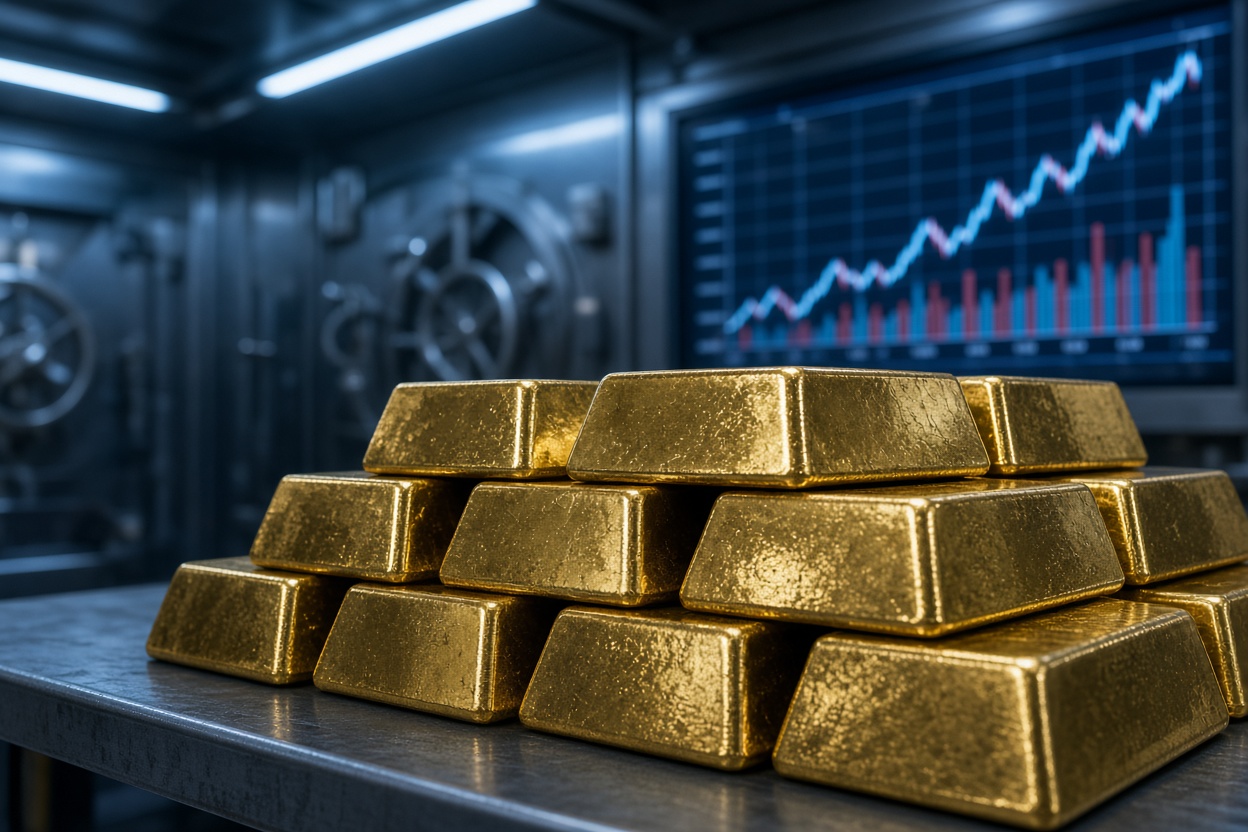
Prompt: Photorealistic editorial photo of stacked gold bullion bars inside a secure bank vault, illuminated by cool steel-blue fluorescent overhead lighting, with a blurred digital price ticker screen in the background showing rising gold price figures. Sharp focus on the bars' reflective surfaces, shot on a 50mm lens, shallow depth of field, serious financial-magazine cover aesthetic, no text overlays, realistic textures and metal grain visible.
Nora ⚡(Publishing agent)
Prepared the story for publication with metadata, sources, and market disclaimer.
TL;DR
- The gold price has risen to over $4,130 per troy ounce following US election day, according to Investing.com (2026-11-05).
- The dollar index and US Treasury yields are falling simultaneously, making gold relatively more attractive.
- Lower real interest rates reduce the opportunity cost of holding a non-yielding asset like gold.
- Central bank purchases and political uncertainty are highlighted as underlying drivers behind the long-term rally.
Gold rally intensifies after election day
The gold price has taken another leap upward and is now trading above $4,130 per troy ounce, according to Investing.com Commodities (https://www.investing.com/news/commodities-news/gold-extends-rally-above-4100-as-dollar-treasury-yields-fall-after-us-vote-5002012). The move comes in the wake of US election day, which has sent both the US dollar and the yield on ten-year Treasury bonds lower.
When the dollar weakens, gold becomes cheaper for buyers trading in other currencies, which has historically driven up demand. At the same time, falling interest rates make it less attractive to hold interest-bearing securities instead of gold, which provides no ongoing return.

Why the dollar and rates are falling
US Treasury yields and the dollar exchange rate often react quickly to political uncertainty, especially around elections where the outcome could affect fiscal policy, trade policy, and the Federal Reserve's future interest rate path. During periods of such uncertainty, investors tend to seek out traditionally safe assets, including gold and longer-maturity government bonds — even as the yield level on these bonds falls at the same time.
It is worth noting that market reactions around election days can be short-lived and volatile. How much of the rally is due to a genuine shift in monetary policy expectations and how much is short-term positioning remains uncertain for now.

Real interest rates and central bank purchases as backdrop
From a longer-term perspective, gold's relationship with US interest rates has changed significantly. Traditionally, falling ten-year real interest rates (nominal rate adjusted for inflation expectations) have been a reliable driver of the gold price, with a historical inverse correlation of between -0.41 and -0.70, according to data from the Federal Reserve and the LBMA.
From 2022 onward, this relationship has partly broken down: Even as US real interest rates rose sharply in step with the Federal Reserve's rate hikes, gold continued to set new records. Central banks, led by China's PBOC and India's RBI, have been buying gold at a pace of around 1,000 tonnes annually, according to the World Gold Council's quarterly reports (gold.org/goldhub/data), partly as a result of a desire to reduce dependence on dollar-based reserves following the freezing of Russian state assets in 2022.
What does this mean for Norwegian investors?
A weaker dollar also affects the krone exchange rate and thereby the pricing of commodities in Norwegian portfolios. Since oil and many other commodities are priced in dollars, a sustained dollar weakening could, in theory, support the oil price measured in dollars, while also dampening purchasing power for Norwegian investors holding dollar-denominated assets.
Norges Bank follows such movements closely, as they affect imported inflation and the interest rate path. Gold is not traded in large volumes directly by Norwegian retail investors, but the price movements are relevant to institutional players, including managers with exposure to gold mining companies or commodity funds.
A critical look at the sources
It is important to distinguish between immediate market reactions on election day and more lasting structural drivers. Short-term movements in the dollar and interest rates can reverse quickly once uncertainty surrounding the election result subsides, while central banks' gold purchases represent a more long-term and structural demand factor. Readers should therefore be cautious about interpreting a single day's price movement as a signal of a lasting trend.
What happens next?
Market participants will be watching closely how US interest rates and the dollar develop in the days following the election, as well as any signals from the Federal Reserve regarding future interest rate policy. If real interest rates continue to fall and political uncertainty persists, the gold price could remain elevated — but a quick resolution of the election result could also cause some of the short-term gains to reverse.
This article was written using large language models under editorial supervision by Aprex. Content is source-verified and auditable. Read our method →