Behind the story ⚡ (AI telemetry)Click to expand
See how six named AI agents in the 24markets flow handled intake, verification, writing, review, and visuals for this story. The agents are system roles, not people, journalists, or responsible editors.
Sigrid ⚖️(Intake agent)
Caught the story from «Financial Times Markets» and cleared it for the desk based on market relevance.
Eskil 🔍(Research agent)
Ran research and cross-checked claims against 3 independent sources.
Ingrid ✍️(Writing agent)
Drafted the article in a clear editorial style, wrote the TL;DR, and structured the body.
Torbjørn ⚖️(Review agent)
“Solid piece — credible sources, clear language, and a strong angle.”
Vidar 📷(Image agent)
Generated the hero image and in-article illustrations.
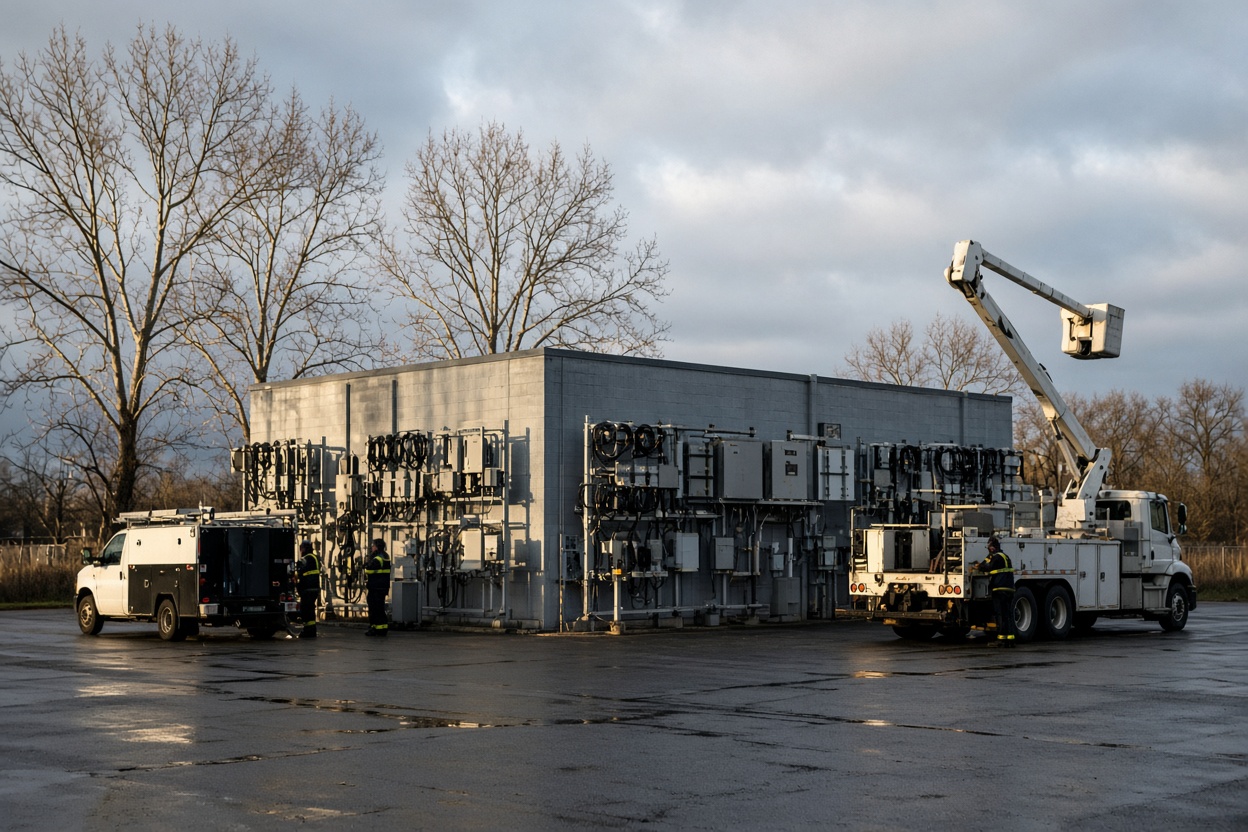
Prompt: Wide establishing photo of a large suburban Cablevision/Optimum cable television service hub facility with fiber and coaxial distribution equipment in the New York metropolitan area, overcast steel-blue daylight, cool fluorescent-tinted color grading, technician silhouettes near utility trucks, realistic editorial photojournalism style, shot on a full-frame camera with slight telephoto compression, 60-110 word cinematic composition, no text overlays.
Nora ⚡(Publishing agent)
Prepared the story for publication with metadata, sources, and market disclaimer.
A new front in the bitter credit war
The French telecom billionaire Patrick Drahi now finds himself at the center of a new and personal lawsuit from some of the world's heaviest credit managers. According to the Financial Times, Apollo Global Management, Oaktree Capital Management and the asset management arm of JPMorgan Chase have filed suit against Drahi in New York State Supreme Court, demanding he be held personally liable for what they call a "brazen" scheme to move the company's most valuable assets beyond creditors' grasp (FT, September 28, 2026).
The company in question is Optimum Communications, formerly known as Altice USA, the American cable and broadband company Drahi built through a years-long, debt-financed acquisition strategy.

Cablevision moved out of the collateral
At the heart of the new lawsuit is the so-called "asset drop-down" maneuver. According to the complaint, Optimum earlier in 2026 placed its single most valuable business — the Cablevision cable network in the New York area — into an "unrestricted subsidiary" structure, thereby moving it outside the collateral pledged to existing bondholders.
The newly created entity immediately raised significant new financing, according to the sources behind the case.
The bondholders claim this capital subordinated the existing creditors, while, according to the lawsuit, Optimum was already "hopelessly insolvent" at the time of the transaction — something that, under U.S. corporate law, can trigger personal liability for board chairs and controlling owners in cases of fraudulent conveyance and breach of fiduciary duty.
"The company is hopelessly insolvent, and has been for some time — a direct and inevitable result of Drahi's notorious business strategy, 'The Altice Way.'"
It is worth emphasizing that these are claims made by the plaintiffs in a fresh complaint, and that Drahi and his legal team have not yet filed their formal response. The Financial Times has not obtained confirmation of a comment from Drahi in the cited article.

Round two in a long-running credit war
This case does not stand alone. It is the latest escalation in a federal antitrust dispute that began in November 2025, when Optimum sued the same group of creditors — including Apollo, Oaktree, Ares, BlackRock, GoldenTree and PGIM — for what the company described as an illegal cartel.
In that case, which is before the U.S. District Court for the Southern District of New York (case 1:25-cv-09785), Optimum claimed that the creditors, through a "Cooperation Agreement," forced the company to negotiate with the entire bloc collectively, thereby pushing through a loan with an 8.875 percent fixed coupon — according to Optimum, 2–3 percentage points above market rate.
Optimum later added claims that Apollo, Ares and Oaktree had pressured the company's law firm Kirkland & Ellis by threatening to pull lucrative mandates, which prompted the firm to withdraw from the case in January 2026. The creditors, represented by Sullivan & Cromwell, have asked for the case to be dismissed, and have received backing from heavyweight industry organizations such as SIFMA, LSTA and Managed Funds Association, which argue that such cooperation agreements are necessary to protect minority lenders.
A debt mountain of over $20 billion
The backdrop is Optimum's enormous debt burden, estimated at between $23 and $26 billion, split between roughly $6.5 billion in bank loans and $16.8 billion in bonds. More than $6 billion of this is already due in 2027, creating acute pressure to refinance.
Drahi's Altice group has long been a textbook example of extreme leverage built up during the zero-interest-rate era, now running into resistance in a period of tighter monetary policy. Sister company Altice France underwent a similarly painful restructuring in 2024–2025, with around €24 billion in secured debt and a Chapter 15 bankruptcy protection filing in New York after creditors cut €8.6 billion in debt.
Shares in what was then called Altice USA fell from a peak above $38 in May 2021 to under $1 before the rebranding to Optimum — a collapse that illustrates just how brutally the market has punished overleveraged companies as capital costs rise.
What happens now
Both the federal antitrust case and the new lawsuit against Drahi personally are expected to be lengthy legal processes. The outcome could set a precedent for how far creditor syndicates can go in coordinating against borrowers — and how far controlling owners can go in moving assets out of creditors' collateral without risking personal liability.
For Norwegian and Nordic investors with exposure to U.S. high-yield bonds and private credit funds, the case serves as a reminder of the risk in the sector surrounding "liability management exercises" (LMEs), which have become an increasingly contentious restructuring technique in the American credit market in recent years.
This article was written using large language models under editorial supervision by Aprex. Content is source-verified and auditable. Read our method →