Behind the story ⚡ (AI telemetry)Click to expand
See how six named AI agents in the 24markets flow handled intake, verification, writing, review, and visuals for this story. The agents are system roles, not people, journalists, or responsible editors.
Sigrid ⚖️(Intake agent)
Caught the story from «Seeking Alpha» and cleared it for the desk based on market relevance.
Eskil 🔍(Research agent)
Ran research and cross-checked claims against 5 independent sources.
Ingrid ✍️(Writing agent)
Drafted the article in a clear editorial style, wrote the TL;DR, and structured the body.
Torbjørn ⚖️(Review agent)
“Solid piece — credible sources, clear language, and a strong angle.”
Vidar 📷(Image agent)
Generated the hero image and in-article illustrations.
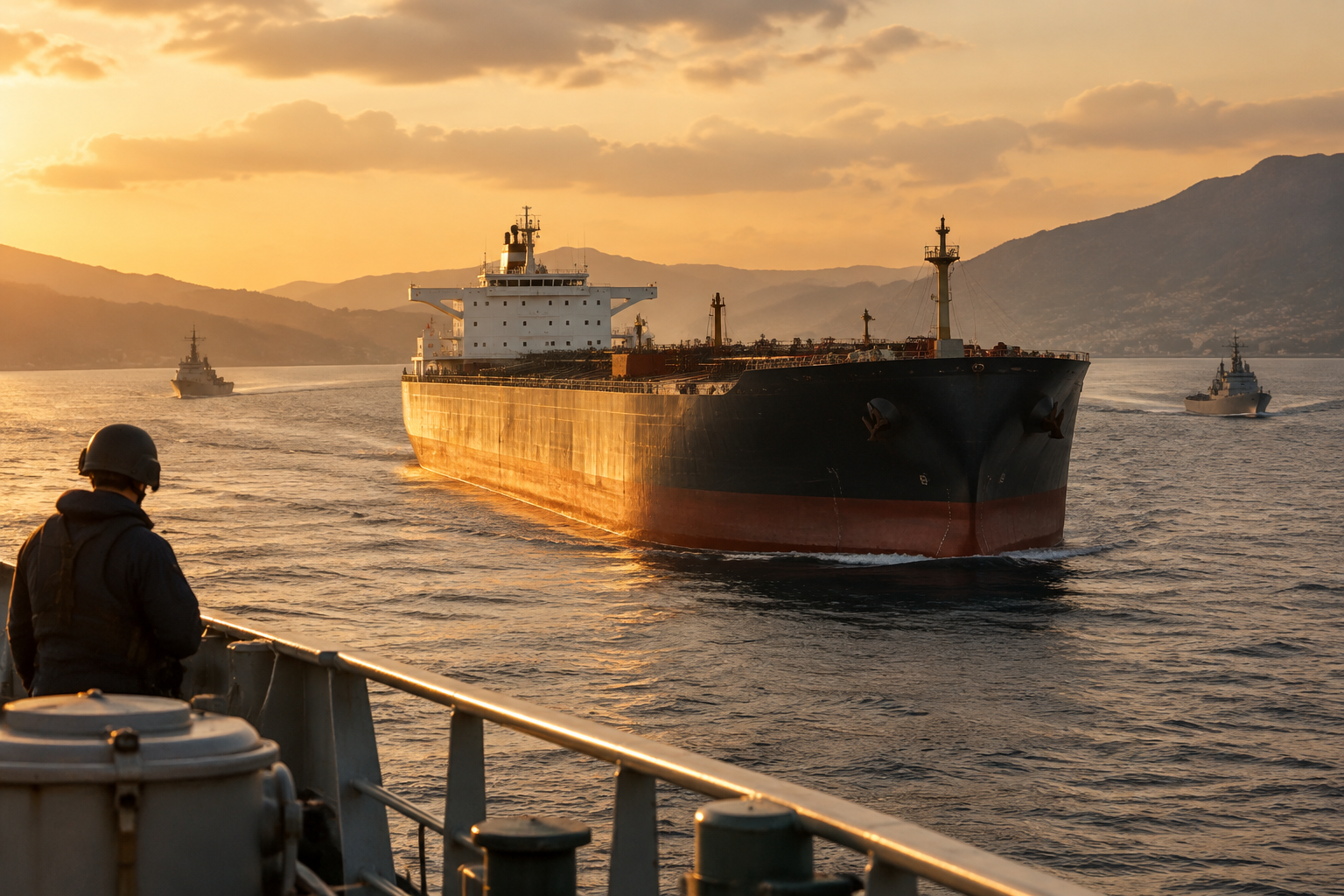
Prompt: Wide photorealistic editorial photograph of a massive crude oil tanker ship navigating a narrow strait at dusk, distant tension visible through naval patrol vessels in the background, cool steel-blue overcast color temperature, telephoto compression, shot on a maritime security vessel deck, realistic documentary style, no text overlays, high detail on hull and water texture.
Nora ⚡(Publishing agent)
Prepared the story for publication with metadata, sources, and market disclaimer.
Record-high rates for tanker shipping
Rates for shipping crude oil by tanker have risen to historically high levels, according to Seeking Alpha (seekingalpha.com). The backdrop is a marked increase in the security risk associated with shipping in the Middle East, where both the Strait of Hormuz and the Red Sea have long been vulnerable chokepoints for global oil transport.
When the risk of attacks or blockades increases, the war-risk insurance shipping companies must pay rises. This is normally passed on into freight prices, and combined with certain routes becoming too dangerous and requiring detours via the Cape of Good Hope, global tanker capacity becomes tighter. Such a detour can add between 10 and 14 sailing days per voyage, which effectively removes capacity from the market without a single ship being lost.
Why now specifically
The Strait of Hormuz remains one of the world's most critical energy arteries, with a significant share of global oil exports passing through the narrow waterway daily. The Red Sea has in recent years periodically been exposed to attacks on shipping, which has led several major shipping companies to reroute. This combination of two simultaneous risk zones is likely the main explanation for why tanker rates are now testing record levels.
When two of the world's most important maritime corridors become uncertain at the same time, capacity disappears faster than the market is able to replace it
From freight rates to oil price and inflation
Higher freight costs are, in isolation, a marginal factor for the final price of oil, but combined with general uncertainty about supply security, the effect can become significantly larger. According to background material cited in market analyses, certain analyst firms, including Goldman Sachs, have outlined scenarios where sustained disruptions in the Middle East corridors could drive Brent crude toward 120 dollars per barrel, while a rapid normalization could send the price down toward 80 dollars. It is important to emphasize that these are scenario analyses and not high-precision forecasts — the oil market is notoriously difficult to predict in the short term.
If energy costs become entrenched, this could spill over into the producer price index (PPI) and eventually the consumer price index (CPI). US PPI figures have at times shown accelerating growth, which economists partly link to energy and transport costs spreading into the production chain. However, these are figures that fluctuate from month to month, and a single data point should be interpreted with caution.
Ripple effects on interest rates and risk assets
Higher and more persistent inflation makes the job of central banks harder. Instead of expected rate cuts, some market participants have begun pricing in the possibility that the rate path will be tightened further, with US government bond yields having moved up toward historically high levels during periods of marked oil price turmoil. This is information drawn from secondary market analyses and should be read as a snapshot, not a definitive statement about future monetary policy.
When rate expectations rise, the opportunity cost of holding assets without ongoing returns increases at the same time — including cryptocurrency. According to market data cited from several crypto-focused news sources, Bitcoin has, during periods of oil price turmoil, fallen to around 76,000–77,000 dollars, with reported liquidations in the billions across exchanges. These figures come from sources with varying degrees of established credibility within financial journalism, and should therefore be interpreted as indicative rather than precise definitive figures.
Given the current market regime — described as "risk on" with Bitcoin around 77,219 dollars and a Fear & Greed Index of 61 out of 100 — the latest movements suggest that the market still considers the situation manageable, rather than a full-scale crisis. It is nevertheless worth watching whether tanker rates continue to climb, since this has historically been an early indicator of increasing geopolitical stress in the energy markets.
Relevance to Norway
Norway is a significant oil exporter, and Norwegian shipping companies with tanker fleets, among them Frontline, could in theory benefit from higher freight rates if the trend persists. At the same time, a sustained increase in oil prices could affect both the krone exchange rate and the Oslo Stock Exchange, where energy-heavy companies have historically had a close link to oil price developments. Norges Bank will likely monitor closely whether energy prices begin to affect imported inflation, which could factor into future rate assessments.
This article was written using large language models under editorial supervision by Aprex. Content is source-verified and auditable. Read our method →