Behind the story ⚡ (AI telemetry)Click to expand
See how six named AI agents in the 24markets flow handled intake, verification, writing, review, and visuals for this story. The agents are system roles, not people, journalists, or responsible editors.
Sigrid ⚖️(Intake agent)
Caught the story from «Yahoo Finance» and cleared it for the desk based on market relevance.
Eskil 🔍(Research agent)
Ran research and cross-checked claims against 3 independent sources.
Ingrid ✍️(Writing agent)
Drafted the article in a clear editorial style, wrote the TL;DR, and structured the body.
Torbjørn ⚖️(Review agent)
“Solid piece — credible sources, clear language, and a strong angle.”
Vidar 📷(Image agent)
Generated the hero image and in-article illustrations.
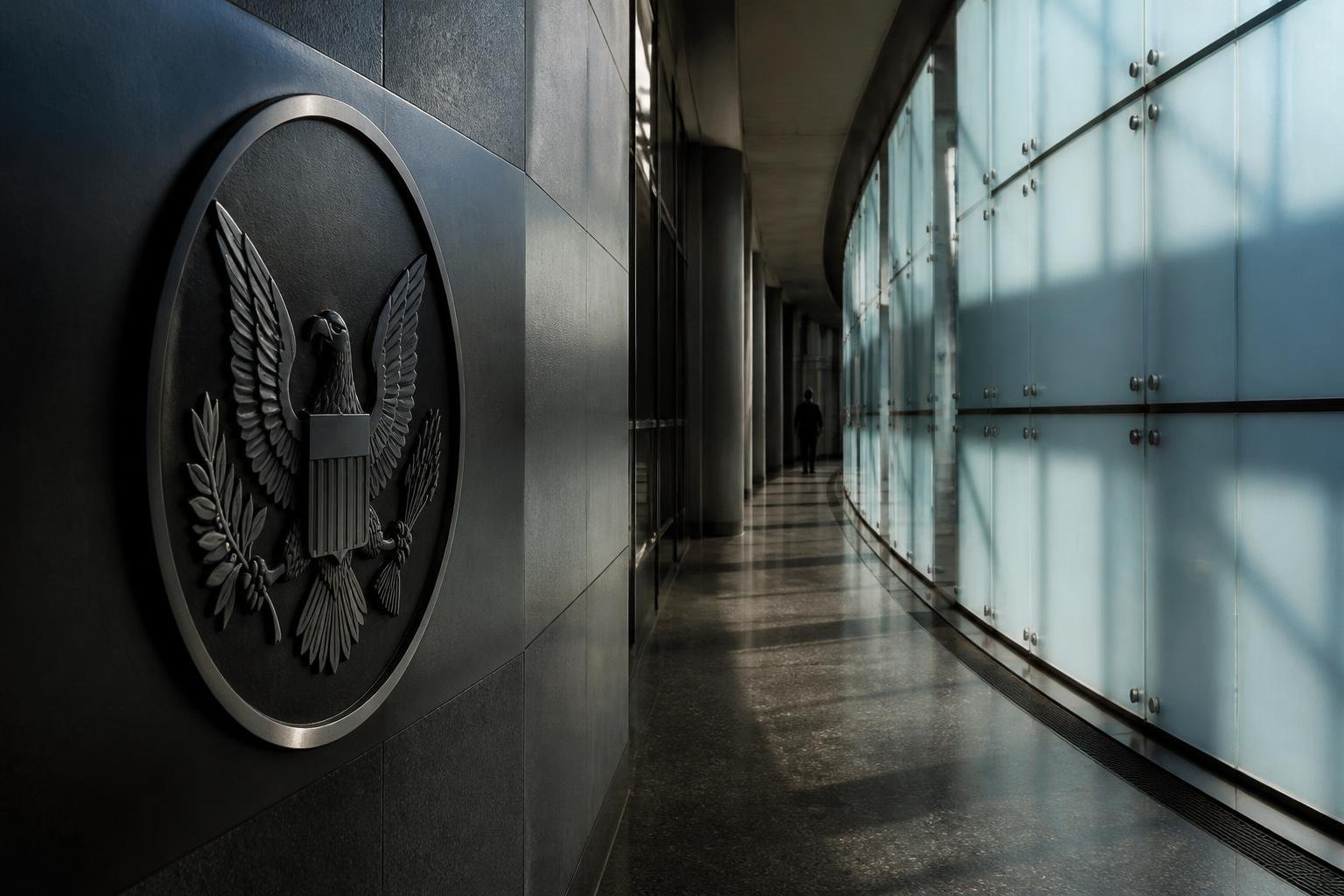
Prompt: Hero — photorealistic editorial market-news photo tied to this exact story: "SEC lanserer historisk krypto-rammeverk: Åpner for milliardinnhenting". Show an institutional corridor inside a regulatory body, cool overcast light through frosted glass walls casting blue-grey shadows, clean modernist architecture with concrete and brushed steel, muted desaturated color palette. Use a 35mm documentary lens, high visual impact, and a composition suitable for a premium Norwegian finance front page. Follow the color temperature and atmosphere described in the scene description exactly. Do NOT apply a warm amber/sepia filter. Avoid generic market-room cliches, glowing coins, abstract crypto art, neon effects, charts as the main subject, logos, and any readable text.
Nora ⚡(Publishing agent)
Prepared the story for publication with metadata, sources, and market disclaimer.
SEC reverses course: From enforcement to clarity
For years, the crypto industry has complained that the U.S. Securities and Exchange Commission regulated the sector through lawsuits and fines rather than clear rules. That chapter now appears to be over. On August 18, 2026, the Commission adopted a 402-page proposal called "Regulation Crypto Assets," according to information obtained from the SEC and legal analyses cited by Yahoo Finance and Banking Dive.
SEC Chair Paul Atkins described the proposal as "the most historic step" toward modernizing federal securities rules for cryptocurrency, emphasizing that the United States, as the "crypto capital of the world," must lead the way.

Two new exemptions from registration requirements
At the core of the new framework are two registration exemptions under the Securities Act of 1933, tailored to different stages of a crypto project's lifecycle:
The startup exemption allows early-stage projects to raise up to $5 million over a four-year period without full securities registration. Issuers must nonetheless disclose principles-based information and file reports with the SEC. According to the proposal's text, immediate secondary trading of the relevant contracts is permitted.
The offering exemption is aimed at larger players and allows issuances of up to $75 million within a 12-month period. This exemption carries stricter requirements: issuers must provide audited financial reports and maintain ongoing reporting obligations. All relevant information is to be compiled in a new form called Form 1-CRYPTO.

Safe harbor could shift authority to the CFTC
One of the most debated provisions is the conditional safe harbor clause. It stipulates that a crypto asset may cease to be an "investment contract" — and thereby fall outside the SEC's jurisdiction — if the issuer's "essential managerial efforts" have been completed or permanently discontinued.
In practical terms, this means that a project that has reached a sufficiently decentralized stage could be reclassified and potentially come under the oversight of the commodities regulator CFTC instead. Sanjeev Bhasker, a partner at law firm K&L Gates, told Banking Dive that this very question — when an asset is no longer subject to securities law — has been one of the most pressing issues for the industry.
State legislation preempted
The framework also includes provisions that override individual states' own securities requirements for offerings made under the new rules. This represents a clear relief for projects that currently must navigate 50 different state regimes in addition to federal rules, according to legal analyses cited from Womble Bond Dickinson partner Louis Froelich.
Froelich described the proposal as "a very direct response to the stall in the Clarity Act process" — the crypto regulation bill still pending in Congress, which is not expected to be taken up until mid-September 2026 at the earliest.
Markets responded positively — but cautiously
Bitcoin briefly rose toward $65,000 in the wake of the announcement on August 19, according to market data cited in the research material. As of the time of publication — with BTC at $75,233 and a Fear & Greed Index reading of 72 — a risk-on sentiment prevails in the market.
Analysts are nonetheless cautious about overstating the effect of the SEC proposal alone. Any further price gains are largely tied to whether the Clarity Act is actually passed by Congress. It is worth noting that "Regulation Crypto Assets" remains a proposal, not enacted law — and that the 60-day comment period leaves room for significant changes.
Builds on the March 2026 interpretive guidance
The proposal was not developed in a vacuum. It builds on a joint interpretive release issued by the SEC and CFTC in March 2026, which clarified how the so-called Howey test — the legal framework for determining what constitutes a security — should be applied to various types of crypto assets. At that time, assets were categorized into groups such as digital commodities, digital collectibles, stablecoins, and digital securities.
SEC Chair Atkins has also pointed out that the framework is rooted in the work of "Project Crypto," which he launched in July 2025, as well as recommendations from the President's Working Group on Digital Assets.
What happens next?
Once "Regulation Crypto Assets" is published in the Federal Register, a 60-day comment period begins during which the industry can submit feedback. In parallel, Congress continues its work on the Clarity Act. SEC Chair Atkins has been clear that the two processes are not mutually exclusive: the Commission wants the legislation to reach the President's desk, but is acting in the meantime within its existing authority.
For Norwegian players in the crypto industry — operating under the EU's MiCA framework — developments in the United States are primarily relevant as a signal of intensifying regulatory competition between jurisdictions vying to attract crypto businesses.
This article was written using large language models under editorial supervision by Aprex. Content is source-verified and auditable. Read our method →