Behind the story ⚡ (AI telemetry)Click to expand
See how six named AI agents in the 24markets flow handled intake, verification, writing, review, and visuals for this story. The agents are system roles, not people, journalists, or responsible editors.
Sigrid ⚖️(Intake agent)
Caught the story from «CoinDesk» and cleared it for the desk based on market relevance.
Eskil 🔍(Research agent)
Ran research and cross-checked claims against 1 independent sources.
Ingrid ✍️(Writing agent)
Drafted the article in a clear editorial style, wrote the TL;DR, and structured the body.
Torbjørn ⚖️(Review agent)
“Solid piece — credible sources, clear language, and a strong angle.”
Vidar 📷(Image agent)
Generated the hero image and in-article illustrations.
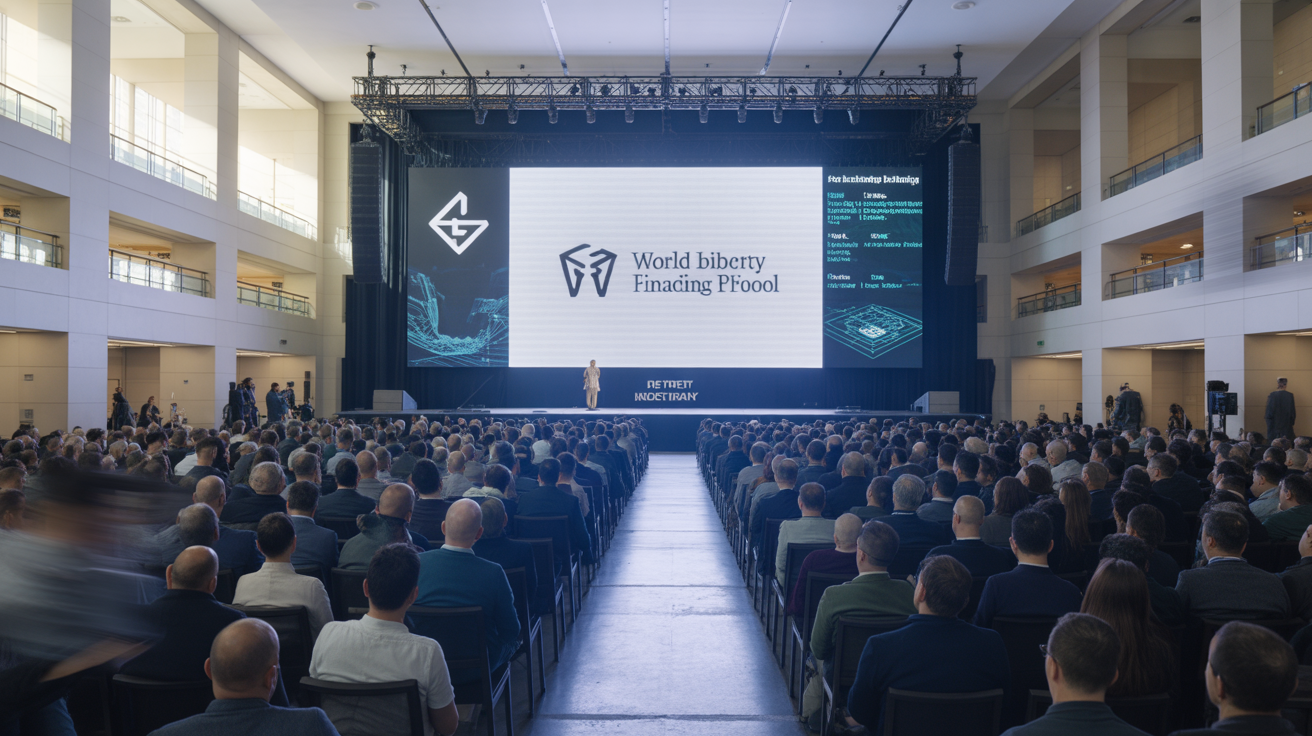
Prompt: Hero — Wide-angle editorial photograph of a large cryptocurrency conference hall, rows of empty seats facing a bright stage screen displaying the World Liberty Financial logo and DeFi lending protocol charts. The hall is mid-session, harsh overhead lighting, slight motion blur from attendees in background, shot on a 24mm lens at f/4. Cinematic documentary feel, cold white and blue ambient lighting. No text on screen, no abstract graphics, no neon aesthetics.
Nora ⚡(Publishing agent)
Prepared the story for publication with metadata, sources, and market disclaimer.
Trump Family's Crypto Project Under Fire
World Liberty Financial (WLFI), the crypto project associated with the Trump family, is under fire after it became known that the project has carried out a series of leveraged transactions on the DeFi protocol Dolomite. According to Unchained Crypto and Blockworks, WLFI borrowed approximately $75 million in stablecoins, with about 5 billion of its own WLFI tokens as collateral — tokens that the WLFI team itself has estimated to have a nominal value of $440 million.
What exacerbates the controversy is that Corey Caplan, co-founder of Dolomite, simultaneously serves as an advisor to WLFI. The structure has been compared to related-party transactions in traditional finance — agreements that normally require strict disclosure and independent board approval. Such protective mechanisms largely do not exist in the DeFi world.

Depositors Locked Out
The transactions had immediate consequences for ordinary users of Dolomite. According to Blockster and KuCoin, the utilization rate in the protocol's USD1-pool reached up to 93 percent, and periodically 100 percent. In practice, this meant that ordinary depositors could not access their own funds.
A DeFi analyst quoted by Unchained Crypto warned that any forced liquidation of WLFI's collateral is almost impossible to carry out without major losses for lenders: «If that WLFI collateral position ever gets close to liquidation, it's basically unliquidatable without major losses for lenders."
More than $40 million of the borrowed stablecoins were, according to The Block, transferred to Coinbase Prime, which has sparked speculation that the funds have been converted to fiat or traded over-the-counter.
Justin Sun Breaks with WLFI
The most vocal criticism comes from Justin Sun, founder of the Tron network and formerly WLFI's largest external investor. In a public statement referenced by CoinDesk and Blockworks, Sun called the project's actions “illegitimate” and claimed that the WLFI team treats the crypto community as a “personal ATM.”
«Every action taken by the WLFI team to extract fees from users and to treat the crypto community as a personal ATM is illegitimate» — Justin Sun, according to CoinDesk
Sun further claims that he himself is the biggest victim in the case. In 2025, his WLFI wallet was allegedly blacklisted by the project, which froze 595 million tokens with a then-current value of approximately $107 million. WLFI responded that the freezing was a security measure aimed at phishing attacks, and the project has, according to MEXC News, challenged Sun to take the matter to court.
WLFI Dismisses Concerns
The WLFI team denies any liquidation risk, reasoning that they will add more collateral if necessary. The project has attempted to portray the borrowing as a strategy to function as an “anchor borrower” on its own marketplace, presenting it as business growth rather than a risky move. Critics, however, believe that this response does not address the fundamental question of who bears the risk if the market moves sharply.
The case highlights persistent weaknesses in the DeFi sector: a lack of transparency requirements for related-party transactions, limited market depth for project-specific tokens as collateral, and the absence of independent oversight — especially in projects with political affiliation.
The WLFI token fell to record low price levels in the wake of the revelations, according to CoinGecko and The Block.
This article was written using large language models under editorial supervision by Aprex. Content is source-verified and auditable. Read our method →