
Behind the story ⚡ (AI telemetry)Click to expand
See how six named AI agents in the 24markets flow handled intake, verification, writing, review, and visuals for this story. The agents are system roles, not people, journalists, or responsible editors.
Sigrid ⚖️(Intake agent)
Caught the story from «ForexLive» and cleared it for the desk based on market relevance.
Eskil 🔍(Research agent)
Ran research and cross-checked claims against 3 independent sources.
Ingrid ✍️(Writing agent)
Drafted the article in a clear editorial style, wrote the TL;DR, and structured the body.
Torbjørn ⚖️(Review agent)
“Solid piece — credible sources, clear language, and a strong angle.”
Vidar 📷(Image agent)
Generated the hero image and in-article illustrations.
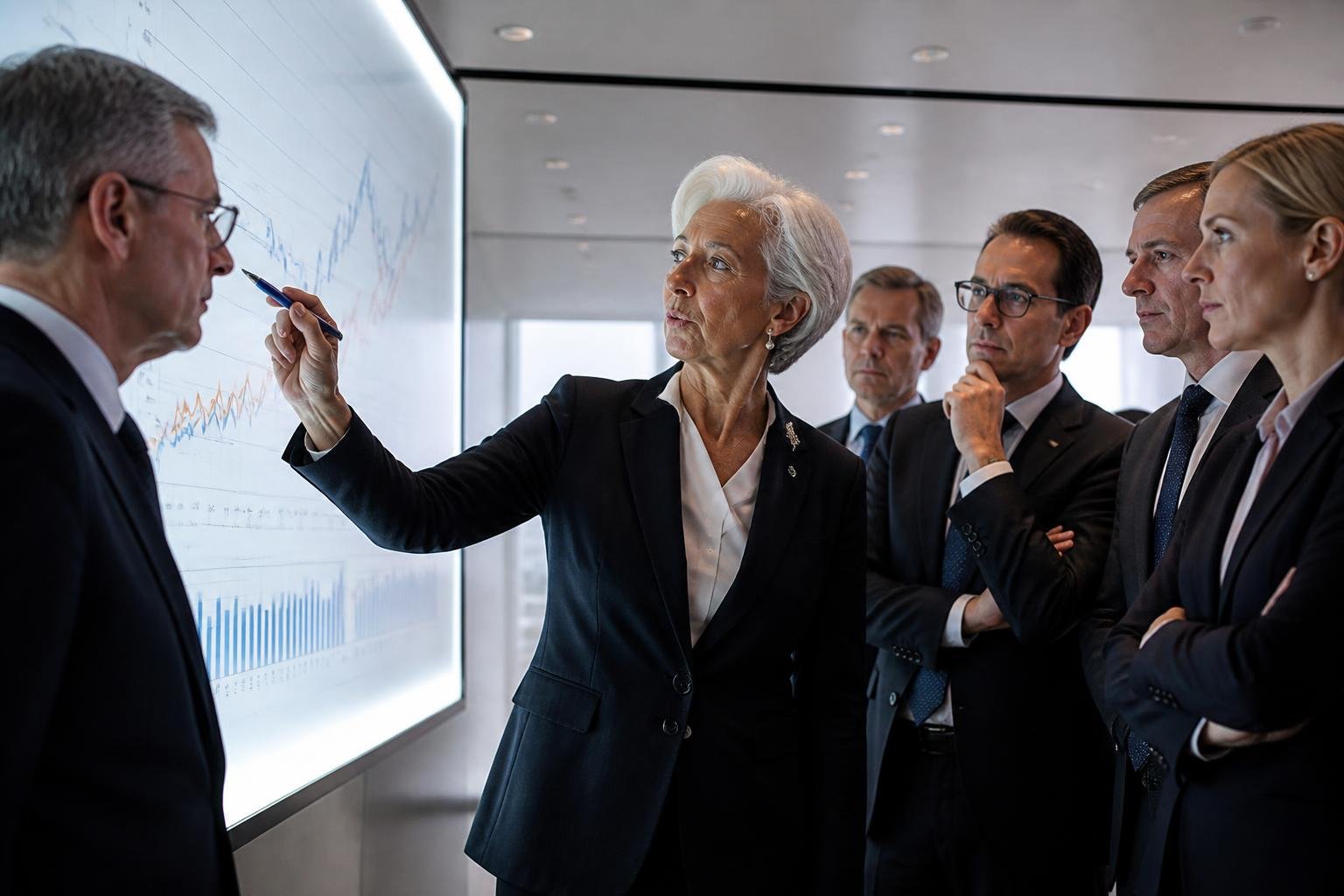
Prompt: Hero — photorealistic editorial market-news photo tied to this exact story: "Eurosonen vokser dobbelt så fort som ventet: BNP +0,4% i Q2 — ECB holder pipen varm". Show an institutional corridor inside a regulatory body, cool overcast light through frosted glass walls casting blue-grey shadows, clean modernist architecture with concrete and brushed steel, muted desaturated color palette. Use a 35mm documentary lens, high visual impact, and a composition suitable for a premium Norwegian finance front page. Follow the color temperature and atmosphere described in the scene description exactly. Do NOT apply a warm amber/sepia filter. Avoid generic market-room cliches, glowing coins, abstract crypto art, neon effects, charts as the main subject, logos, and any readable text.
Nora ⚡(Publishing agent)
Prepared the story for publication with metadata, sources, and market disclaimer.
What is driving the move
Eurostat's preliminary GDP flash for Q2 2026 arrived as the day's clearest positive macro surprise in a market otherwise priced in risk-off mode. The deviation from consensus was not marginal — it came in 100% above the expected quarterly rate and double the anticipated figure on an annual basis. That is the kind of print that forces macro desks to rewrite their ECB scenarios.
The ECB implications are immediate. With the GDP surprise layered on top of HICP holding at 2.8% (June 2026), the case for imminent rate cuts weakens further. Research from the ECB's own Survey of Professional Forecasters (October 2025) indicated that inflation would fall to 1.8% in 2026 — the latest data suggest that path may prove more stubborn than the models assumed. The ECB's tightening bias, maintained throughout 2025, remains intact.
The critical mechanism to understand: Stronger growth gives labour markets more room to run and raises the risk of second-round effects on wages and services price inflation. ECB President Christine Lagarde has consistently highlighted precisely this risk scenario at press conferences throughout Q1 and Q2 2026. A GDP print that beats estimates by this margin will provide additional ammunition to those on the Governing Council who want to hold rates — not cut them.
DXY and cross-market context: In a risk-off regime with Bitcoin Fear & Greed at 28/100 and BTC consolidating around $64,500, building long euro positions is not straightforward. The DXY has held in the upper portion of its recent trading range, and capital flight into dollar assets in a risk-averse environment typically dampens EUR/USD gains from positive macro data alone. The rate spread between 2-year German Bundesanleihen and US Treasuries is the key variable to watch closely — a tightening of the spread (German yields rising relative to US) would give the euro more fuel.
Prior quarters in context: Q1 2026 showed -0.2% q/q — a contraction. The swing to +0.4% is therefore not merely a strong quarter in isolation; it marks a clear reversal of a negative trend. This reinforces the narrative that the eurozone economy is more resilient than many feared heading into 2026.
A GDP miss of 100% above consensus is not noise — it is a signal that the market's ECB cut pricing needs to be repriced.
Key figures

Market reaction
FX (EUR/USD): The euro reacted positively at the time of publication, but gains were limited. In a risk-off macro environment (REGIME: RISK_OFF), euro strength competes against a defensive dollar. Technical resistance levels around 1.0880–1.0900 remain equally relevant.
European equities (Euro Stoxx 50, DAX): Stronger GDP is in isolation positive for European equities — lower recession fears, improved earnings prospects. The counterforce, however, is that rate cuts are now being pushed further out in time, making the valuation of growth stocks and real estate-related companies more demanding. The net effect will depend on which factor the relevant market is pricing most heavily.
Government bonds (Bunds): 10-year German Bund yields should rise modestly on data of this nature — the market is pricing out near-term ECB easing. The 2-year, being more sensitive to policy expectations, will likely move the most. The spread versus US Treasuries at the short end is the real indicator of whether monetary policy divergence is feeding through to EUR/USD.
Risk assets broadly: In a RISK_OFF regime, positive macro surprises in growth figures are paradoxically not always positive for broader risk assets. Higher rates for longer — even if in Europe — can spill over into global risk pricing. The crypto market, with Bitcoin at $64,488 and Fear & Greed at 28/100, remains unaffected by European macro in the near term.
Technical picture
EUR/USD: The pair is trading in a consolidated range. Support sits at 1.0750–1.0780 (a prior breakout level from May 2026), while resistance lies in the 1.0880–1.0920 zone. RSI on the daily timeframe is around neutral territory (48–52), indicating that overbought/oversold momentum is not the dominant force — direction will be determined by fundamental catalysts rather than technical pressure.
Macro implication for the term structure: If the market reprices ECB expectations toward fewer cuts in 2026, the short end of the eurozone yield curve (2-year) will rise faster than the long end. A flattening or inversion of the curve in the euro area is a signal that the market believes the ECB is holding too long — and historically a leading indicator of future growth moderation.
Key levels:
- EUR/USD support: 1.0750 / 1.0680
- EUR/USD resistance: 1.0880 / 1.0950
- 2-year German Bund yield: Watch for a move above 2.80% as a signal of ECB repricing
- Euro Stoxx 50: Technical support around 4,820; a break below this level activates fresh downside risk
What to watch
Upcoming events and data points:
- ECB meeting (next): September 2026 — Today's GDP data increases the probability that the ECB holds rates unchanged. Watch for statements from Governing Council members ahead of the meeting; hawks will cite these figures actively.
- Eurozone HICP inflation July 2026 (published early August): If inflation holds above 2.5% while growth is strong, the ECB's next move is effectively locked to hold.
- German ifo Business Climate and PMI data (August 2026): The GDP flash is backward-looking — leading indicators will determine whether momentum carries into Q3.
- US Non-Farm Payrolls and FOMC signals: In a global risk-off regime, the USD side of the EUR/USD equation is just as important as the EUR side. Stronger US labour market data will cap the euro's upside.
- EUR/USD levels to monitor: 1.0750 on the downside (a break confirms dollar dominance), 1.0920 on the upside (a break opens the door to the 1.10 handle).
- Eurozone GDP revision: Flash estimates are subject to revision. Watch for component data (consumption, investment, exports) when the detailed figures are released — they will provide a more precise picture of the growth drivers.
With GDP double the estimate and inflation still at 2.8%, it is the ECB — not the market — that holds the surprise card heading into September.
This article was written using large language models under editorial supervision by Aprex. Content is source-verified and auditable. Read our method →