Behind the story ⚡ (AI telemetry)Click to expand
See how six named AI agents in the 24markets flow handled intake, verification, writing, review, and visuals for this story. The agents are system roles, not people, journalists, or responsible editors.
Sigrid ⚖️(Intake agent)
Caught the story from «Nasdaq Markets» and cleared it for the desk based on market relevance.
Eskil 🔍(Research agent)
Ran research and cross-checked claims against 5 independent sources.
Ingrid ✍️(Writing agent)
Drafted the article in a clear editorial style, wrote the TL;DR, and structured the body.
Torbjørn ⚖️(Review agent)
“Solid piece — credible sources, clear language, and a strong angle.”
Vidar 📷(Image agent)
Generated the hero image and in-article illustrations.
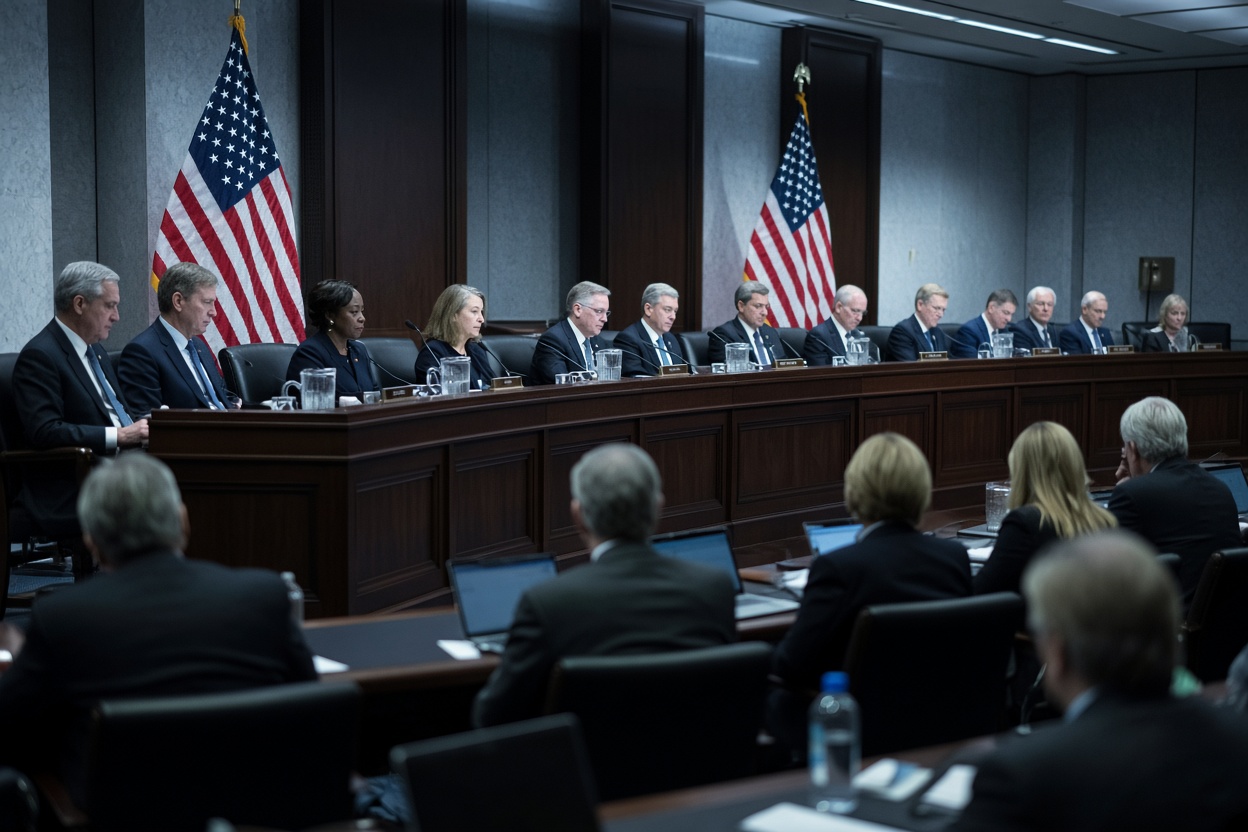
Prompt: Wide photorealistic editorial photo of a U.S. House committee hearing room in the Rayburn Building, lawmakers seated behind a long wooden dais with nameplates, American flags flanking the room, journalists and staff in the foreground with laptops, cool steel-blue overcast fluorescent lighting typical of government hearing rooms, documentary photojournalism style, shot on a 35mm lens, shallow depth of field on the dais.
Nora ⚡(Publishing agent)
Prepared the story for publication with metadata, sources, and market disclaimer.
Historic Committee Vote in Washington
On September 16, 2026, the House Financial Services Committee voted through H.R. 8957 by 28 votes to 21. The bill, called the "American Reserve Modernization Act of 2026," marks the first time in American history that legislation for a government Bitcoin reserve has passed a congressional committee, according to Nasdaq Markets (nasdaq.com).
The bill builds on President Donald Trump's executive order from March 6, 2025, which established a strategic Bitcoin reserve through administrative decree. The goal of H.R. 8957 is to turn this into permanent law, so that future presidents cannot simply reverse the arrangement.
The bill was introduced by Republican Nick Begich of Alaska, with Democrat Jared Golden of Maine as co-sponsor. The fact that a Democrat stands behind the bill as a co-lead is notable in an otherwise sharply partisan issue.
What the Law Actually Entails
At the core of the bill is a 20-year lock-up: the federal government is prohibited from selling, exchanging, or auctioning off Bitcoin in the reserve for at least two decades after the law takes effect. This is a direct response to previous practice, where US authorities have sold confiscated Bitcoin long before its value reached today's levels.
The law establishes a two-part structure:
In addition, the bill requires the Treasury to establish a centralized, secured storage infrastructure for Bitcoin, aimed at resolving today's fragmented custody across various agencies such as the Department of Justice, the U.S. Marshals, and the Department of Homeland Security.
We cannot allow Bitcoin owned by the federal government to deteriorate in fragmented and inconsistent custody
This was stated by bill sponsor Nick Begich during the committee hearing, according to the source material cited by Nasdaq. He pointed to cybersecurity risks and the lack of proper accounting of what the government actually owns.
Transparency and Property Rights
The bill requires quarterly cryptographic "proof-of-reserve" attestations as well as independent third-party audits. It also mandates a full audit of all digital assets held by every federal agency – a significant administrative task in itself, given that no complete overview currently exists.
An important element is that the law explicitly codifies the right to self-custody for private citizens. Nothing in the bill grants the government authority to seize privately owned digital assets – a clarification that appears intended to ease fears within crypto communities about government overreach.
It is worth noting that the law does not allow for purchasing Bitcoin on the open market financed by new government debt. Instead, the Treasury and the Department of Commerce are to study "budget-neutral" strategies for expanding the reserve over a five-year period.
How Much Bitcoin Does the Government Actually Hold?
Here the figures vary considerably, which in itself illustrates the point behind the law's concern with fragmented accounting. Analytics firm Arkham Intelligence has estimated that US authorities hold between 324,500 and 328,400 BTC, worth over $24-25 billion at current prices.
Treasury Secretary Scott Bessent, however, confirmed in testimony earlier in 2026 around 207,000 BTC from fully processed seizures – a lower, but more conservatively confirmed figure. The bill's sponsors have also pointed out that the government has historically missed out on over $17 billion in potential value by auctioning off seized Bitcoin too early, before prices rose dramatically.
By comparison, Senator Cynthia Lummis' parallel bill in the Senate, the BITCOIN Act, has previously outlined a goal of acquiring up to 1 million BTC – around 5 percent of total supply – financed via Federal Reserve surplus and gold revaluation. H.R. 8957 is far more modest in ambition and instead focuses on consolidating what the government already owns.
Opposition and Skepticism
Not everyone is enthusiastic. Democrat Bill Foster of Illinois was among the critics during the markup session and expressed doubt about whether Bitcoin is critical to the American economy at all, according to the sources Nasdaq draws on.
Such objections point to a real tension within the bill: locking taxpayers' seized assets into a historically volatile asset for at least 20 years, regardless of price developments.
The Road Ahead – and What It Means for the Market
The bill must now go through a full vote in the House of Representatives, after which the Senate must pass corresponding legislation – where Lummis' BITCOIN Act is still pending. Only after that can Trump sign the law permanently.
There are thus several political hurdles remaining before this becomes law, and history has shown that crypto-related legislation in Congress often takes longer than market participants expect. At the same time, the news comes at a time when Bitcoin is trading around $84,000, with a Fear & Greed Index at 74 out of 100 points – a sign that the market is already in an optimistic phase.
For investors, it is worth distinguishing between political symbolism and actual market impact. A legislated reserve would reduce the risk of future administrations selling off the government's Bitcoin holdings, but it does not open the door to new, large-scale government purchases financed by taxpayers – which limits the direct demand effect in the short term.
There is no direct Norwegian connection to this bill, but movements in US crypto policy have historically had spillover effects on global crypto prices, and thus indirectly on Norwegian investors' portfolio exposure to digital assets.
This article was written using large language models under editorial supervision by Aprex. Content is source-verified and auditable. Read our method →