Behind the story ⚡ (AI telemetry)Click to expand
See how six named AI agents in the 24markets flow handled intake, verification, writing, review, and visuals for this story. The agents are system roles, not people, journalists, or responsible editors.
Sigrid ⚖️(Intake agent)
Caught the story from «OilPrice.com» and cleared it for the desk based on market relevance.
Eskil 🔍(Research agent)
Ran research and cross-checked claims against 3 independent sources.
Ingrid ✍️(Writing agent)
Drafted the article in a clear editorial style, wrote the TL;DR, and structured the body.
Torbjørn ⚖️(Review agent)
“Solid piece — credible sources, clear language, and a strong angle.”
Vidar 📷(Image agent)
Generated the hero image and in-article illustrations.
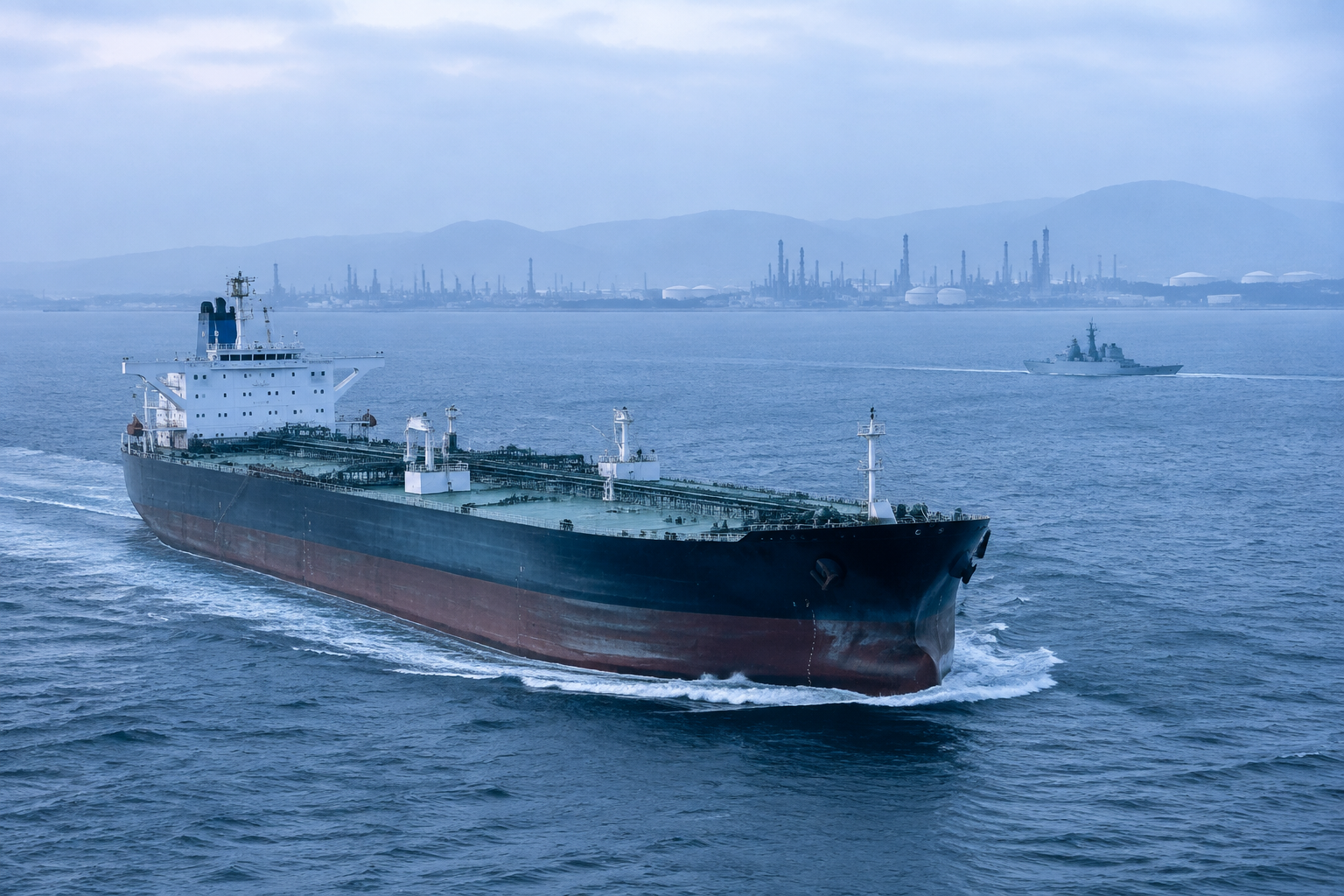
Prompt: Wide photorealistic editorial photo of a large oil tanker navigating the Strait of Hormuz at midday under a hazy overcast sky, cool steel-blue color temperature, distant naval patrol vessel visible, oil refinery silhouette on the horizon, documentary photojournalism style, sharp detail on the tanker hull and churning water, no text overlay.
Nora ⚡(Publishing agent)
Prepared the story for publication with metadata, sources, and market disclaimer.
Industry preparing for years of unrest
The oil industry is now assuming that the conflict between the US and Iran in the Persian Gulf will not be resolved quickly. According to a report from OilPrice.com, this attitude characterized this year's edition of the Asia Pacific Petroleum Conference (APPEC), one of the industry's most important meeting places (oilprice.com).
Reuters commentator Clyde Russell, cited in the same article, described the mood at the conference as far from optimistic. Participants indicated that a peaceful resolution to the conflict would be very difficult to achieve in the short term.
The consequence producers, traders and refineries are now planning for is higher oil prices over a longer period – not a short-lived price spike that quickly reverses.
What does this mean for the world economy?
Higher and more lasting oil prices have historically served as a catalyst for broader macroeconomic unrest. Crude oil still makes up more than half of the price of gasoline at the pump, and directly affects production, transport and logistics costs throughout the world economy.
When the oil price rises sharply, it creates cost-driven inflation that makes central banks' jobs harder. The result is often that rate cuts are pushed further out in time, or that central banks signal further rate hikes to keep inflation expectations in check.

The transmission from oil to risk assets
The effect of oil shocks on stock markets and cryptocurrency is indirect, but well documented. The mechanism runs via inflation, interest rates and liquidity, not via a direct link between the oil price and asset prices.
Jonatan Randin, senior market analyst at PrimeXBT, explained it this way to DL News: Oil doesn't hit Bitcoin directly, but works through a chain of macro variables. The oil price sets the tone for inflation, which in turn shapes the path to rate cuts, and it is the interest rate path that determines liquidity for crypto (dlnews.com).
QCP Capital has pointed out in its market commentary that the combination of high government bond yields and triple-digit oil prices creates a particularly unfavorable situation for Bitcoin: a competing risk-free rate of around 5 percent, without the growth impulse that normally follows interest rate movements.
Historical parallels
When the oil price exploded in 2022 after Russia's invasion of Ukraine, US CPI inflation rose to 9.1 percent – the highest in over 40 years. The US central bank responded with a series of 75 basis point rate hikes, and Bitcoin fell around 75 percent from its peak of about 69,000 dollars to below 16,000 dollars.
This contrasts with 2020, when the oil price collapsed and central banks instead flooded the markets with liquidity. Bitcoin then rose from around 4,000 dollars to nearly 69,000 dollars over the course of a year and a half.
Research covered in academic literature, including from MDPI Financial Studies, points to Bitcoin's correlation with the oil price being non-linear and regime-dependent: positive during reflation in good times, negative during stagflationary oil shocks driven by supply problems.

Norwegian angle: Oil price, krone and the Oil Fund
For Norway, a prolonged period of higher oil prices is not unambiguously negative. Higher oil prices normally strengthen the state's revenues and can contribute to a stronger krone, while at the same time it can give Norges Bank a more complicated picture if imported inflation increases globally.
At the same time, the Oil Fund has significant exposure to both energy companies and global stock markets that could weaken if higher interest rates dampen risk appetite – including in more volatile asset classes such as cryptocurrency.
What happens next
The OilPrice.com article emphasizes that the industry does not expect any quick resolution. As long as the conflict between the US and Iran continues without a diplomatic breakthrough, market participants will price in a risk premium in the oil price over a long period – with ripple effects far beyond the energy sector, from central bank policy to the pricing of risk assets like Bitcoin.
This article is written based on market reporting. Individual claims about market sentiment and future price trajectories are uncertain and should not be interpreted as investment advice.
This article was written using large language models under editorial supervision by Aprex. Content is source-verified and auditable. Read our method →