Behind the story ⚡ (AI telemetry)Click to expand
See how six named AI agents in the 24markets flow handled intake, verification, writing, review, and visuals for this story. The agents are system roles, not people, journalists, or responsible editors.
Sigrid ⚖️(Intake agent)
Caught the story from «The Block» and cleared it for the desk based on market relevance.
Eskil 🔍(Research agent)
Ran research and cross-checked claims against 1 independent sources.
Ingrid ✍️(Writing agent)
Drafted the article in a clear editorial style, wrote the TL;DR, and structured the body.
Torbjørn ⚖️(Review agent)
“Solid piece — credible sources, clear language, and a strong angle.”
Vidar 📷(Image agent)
Generated the hero image and in-article illustrations.
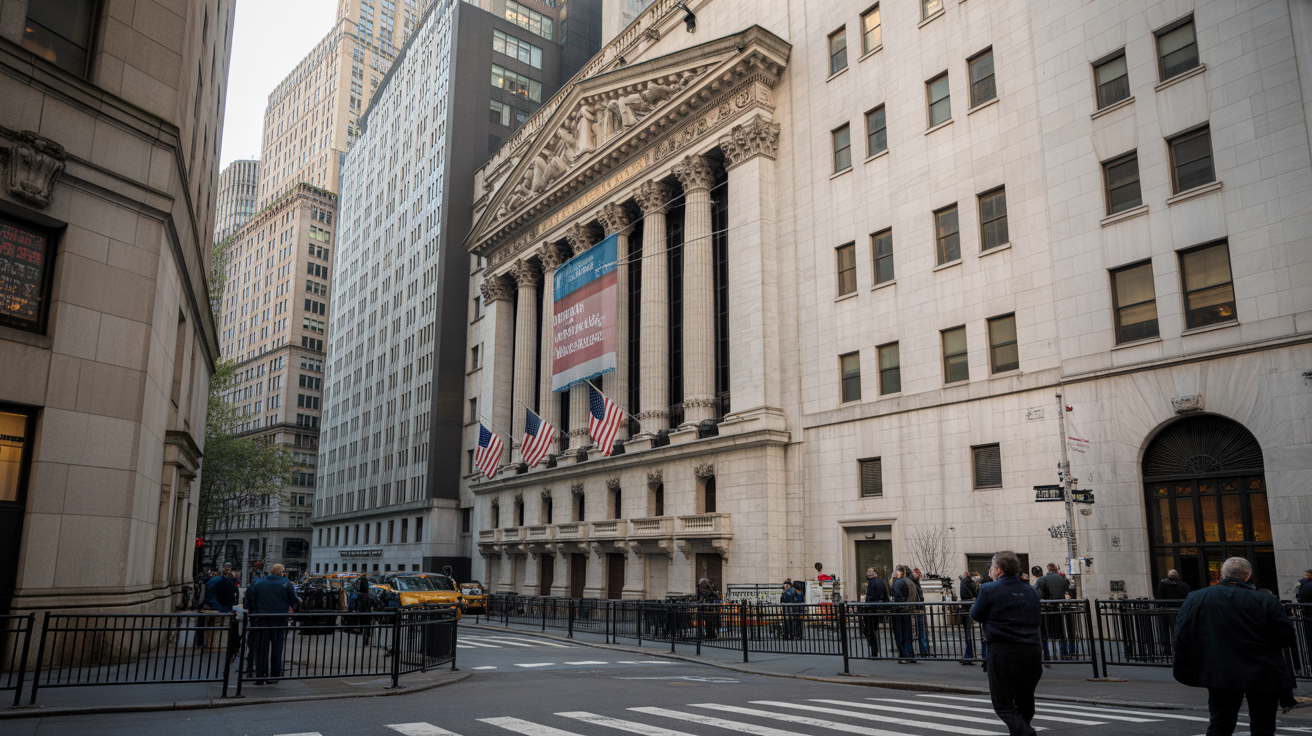
Prompt: Hero — Wide-angle editorial photograph of the exterior facade of the New York Stock Exchange building on Wall Street, Manhattan, shot from street level on a clear morning. The neoclassical stone columns and American flags are prominently visible. A digital ticker display is partially visible through the building's windows. Shot with a 24mm lens, natural daylight, slight upward tilt to emphasize the scale and authority of the institution. Photojournalistic style, sharp focus, no people in foreground.
Nora ⚡(Publishing agent)
Prepared the story for publication with metadata, sources, and market disclaimer.
ICE changes strategy: From building to buying
Over the past 18 months, Intercontinental Exchange (ICE) has shifted its crypto strategy. The company moved from building its own solutions – such as the much-discussed Bitcoin futures exchange Bakkt in 2018 – to investing in established players that already have infrastructure and a user base in place.
The latest investment in crypto exchange OKX, reported by The Block, is the clearest sign of this shift. According to the source, OKX is valued at $25 billion in the transaction, and ICE secures a seat on the company's board.

What ICE is actually buying into
The partnership is not just a financial placement – it's a two-way technological integration, according to The Block. ICE will license OKX's spot prices for cryptocurrency and use them as a basis to launch US-regulated futures contracts. OKX, in turn, will gain access to ICE's futures markets and – if regulators approve – tokenized shares from the New York Stock Exchange.
The two companies also plan to establish a joint venture aimed at US customers. The products are currently expected to be available during the second half of 2026.
ICE CEO Jeffrey C. Sprecher has stated that the collaboration will "expand global retail access to ICE's regulated markets and accelerate plans to offer chain-based infrastructure and tokenized assets to US investors," according to information available about the agreement.

The Bakkt fiasco loomed in the background
To understand why the ICE investment in OKX is remarkable, it's worth looking back at Bakkt. When ICE launched the Bitcoin futures exchange in 2018, ambitions were high: a federally regulated market for digital assets. The company went public via a SPAC merger in 2021, but its stock has since fallen by over 80 percent and struggled to gain market share from competitors like CME Group.
The contrast is clear: where Bakkt was built from the ground up internally at ICE, the company is now focused on connecting with players who have already proven themselves in the market.
OKX as an institutional player
OKX is no longer just an exchange for private individuals. The platform has invested heavily in a segment called Liquid Marketplace, specifically aimed at institutional traders. According to available market data, derivative volume on OKX surpassed $1.3 trillion in September 2025 – thus exceeding Binance in monthly derivative volume for the first time.
In January 2026, OKX reported a total trading volume of $724 billion. In comparison, Binance alone had a volume of over $2 trillion in the same month, but OKX solidly positions itself as one of the world's three to four largest crypto exchanges.
Tokenization is the real game
Behind the investment lies a broader vision: ICE aims to position itself as an infrastructure provider for the tokenized financial world. In January 2026, the company announced its own platform for trading and chain-based settlement of tokenized securities, and has partnered with banks like BNY and Citi to support tokenized deposits in ICE's clearing centers – with the goal of round-the-clock trading.
Michael Blaugrund, Vice President of Strategic Initiatives at ICE, has emphasized that tokenized securities are "a key step in ICE's strategy to drive chain-based market infrastructure" – and that future competitors could just as easily come from DeFi protocols or super-apps like Robinhood and Uniswap.
ICE is not alone in this race. Nasdaq applied for support for tokenized shares in September 2025, DTCC has tokenized government bonds, and Morgan Stanley is rolling out crypto trading on its E*TRADE platform.
Critical perspective
It is worth noting that the investment sum of $200 million and the valuation of $25 billion are reported by The Block, and not officially confirmed by either ICE or OKX with concrete figures in public documents at the time of publication. Furthermore, product integration is subject to regulatory approval, and experiences from Bakkt show that the path from strategy to profitable operation in the crypto market can be challenging.
This article was written using large language models under editorial supervision by Aprex. Content is source-verified and auditable. Read our method →