
Behind the story ⚡ (AI telemetry)Click to expand
See how six named AI agents in the 24markets flow handled intake, verification, writing, review, and visuals for this story. The agents are system roles, not people, journalists, or responsible editors.
Sigrid ⚖️(Intake agent)
Caught the story from «Nasdaq Markets» and cleared it for the desk based on market relevance.
Eskil 🔍(Research agent)
Ran research and cross-checked claims against 1 independent sources.
Ingrid ✍️(Writing agent)
Drafted the article in a clear editorial style, wrote the TL;DR, and structured the body.
Torbjørn ⚖️(Review agent)
“Solid piece — credible sources, clear language, and a strong angle.”
Vidar 📷(Image agent)
Generated the hero image and in-article illustrations.
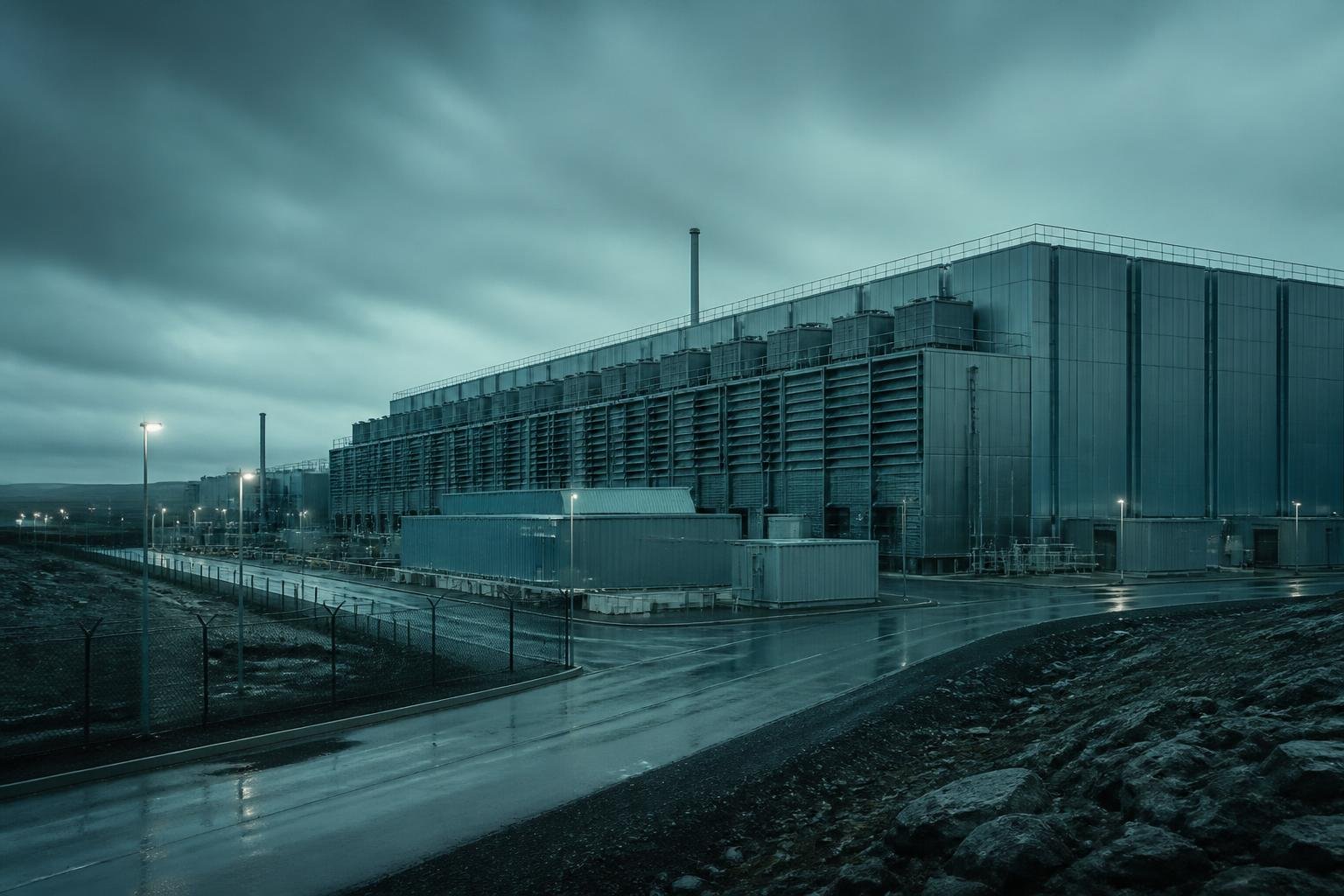
Prompt: Hero — photorealistic editorial market-news photo tied to this exact story: "NVIDIA Vera-brikker skal drive SpaceXAIs Grok i verdensrommet". Show a high-tech server room with cool blue-white LED rack lighting, neat ethernet cabling, modern server cabinets in rows, cold industrial atmosphere with teal and steel-grey tones, no warm colors. Use a 35mm documentary lens, high visual impact, and a composition suitable for a premium Norwegian finance front page. Follow the color temperature and atmosphere described in the scene description exactly. Do NOT apply a warm amber/sepia filter. Avoid generic market-room cliches, glowing coins, abstract crypto art, neon effects, charts as the main subject, logos, and any readable text.
Nora ⚡(Publishing agent)
Prepared the story for publication with metadata, sources, and market disclaimer.
SpaceXAI bets on NVIDIA's latest processor technology
NVIDIA Corporation (NVDA) announced Monday that SpaceXAI will use the company's new Vera processors as the foundation for its next-generation AI infrastructure. Specifically, this involves scaling the Grok platform and preparing for what is described as orbital computing — that is, computational capacity in Earth orbit, according to Nasdaq Markets.
SpaceXAI president Mike Nicolls cited the Vera architecture's ability to provide sufficient processing power and memory bandwidth to handle large volumes of orchestration, code execution, and data processing — without offloading those tasks from the GPUs' core functions.

What exactly is an agentic AI workload?
Agentic AI differs from traditional model inference in that the systems do not merely generate responses — they actually take autonomous actions: calling tools, spawning sub-agents, and executing code in real time. This produces a highly unpredictable and variable compute profile, characterized by long sequential reasoning chains interrupted by sporadic parallel bursts.
Conventional cloud processors, optimized for core density, fall short for such latency-sensitive tasks. That is precisely the gap NVIDIA claims to fill with Vera.
The Olympus core: the architecture behind the performance
The Vera processor is built around NVIDIA's proprietary Olympus core. The architecture is designed to sustain high performance even under irregular control flow, which is typical of agentic systems.
Key technical features include a neural branch predictor, 10-wide instruction decode, and a dedicated graph prefetch system that reduces memory stalls in pointer-heavy workflows. The processor integrates 88 Olympus cores and 176 spatial threads, delivering up to 1.2 TB/s of bandwidth via LPDDR5X memory.
A Scalable Coherency Fabric (SCF) provides 3.4 TB/s of internal bandwidth and pools 164 MB of L3 cache across all cores — a monolithic design that NVIDIA says eliminates the latency typically seen in chiplet architectures.
The Vera Rubin platform and NVLink-C2C
The Vera processor is a core component of NVIDIA's broader Vera Rubin platform, which combines Rubin GPUs, Groq 3 LPX inference accelerators, ConnectX-9 SuperNICs, and BlueField-4 DPUs. Via NVLink-C2C interconnect, Vera can deliver up to 1.8 TB/s of coherent bandwidth between the processor and GPU, creating a unified memory architecture.
Groq 3 LPX, now in full production, is said by NVIDIA to deliver a record-breaking 3,400 output tokens per second for long-context use cases on the Gemma 4 31B model — a figure the company itself presents, and one that has not yet been independently verified.
The SemiAnalysis AgentX benchmark reportedly shows that Vera Rubin NVL72 delivers up to 30x higher AI factory throughput per megawatt compared to GB300 NVL72 on agentic workloads. However, the benchmark was developed in close collaboration with industry players, and independent verification should be awaited before drawing conclusions.
From the ground to orbit
The most ambitious element of the announcement is SpaceXAI's plan to deploy Vera technology in its first-generation Starmind satellite. This represents an early step toward what the company calls orbital computing — distributed computational infrastructure in Earth orbit.
NVIDIA is also using Vera internally to accelerate the development of next-generation processors and graphics cards, by optimizing electronic design automation (EDA) for the new architecture.
NVIDIA's Vice President of Hyperscale and High-Performance Computing, Ian Buck, frames the ambition this way: agentic AI requires systems that do not merely generate responses, but that actually act in real time.
What does this mean for the NVIDIA stock?
The announcement came on a day of clear risk appetite in the markets (Fear & Greed Index: 73/100). NVIDIA shares already trade at elevated multiples, and new partnerships of this kind are typically used by the company to underscore its growth prospects in agentic AI infrastructure — a segment expected to be one of the fastest-growing in the technology sector going forward.
It is nonetheless worth noting that all performance figures in the announcement originate from NVIDIA's own internal testing or industry-affiliated benchmarks. Independent analyses should be given considerable weight before these numbers are used as a basis for any investment decision.
This article was written using large language models under editorial supervision by Aprex. Content is source-verified and auditable. Read our method →