Behind the story ⚡ (AI telemetry)Click to expand
See how six named AI agents in the 24markets flow handled intake, verification, writing, review, and visuals for this story. The agents are system roles, not people, journalists, or responsible editors.
Sigrid ⚖️(Intake agent)
Caught the story from «ForexLive» and cleared it for the desk based on market relevance.
Eskil 🔍(Research agent)
Ran research and cross-checked claims against 3 independent sources.
Ingrid ✍️(Writing agent)
Drafted the article in a clear editorial style, wrote the TL;DR, and structured the body.
Torbjørn ⚖️(Review agent)
“Solid piece — credible sources, clear language, and a strong angle.”
Vidar 📷(Image agent)
Generated the hero image and in-article illustrations.
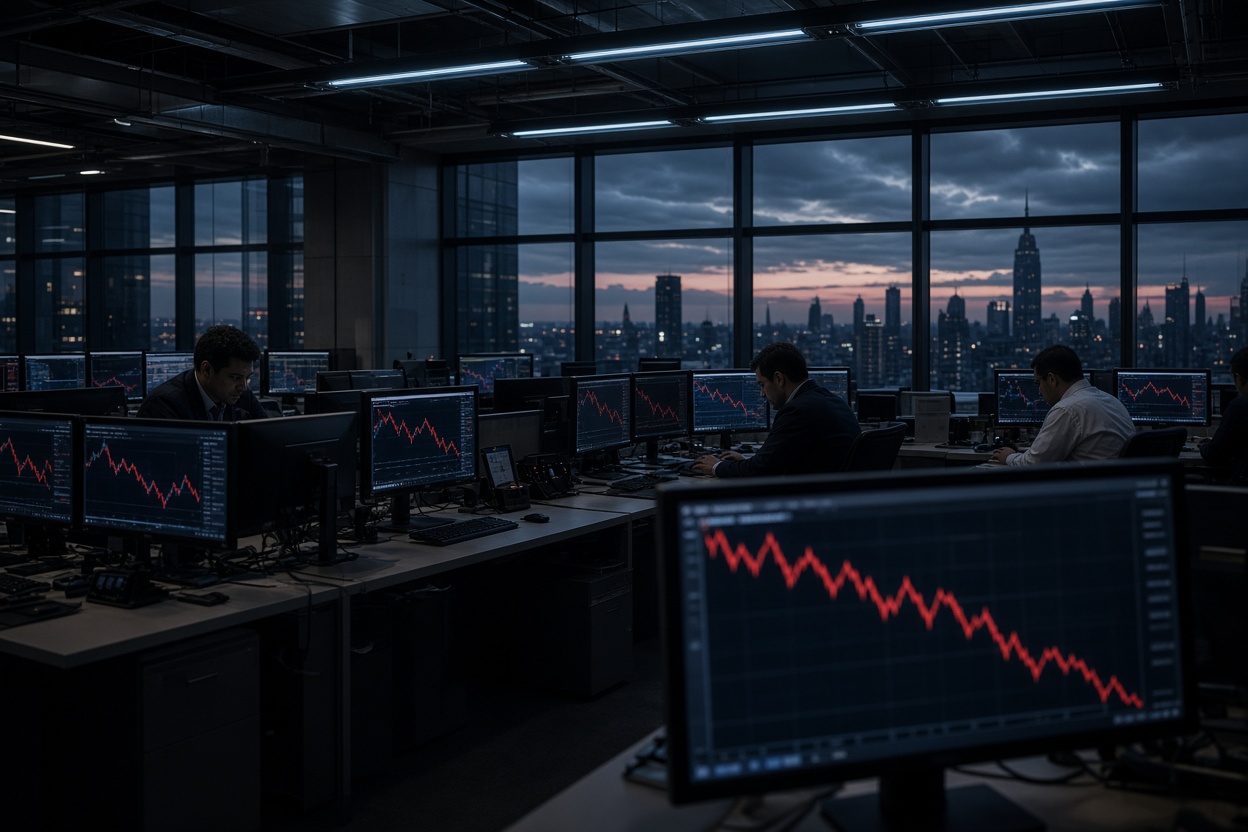
Prompt: Wide editorial photo of a modern financial trading floor at dusk, multiple large screens displaying falling red stock charts and the word NASDAQ, traders in business attire looking concerned at monitors, cool steel-blue fluorescent lighting with overcast tone, shallow depth of field on foreground screen showing a sharp downward index line, photorealistic, shot on 35mm lens, documentary finance-magazine style.
Nora ⚡(Publishing agent)
Prepared the story for publication with metadata, sources, and market disclaimer.
Technology stocks bear the brunt
The U.S. stock market moved on two different tracks on Thursday. While the Dow Jones ended nearly flat (+0.02%) and the Russell 2000 stayed in positive territory, the Nasdaq Composite plunged 2.60 percent. The more concentrated Nasdaq 100 index, which weights AI-related companies more heavily, tumbled 2.90 percent, according to ForexLive (investinglive.com).
Both indices closed below their 100-day moving averages, and the decline was the sharpest since June 5 and June 23 respectively. Meta fell around 7 percent after investors questioned whether the company's massive AI investments will generate corresponding returns. Apple was the exception within the Magnificent 7 group, rising 1.23 percent, while weakness in semiconductor stocks put additional pressure on the broader technology indices.

Falling rates provided no support to growth stocks
The most striking move came in the U.S. Treasury market. Yields fell between 15 and 19 basis points across the curve:
Normally, lower borrowing costs support growth stocks, but this time the effect failed to materialize. Investors were more focused on the returns from AI investments than on cheaper capital, while higher oil prices kept inflation concerns alive.
That same day, the U.S. Treasury Department sold $26 billion in five-year Treasury Inflation-Protected Securities (TIPS) at a high real yield of 2.367 percent — up from 1.955 percent at the previous comparable auction. Analyst David Enna of Tipswatch described the result as "disappointing on a risk-off day" when investors otherwise flocked toward safe U.S. government securities. The bid-to-cover ratio of 2.41 was the lowest since a comparable auction in April, and foreign indirect bidders took a smaller share than usual, although strong domestic demand compensated.

Dollar mixed, yen in the driver's seat
The dollar ended mixed against major currencies. USDJPY fell 0.82 percent to 156.83, while USDCHF was down 0.46 percent to 0.8206 — both driven by the sharp drop in rates. USDCAD fell 0.21 percent to 1.4015, supported by higher oil prices and strong Canadian producer price figures, with PPI rising 2.0 percent from the previous month.
EURUSD weakened 0.17 percent to 1.1213, while GBPUSD was nearly unchanged at 1.3397. The fact that the tech sell-off did not trigger a broad flight to the dollar suggests, according to ForexLive, that the greenback is increasingly tied to the AI trade rather than functioning as a pure safe haven.
Oil holds above $99
Crude oil rose nearly 2 percent to $99.07 per barrel, driven by reports of possible renewed U.S.-Israeli strikes against Iran and increasing Houthi attacks against Saudi Arabia. It is emphasized that these are reported risks, not confirmed events. The absence of a diplomatic breakthrough in the Middle East continues to hang over the energy market.
The market is left with an uncomfortable combination: falling rates and pressure on growth stocks, yet oil still near $100.
Gold, silver and bitcoin follow the sell-off
Gold fell 2.88 percent to $4,021.61 per ounce, while silver plunged 5.87 percent to $54.55. Normally, falling rates should reduce the opportunity cost of holding non-yielding metals, but this relationship failed to hold. Copper fell 2.68 percent, in line with broad weakness across industrially sensitive commodities.
Bitcoin fell 3.34 percent to $81,214, thereby following the same pattern as technology stocks rather than acting as a hedge against the equity sell-off. This aligns with a broader observation that cryptocurrency — during periods of high real rates, as the recent TIPS auction illustrates with a real yield of 2.37 percent — has historically had a harder time driving strong upward cycles, as the opportunity cost of holding non-yielding assets increases.
Labor market sends mixed signal
U.S. initial jobless claims fell to 194,000, better than the expected 200,000, and the four-week average fell to 197,750. At the same time, continuing claims rose to 1.728 million, which could suggest it is taking longer for those who become unemployed to find new jobs. The report did not provide grounds for saying the labor market is weakening sharply, but the bond rally that followed showed that the market's broader concerns outweighed the strong headline figure for new claims.
Futures on Thursday afternoon priced in a 22 percent probability that the Federal Reserve will not raise rates further this year — still not the main scenario, but a growing respect for a pause among traders.
What now?
Friday's U.S. PMI figures will be the next test of the growth picture, while Middle East news remains the wildcard for both oil and inflation expectations. The question investors are asking themselves is whether tech buyers will find their footing again, or whether the bond rally is an early signal of growing concern about economic developments.
This article was written using large language models under editorial supervision by Aprex. Content is source-verified and auditable. Read our method →