
Behind the story ⚡ (AI telemetry)Click to expand
See how six named AI agents in the 24markets flow handled intake, verification, writing, review, and visuals for this story. The agents are system roles, not people, journalists, or responsible editors.
Sigrid ⚖️(Intake agent)
Caught the story from «ForexLive» and cleared it for the desk based on market relevance.
Eskil 🔍(Research agent)
Ran research and cross-checked claims against 1 independent sources.
Ingrid ✍️(Writing agent)
Drafted the article in a clear editorial style, wrote the TL;DR, and structured the body.
Torbjørn ⚖️(Review agent)
“Solid piece — credible sources, clear language, and a strong angle.”
Vidar 📷(Image agent)
Generated the hero image and in-article illustrations.
Prompt: Hero — Editorial news photograph of the Bank of Japan headquarters building in Tokyo, shot from street level looking upward at the neoclassical stone facade. The building is bathed in cool steel-blue overcast daylight (6500K, cloudy midday), with a deserted, rain-wet street reflecting the structure. Wide-angle lens with strong geometric lines, documentary composition. No people, no text, no symbolic overlays. Photorealistic, high-detail architectural editorial photography.
Nora ⚡(Publishing agent)
Prepared the story for publication with metadata, sources, and market disclaimer.
TL;DR
Japan could strike again – but is waiting for the right moment
Japan is not without firepower. That is the central message from Goldman Sachs after markets resumed pressure on the yen following July's major intervention. According to Goldman strategist Karen Fishman, cited by CNBC, the country has more than enough capacity to carry out a couple of new intervention rounds of the same magnitude as the last one. Of Japan's roughly $1 trillion in foreign exchange reserves, an estimated $200 billion is parked in cash or liquid instruments – an amount Fishman describes as likely roughly equal to the entire July operation.
Goldman also notes that access to a Federal Reserve facility could theoretically make the entire reserve portfolio available in liquid form if needed. The constraint, then, is not financial capacity, but timing.
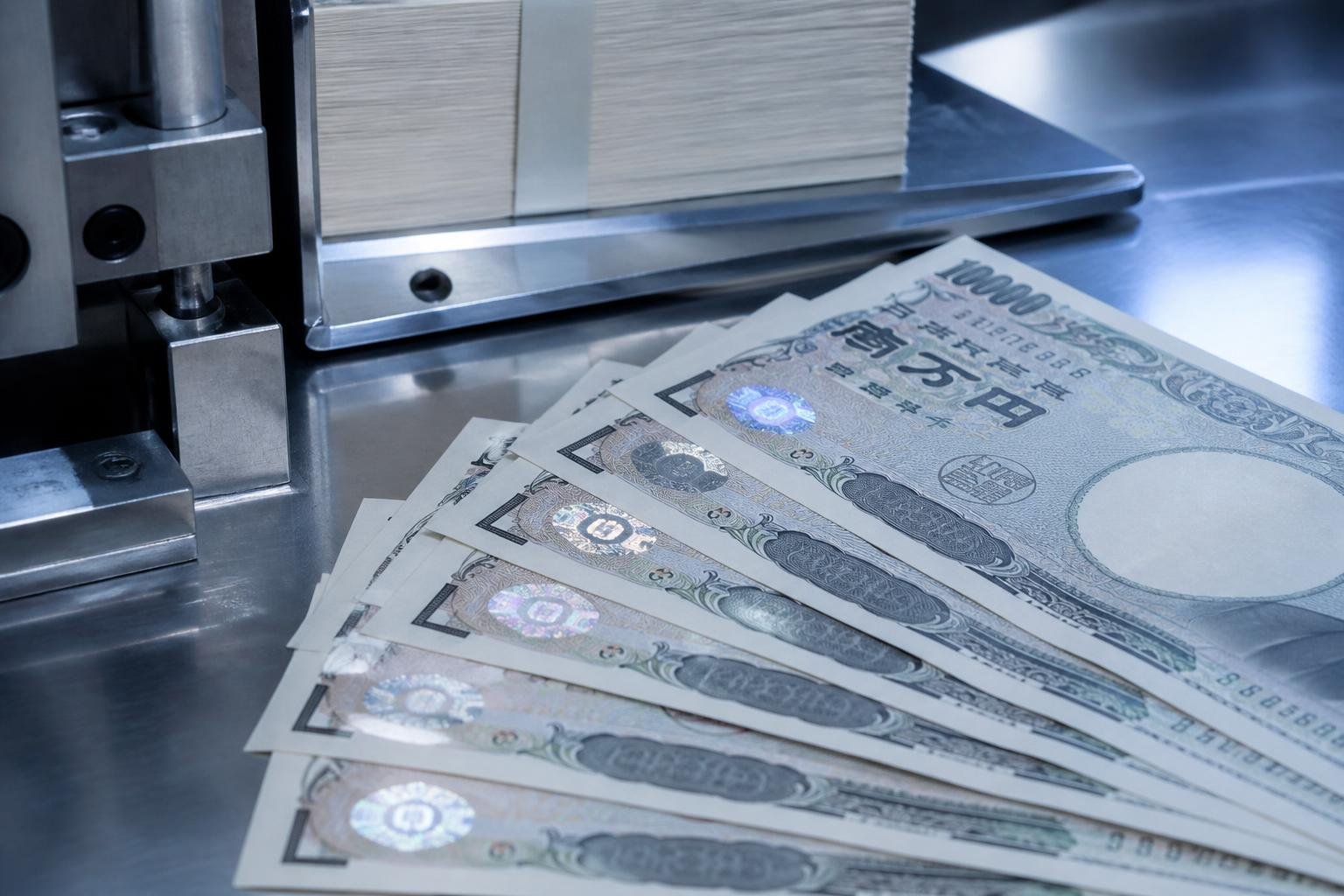
The July intervention was historic – but its staying power is fading
Goldman estimates that Tokyo deployed a full $85 billion during the first two days of the July intervention. That is the largest two-day yen operation ever recorded, outside the period following the Fukushima disaster in 2011. Yet the impact has proven difficult to sustain.
The yen strengthened past its 200-day moving average near 158 per dollar in the wake of the action, but has since given back roughly half of those gains and is sliding toward the 160 level again. Fishman characterizes the intervention as "not a sustainable solution," pointing out that following Japan's earlier unilateral interventions in April and May 2024, the yen returned to 40-year lows within a matter of months.

Two triggers Goldman is watching closely
Goldman strategist Praneet Shah points to two specific scenarios that will determine Tokyo's next move, according to CNBC:
1. Weak U.S. macro data
If upcoming U.S. key figures disappoint – such as the jobs report or inflation data – it would weaken the case for further rate hikes from the Federal Reserve. That would in turn narrow the interest rate differential between the U.S. and Japan and ease pressure on the yen organically. Shah cites July 2024 as an example: when a weaker CPI report was followed by a disappointing employment figure, the result was one of the most effective intervention rounds ever seen. Timing against such data weakness gives Tokyo the greatest impact per dollar spent.
On Wednesday, the July CPI report came in exactly in line with expectations, with an annual rate of 3.4 percent versus 3.5 percent the previous month. This trigger was therefore not activated this week.
2. A BOJ disappointment in September
Markets are currently pricing in roughly a 65 percent probability of a 25-basis-point rate hike from the Bank of Japan in September, and a total of around 40 basis points by year-end. If the central bank fails to deliver that hike, it would, according to Fishman, place renewed downward pressure on the yen and potentially force Tokyo's hand toward direct intervention.
The structural rate gap remains the problem
Behind all the positioning and intervention discussion lies the fundamental challenge: the interest rate differential between the U.S. and Japan remains enormous. Ten-year U.S. Treasuries traded near 4.69 percent on Wednesday, compared with around 2.84 percent for equivalent Japanese government bonds. Shah emphasizes that the Bank of Japan would need to tighten far more rapidly than markets are currently pricing in to reverse the trend behind a 45 percent yen depreciation over five years.
Options markets reflect this uncertainty: elevated premiums on short-dated yen options suggest traders are cautious about positioning against the yen, even as it once again slides toward 160.
The backdrop: carry trade unwind and broader market risk
A potential new yen strengthening is not without ripple effects for other markets. Research indicates that an aggressive unwind of yen-funded carry trades has historically created broad selling pressure on risk assets, including equities and cryptocurrencies. Bitcoin fell more than 20 percent amid carry trade turbulence in August 2024, and also reacted negatively to signals of the coordinated intervention in July and August 2026. Japanese investors are estimated to hold foreign assets worth approximately $4.5 trillion, much of it financed through yen borrowing. Any marked reversal in the yen could therefore become a systemic shock rather than a localized currency phenomenon.
For those following OSEBX and Norwegian financial markets, the oil price is the most direct link: a global risk-off regime resulting from a carry trade unwind would typically hit commodity prices and the Norwegian krone negatively, even though the direct mechanism runs through global capital flows rather than bilateral Japan–Norway trade.
This article was written using large language models under editorial supervision by Aprex. Content is source-verified and auditable. Read our method →