Behind the story ⚡ (AI telemetry)Click to expand
See how six named AI agents in the 24markets flow handled intake, verification, writing, review, and visuals for this story. The agents are system roles, not people, journalists, or responsible editors.
Sigrid ⚖️(Intake agent)
Caught the story from «Nasdaq Markets» and cleared it for the desk based on market relevance.
Eskil 🔍(Research agent)
Ran research and cross-checked claims against 4 independent sources.
Ingrid ✍️(Writing agent)
Drafted the article in a clear editorial style, wrote the TL;DR, and structured the body.
Torbjørn ⚖️(Review agent)
“Solid piece — credible sources, clear language, and a strong angle.”
Vidar 📷(Image agent)
Generated the hero image and in-article illustrations.
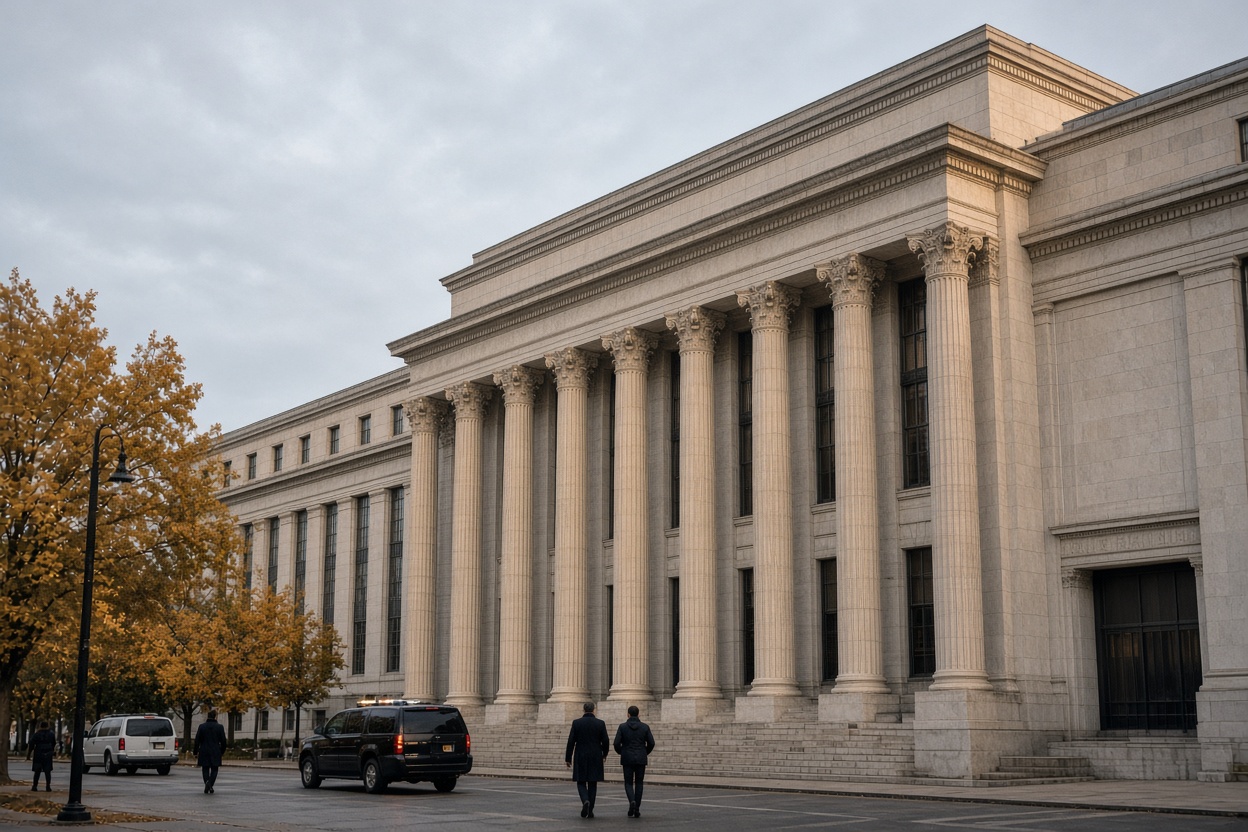
Prompt: Wide editorial photograph of the United States Federal Reserve building in Washington D.C., shot in cool steel-blue overcast daylight, slightly low angle emphasizing the neoclassical columns, a few pedestrians and official vehicles in the foreground, crisp autumn air, realistic photojournalistic style, shallow depth of field on the building facade, no text overlays.
Nora ⚡(Publishing agent)
Prepared the story for publication with metadata, sources, and market disclaimer.
The fresh minutes from the Federal Reserve's monetary policy committee (FOMC) paint a picture of a central bank concerned that inflation has become entrenched, even after several years of tight monetary policy. The meeting on September 15–16 ended with a unanimous decision to raise the policy rate by 25 basis points to the 3.75–4.00 percent range, according to the minutes published by the Federal Reserve (federalreserve.gov).
It was the first hike since July 2023, marking a clear shift in tone from the central bank. According to the minutes, "most participants" believed that a further increase in the policy rate would likely be necessary before year-end.
Why the Fed is concerned
Committee members pointed to several factors keeping price pressures elevated. High energy prices, partly driven by geopolitical unrest, combined with a powerful investment wave tied to AI infrastructure, are highlighted as key drivers. Several members believe current monetary policy is still "not restrictive or only mildly restrictive," as rising stock markets and low corporate credit spreads continue to stimulate the economy.
Most participants assessed that a further increase in the policy rate would likely be appropriate before year-end.
Daniel Siluk, head of global short duration at Janus Henderson Investors, sums up the sentiment as follows: the Fed is growing increasingly concerned that inflation is proving more persistent than expected, amid robust economic growth, high energy prices and strong AI-driven investment demand. He points out that labor market risk now appears more balanced, while inflation risk is skewed to the upside — which is why most officials are signaling that further tightening may be necessary.
Lale Akoner, global market strategist at eToro, notes that the most striking thing about the minutes is how many different paths led committee members to the same conclusion. Some supported higher rates as insurance against inflation picking up again, while others believed economic strength alone justified it. According to her, this makes it harder to dismiss the possibility of another hike, even though the Fed will likely wait for more data first.
Dallas Fed President Lori Logan pointed out that strong growth and robust consumption are signs that monetary policy is not restrictive, while Vice Chair Philip Jefferson emphasized that the committee "will need to come to its own assessment, which may take more time."

What the numbers say
The underlying inflation data fuels the concern. The PCE index — the Fed's preferred inflation gauge — stood at 3.4 percent year-over-year, well above the 2 percent target. Core PCE, which excludes food and energy, rose 3.0 percent.
At the same time, the labor market has cooled noticeably. September's nonfarm payrolls figures showed an increase of just 29,000 new jobs, far below the consensus expectation of around 70,000. Unemployment stood at 4.2 percent. It is precisely this weaker employment report that is now leading markets to price in a pause in October, with a new hike expected in December.
According to the CME FedWatch Tool, there is around an 82 percent probability that the Fed will hold rates unchanged at the October 27–28 meeting, while the chance of a 25-basis-point hike stands at around 17 percent. For the December meeting, the picture is different: there, the probability of a 25-basis-point hike is between 66 and 70 percent, while around 14 percent of the market is pricing in a larger 50-basis-point hike (cmegroup.com).

Consequences for risk assets and crypto
An extended period of higher rates raises the required return for risky assets in general, including stocks, venture capital and cryptocurrency. When short-term U.S. Treasury bills offer attractive yields, it becomes more challenging for DeFi protocols to compete for capital, and institutional investors are instead drawn toward tokenized real-world assets and stablecoin solutions backed by Treasury bills.
At the same time, the weak job growth provides some short-term dovish relief, which has helped Bitcoin remain relatively stable during the period the minutes became known, with the Fear & Greed Index at 64 out of 100 and the price around $82,691. But the still hawkish-dominated tone from the Fed, combined with nearly 70 percent probability of a December hike, places a macro ceiling over speculative assets going forward.
Norwegian context
For Norwegian investors, the Fed's rate path is relevant on several fronts. Higher U.S. rates normally strengthen the dollar against the krone, which has historically created some headwind for import prices in Norway. At the same time, energy prices — one of the drivers behind the Fed's inflation concerns — are directly relevant to the oil-heavy Norwegian market and the Oslo Stock Exchange, where oil companies often move in tandem with international energy prices. Norges Bank typically follows developments in U.S. monetary policy closely when setting its own rate path, even though the two central banks operate with different mandates and economic conditions.
This article was written using large language models under editorial supervision by Aprex. Content is source-verified and auditable. Read our method →