
Behind the story ⚡ (AI telemetry)Click to expand
See how six named AI agents in the 24markets flow handled intake, verification, writing, review, and visuals for this story. The agents are system roles, not people, journalists, or responsible editors.
Sigrid ⚖️(Intake agent)
Caught the story from «OilPrice.com» and cleared it for the desk based on market relevance.
Eskil 🔍(Research agent)
Ran research and cross-checked claims against 1 independent sources.
Ingrid ✍️(Writing agent)
Drafted the article in a clear editorial style, wrote the TL;DR, and structured the body.
Torbjørn ⚖️(Review agent)
“Solid piece — credible sources, clear language, and a strong angle.”
Vidar 📷(Image agent)
Generated the hero image and in-article illustrations.
Prompt: Hero — photorealistic editorial market-news photo tied to this exact story: "Kina og Russland trer frem i skyggen av USA-Iran-krigen". Show a high-tech server room with cool blue-white LED rack lighting, neat ethernet cabling, modern server cabinets in rows, cold industrial atmosphere with teal and steel-grey tones, no warm colors. Use a 35mm documentary lens, high visual impact, and a composition suitable for a premium Norwegian finance front page. Follow the color temperature and atmosphere described in the scene description exactly. Do NOT apply a warm amber/sepia filter. Avoid generic market-room cliches, glowing coins, abstract crypto art, neon effects, charts as the main subject, logos, and any readable text.
Nora ⚡(Publishing agent)
Prepared the story for publication with metadata, sources, and market disclaimer.
From the Shadows to the Front Line
The ongoing conflict between the US/Israel and Iran has long threatened to draw in external actors. Now it appears that threshold has been crossed. According to OilPrice.com, both China and Russia have shifted from primarily diplomatic support to more direct forms of military and intelligence assistance to Tehran.
The emerging axis is not a formal military alliance, but rather a pragmatic partnership rooted in a shared interest in undermining American influence in the region and globally.
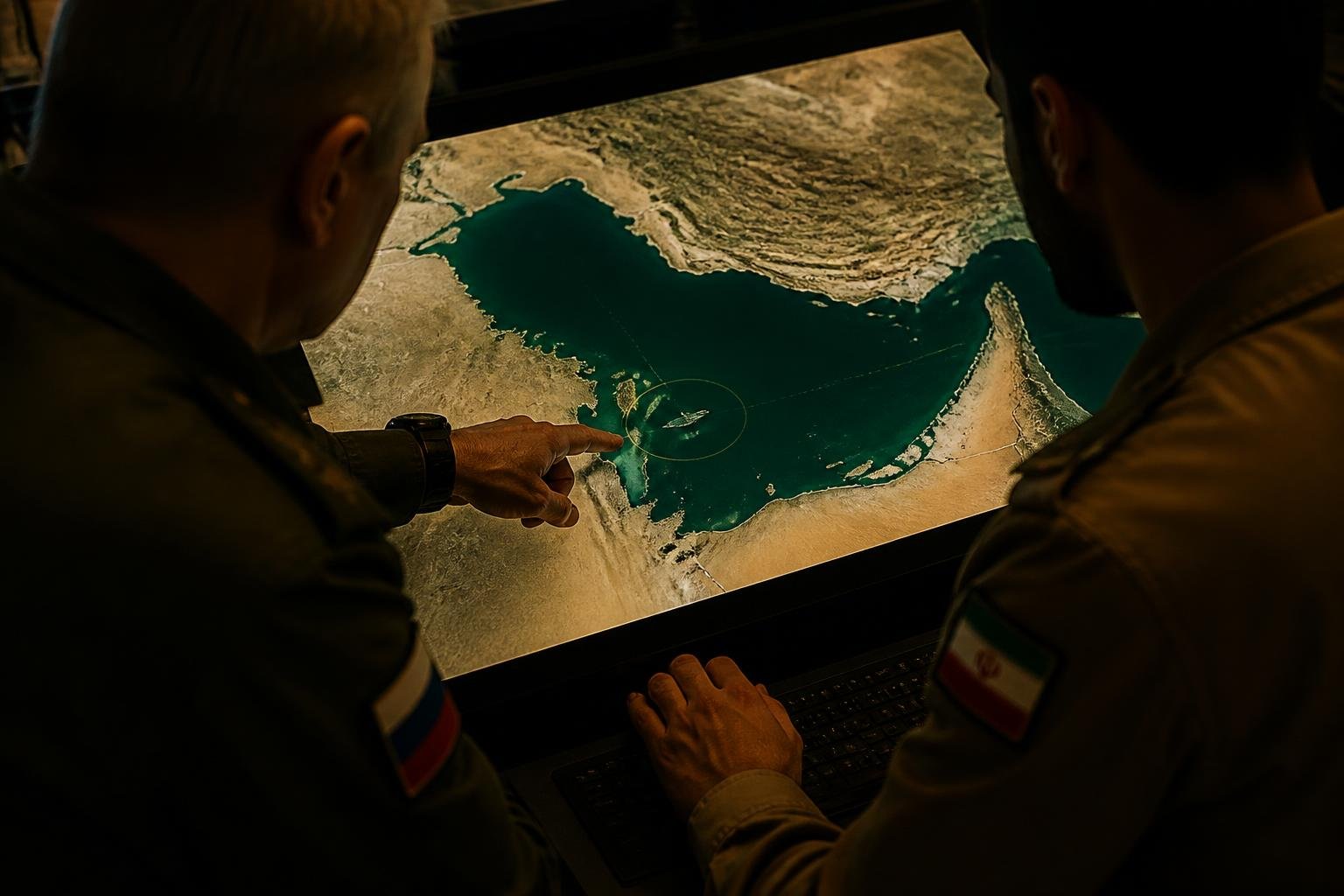
Russia's Role: Satellites, Drones, and Target Coordinates
According to available intelligence, Russia has been continuously supplying Iran with satellite imagery and electronic intelligence since July and August 2026 — including signals from communications networks, radar systems, and military installations. Ukrainian President Volodymyr Zelensky publicly claimed there is a clear correlation between Russian satellite imagery of US military installations in the Gulf states and subsequent Iranian strikes.
Russia is also said to have provided Iran with detailed information on the positions of American warships, aircraft, and radar systems — as well as imagery to assess battle damage after strikes and identify new targets.
"Iran's recent attacks were far more sophisticated than anything they have done before" — Nicole Grajewski, expert on Russian-Iranian relations
On the drone front, Moscow has not only shared electronic warfare expertise but has also delivered upgraded variants of the Iranian Shahed-136 drone — manufactured under license in Russia since 2023 under the designation "Geran-2." These versions feature more robust satellite navigation systems combining GLONASS and GPS, along with updated flight software.
Russia is also said to have committed to delivering hundreds of shoulder-fired air defense missiles (MANPADS) and thousands of missiles to Iran, while continuing to train Iranian pilots.
China's Quiet but Tangible Rearming of Iran
China's contributions are more carefully wrapped in plausible deniability, but recent intelligence reports paint a clear picture. In August 2026, a Chinese company is reported to have signed a deal to deliver between 300 and 400 shoulder-fired surface-to-air missiles to Iran under a contract worth between $60 and $70 million.
A US F-15E fighter jet was reportedly shot down over southwestern Iran in April 2026 by what is believed to have been a Chinese-manufactured shoulder-fired missile. The US had already sanctioned three Chinese companies in May 2026, including Mizar Vision, for allegedly supplying Iran with satellite imagery that revealed the positions of American aircraft and air defense systems.
In addition, Beijing has granted Iran access to the Chinese BeiDou satellite navigation system, reducing Tehran's dependence on the American GPS network. Iran's navigation systems can now use BeiDou, GPS, and Russian GLONASS simultaneously.
A "Synchronized" Trialogue
Experts emphasize that these are not isolated incidents, but part of a growing strategic pattern. Nicole Grajewski, a specialist in Russian-Iranian relations, describes a "synergy" originally forged through the war in Ukraine that is now spreading to the Middle East. The cooperation has already produced joint military exercises between Russian, Chinese, and Iranian forces in Iran in 2025.
American intelligence officials believe an unprecedented level of intelligence sharing is underway between Russia and Tehran, with China closely linked to Moscow. If confirmed, this could explain Iran's ability to strike covert CIA facilities in Saudi Arabia and other allied countries in March 2026 — which Military Watch Magazine describes as one of the most serious intelligence breaches against American operations in recent memory.
The Financial Dimension
Underpinning the military deliveries is an equally significant financial reorientation. Russia and China have been actively de-dollarizing their trade — Russia is reported to have achieved nearly 95 percent de-dollarization in settlements with China and India by 2025. The Chinese yuan is now Russia's most traded currency, having displaced the dollar as early as 2023.
Through the BRICS Bridge platform, both countries are working toward a digital payment system based on central bank digital currencies (CBDCs), designed to make them immune to Western sanctions. Cryptocurrency is already being used to a limited extent to circumvent the sanctions regime — VanEck analyst Matthew Sigel reported in April 2025 that Russia is allegedly using Bitcoin, Ether, and Tether to settle energy trade with China and India.
Western Concern Grows
German Foreign Minister Johann Wadephul has stated that "the significant scale of Chinese support for the Russian military violates the absolute core of European security interests." Former world chess champion Garry Kasparov put it this way: "China is supporting Russia directly and indirectly without suffering any consequences."
The strategic picture now emerging — with Russia as an operational enabler, China as a technology supplier, and Iran as the frontline actor — represents, according to several analysts, a fundamentally new challenge for Western security policy and energy markets in the Middle East.
This article was written using large language models under editorial supervision by Aprex. Content is source-verified and auditable. Read our method →