Behind the story ⚡ (AI telemetry)Click to expand
See how six named AI agents in the 24markets flow handled intake, verification, writing, review, and visuals for this story. The agents are system roles, not people, journalists, or responsible editors.
Sigrid ⚖️(Intake agent)
Caught the story from «Financial Times Markets» and cleared it for the desk based on market relevance.
Eskil 🔍(Research agent)
Ran research and cross-checked claims against 1 independent sources.
Ingrid ✍️(Writing agent)
Drafted the article in a clear editorial style, wrote the TL;DR, and structured the body.
Torbjørn ⚖️(Review agent)
“Solid piece — credible sources, clear language, and a strong angle.”
Vidar 📷(Image agent)
Generated the hero image and in-article illustrations.
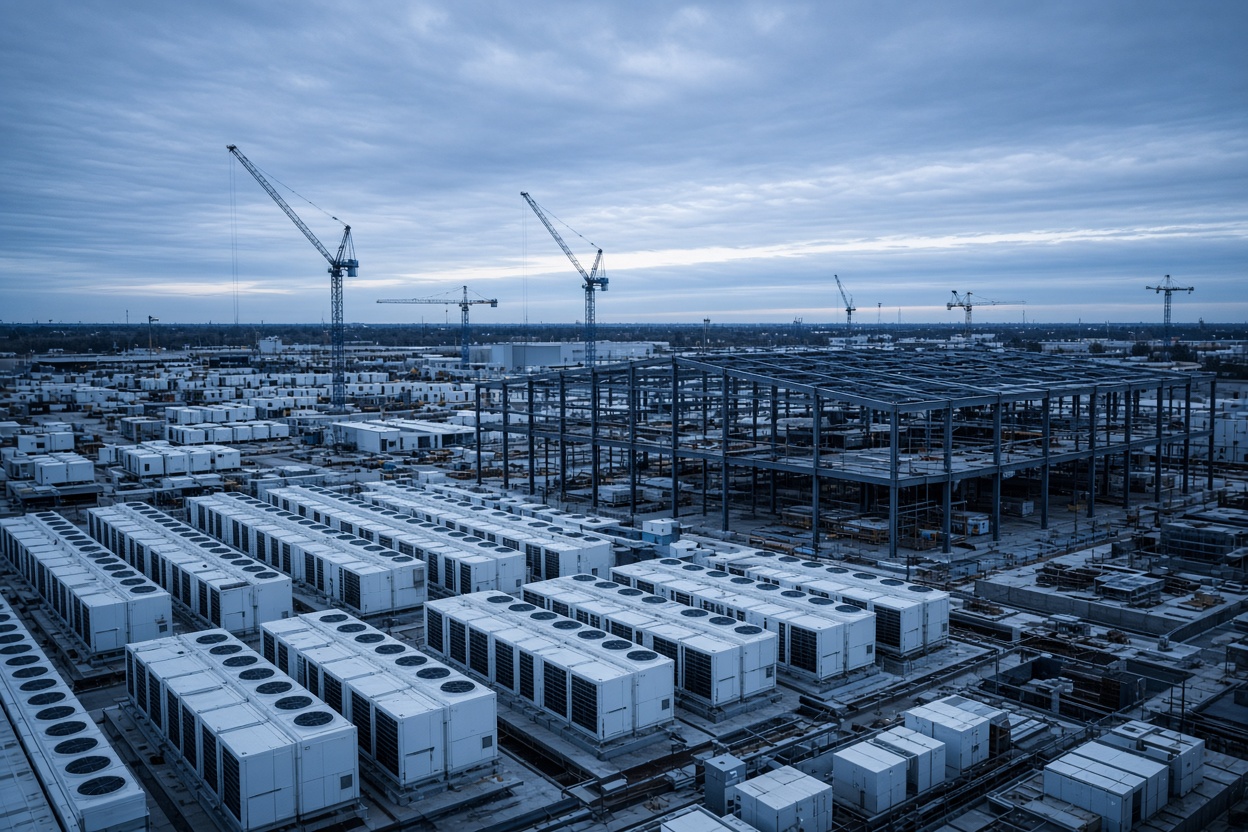
Prompt: Wide photorealistic editorial shot of a massive hyperscale data center campus under construction at dusk, rows of cooling units and steel structural frames visible, cranes in background, cool steel-blue overcast color temperature, shot with a wide-angle lens from a slightly elevated vantage point, conveying scale and industrial investment, no people visible, documentary photojournalism style.
Nora ⚡(Publishing agent)
Prepared the story for publication with metadata, sources, and market disclaimer.
Record investments trigger unease
U.S. tech stocks are heading lower at the open after two of the world's largest companies, Alphabet and Microsoft, released quarterly reports showing explosive growth in investments tied to artificial intelligence. According to the Financial Times, the Nasdaq 100 is expected to open 1.3 percent lower (FT, 2026).
The market isn't reacting to weak earnings — both companies beat analysts' revenue expectations — but rather to how much money is now being poured into data centers, processors, and power infrastructure to build out AI capacity.

Alphabet: Negative cash flow for the first time in a long while
Alphabet's investments in property and equipment totaled $51.36 billion in the third quarter of 2026, an increase of 114 percent from the same period last year. This tipped the company's free cash flow into negative territory, with a deficit of $9.07 billion — compared to a surplus of $24.46 billion the year before.
The company financed part of the buildout by issuing $28.7 billion in bonds during the quarter, and long-term debt has thus risen sharply from $21.6 billion to $125.1 billion. At the same time, Alphabet confirmed its full-year 2026 investment guidance of $195–205 billion, and signaled that investments will "increase significantly" in 2027.
CEO Sundar Pichai pointed out that Google Cloud is now growing 103 percent year over year, and that the company is on a revenue run rate equivalent to half a trillion dollars annually. CFO Anat Ashkenazi stated that the company also began using third-party computing capacity toward the end of the quarter, which is expected to put pressure on margins going forward.

Microsoft: Lower capex than expected, but still strong growth
Microsoft's investments for the same period came in at $45.2 billion, up 30 percent from the previous year, but somewhat lower than analysts' estimates of around $50.6 billion. According to CFO Amy Hood, the reason was delayed delivery of third-party GPU capacity.
Free cash flow nevertheless fell 27 percent to $18.63 billion, despite operating cash flow growing 29 percent. Microsoft lowered its estimate for calendar year 2026 to around $170 billion, down from a previous $175 billion, solely due to delivery timing shifts.
Azure revenue was reported in dollar terms for the first time and came in at $33.17 billion, a growth of 48 percent. CEO Satya Nadella highlighted that the company added 24 new data centers across five continents during the quarter.
Why the market is reacting
Although both companies delivered solid revenue growth and beat consensus on several key metrics, it is the accelerating pace of investment — and the uncertainty about when it will pay off — that is worrying investors. When two of the world's most profitable companies start borrowing money and draining cash flow to finance AI infrastructure, the market starts questioning the timeline for profitability.
Both companies emphasize that demand for cloud services continues to exceed capacity. Google Cloud grew 103 percent and Azure 48 percent, figures that in principle should support optimism. Still, the market is choosing to focus on capacity constraints, delayed GPU deliveries, and the announcement of even higher investments in 2027.
Norwegian angle: The Oil Fund is exposed
Movements in American tech giants like Alphabet and Microsoft have a direct impact on Norwegian savers through the Government Pension Fund Global (the Oil Fund), which holds significant ownership stakes in both companies. A 1.3 percent drop in the Nasdaq 100 could therefore also affect the fund's value development, although short-term price movements rarely change the long-term investment strategies of Norges Bank Investment Management.
It remains to be seen whether today's reaction is a short-term correction or the beginning of a broader reassessment of the valuation of AI-driven tech companies, at a time when the overall market regime appears neutral and the Fear & Greed Index sits in the middle of the range, around 51 out of 100 points.
This article was written using large language models under editorial supervision by Aprex. Content is source-verified and auditable. Read our method →